




Farmers losing out due to 'bad' fertiliser
Some 20,000 farmers up-north want the government to discontinue the supply of misleading and mostly ineffectual free organic fertiliser - from Organic Gro, a Ministry of Agriculture vendor.
Some 20,000 farmers up-north want the government to discontinue the supply of misleading and mostly ineffectual free organic fertiliser - from Organic Gro, a Ministry of Agriculture vendor.
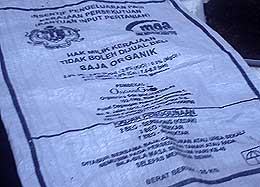 The fertiliser has been used since 2007 in the Muda Agricultural Development Authority (Mada) area, the country’s northern rice belt.
This is a setback, as the government has spent an estimated RM900 million last year for the free fertiliser programme and other concessions for farmers.
The farmers also want a refund for the transportation cost they paid for - totalling RM600,000 - to the District Farmers Association (PPK) since late last year, ferrying the fertiliser from the manufacturing plant to their farms.
If the claim of poor fertiliser is true, then in addition to the loss to the farmers, Malaysian tax-payers are paying for a wasteful project.
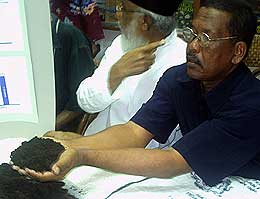 Mada Farmers Action Committee (MFAC) chairperson Cik Ani Mat Zain lamented that the low quality fertiliser had compromised both rice production quality and quantity, increased the farmers’ operation cost and caused skin diseases to farmers.
"Now our livelihood and health are being badly affected by this government-sponsored fertiliser.
"We want back our money paid for transport charges and higher quality fertiliser," he told a press conference held at the Penang Consumers Association (CAP) office today.
'Causing skin disease'
After two growing seasons, the farmers detected stunted rice, the fertiliser emitting foul smells and containing foreign matter like glass and stone, the land remained soft and soggy and the farmers suffering skin problems.
Although MFAC has raised the issue with PPK and Mada several times, Cik Ani claimed that the farmers’ pleas seemed have fallen on deaf ears.
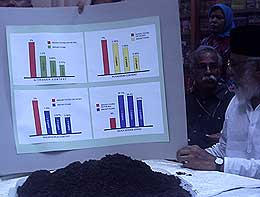 "The authorities claimed that the fertiliser was of good quality, but our experience and CAP’s study revealed contradicting results," he said.
Mada started to distribute the organic fertiliser through PPK as an agricultural input aid initiated under the Agricultural Ministry’s Rice Production Incentive Scheme.
The fertiliser is manufactured and distributed by Petaling Jaya-based company Organic Gro and the farmers need to pay only RM1 per bag to PPK as transport cost.
The organic fertiliser is being distributed to farmers growing padi in a 50,000ha-area, encompassing Jerlun, Air Hitam, Kerpan, Sanglang, Tunjang, Jitra, Sungai Baru and Kodiang in Kedah, and Arau in Perlis.
In an immediate response, Organic Gro commercial manager Zainal Mustafa said the company would look into the complaints "provided they were channelled through the agricultural ministry."
"We are under contract with the ministry to supply the fertiliser to PPK.
"So any complaint on our product should be forwarded to the ministry," he told Malaysiakini , adding that the company would anyway deliberate the complaints with the ministry during a meeting on Monday.
Although skeptical on such claims, he nonetheless assured that the company would run its own test soon to verify it.
CAP test
Organic Gro also supplies similar fertilizer to farmers under the Kelantan Agricultural Development Authority (Kada) since 2007, and Zainal claimed: "The Kelantanese have never complained that the fertiliser was of low quality and caused skin diseases."
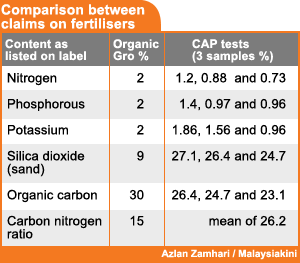 CAP studied three 25kg fertiliser bag samples last month, and its findings are alarming (
see chart
).
CAP studied three 25kg fertiliser bag samples last month, and its findings are alarming (
see chart
).
Necessary ingredients like nitrogen, phosphorous, potassium and organic carbon were found lower than claimed on the label, and the non-contributing ingredient silica dioxide was about three times more than what the label suggested.
CAP tests proved the fertiliser lacked nutritious contents so vital for ‘healthy and wealthy rice production’ and CAP president SM Mohamed Idris substantiated Cik Ani’s claim that "the bags contained more sand than the amount allowed."
The test revealed that organic materials were not fully composted, which explains the process of decomposing after being packaged - that produces the foul smells. It also suggests that poor resource material like mixed city garbage may have been used in the production, resulting in high sand content.
"This caused low quality fertiliser which can generate heat damaging seedlings and plants," said Mohamed Idris, a point concurred by visiting Dr Claude Alwaris from India, the president of Indian Organic Farming Association.


Report this comment
Are you sure you want to delete this comment?
This action cannot be undone.