




Muhyiddin: No one can question social contract
The concept and history of the ‘social contract’ should be taught as part of the tertiary education curriculum so that young Malaysians understand and appreciate it.
The concept and history of the ‘social contract’ should be taught as part of the tertiary education curriculum so that young Malaysians understand and appreciate it.
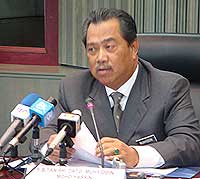 In making the call, Umno vice-president Muhyiddin Mohd Yassin said this would also enable youths to accept the fundamentals of the nation’s democratic system and political governance.
“I think it would be a good start since many young Malaysians now cannot understand and accept what the social contract is all about,” he said today.
He was speaking to journalists after delivering a talk on ‘Malay-Muslim Politics - Crisis and Solutions’ to some 1,000 academicians and students at Universiti Sains Malaysia in Penang.
Muhyiddin, who is international trade and industry minister, said better understanding of the social contract will lead to reduced conflicts and disputes.
He was commenting on the recent statement by the Conference of Rulers, which stated that the social contract and the federal constitution protect the interests, rights and benefits of both Malays and non-Malays.
 Muhyiddin noted that the social contract was drawn up as a consensual agreement among the nation’s founding fathers, representing major communities, when independence was achieved in 1957.
“No one can question the contract as its principles have been embodied in the federal constitution,” he said.
It is not outdated since it forms the basis of communal rights and interests enshrined in the country’s supreme law, he said, suggesting that the government should allow wider democratic space for Malaysians to engage in discussion.
“The discussions should not be to dispute it, but to create better awareness and understanding to observe the social contract,” he said.
‘Yield to popular demands’
Muhyiddin, 61, also fielded questions on several current issues including corruption and the need for reform.
 He said the government has placed priority on eradication of corruption at all levels of governance. Plans are underway to give more powers to the Anti-Corruption Agency, but the public too have a crucial role to play.
“The people should not encourage graft and should resist corruption at all levels,” Muhyiddin said.
He also said a good government should care and listen to public perceptions for “it forms the basis for popular opinion on the government of the day”.
While those in the government would think they are doing all right, outside opinions would be otherwise. A good government has to yield to popular demands because it is public perception that will ultimately determine support for the government, he said.
 On Umno senior leader Rais Yatim’s allegations of money politics in Umno, Muhyiddin said the party leadership is making every effort to contain the problem
The party does not want anyone to win a supreme council seat because “he gave more money to delegates than other candidates”.
Since the Umno supreme council is seen as a national decision-making body that affects all Malaysians, he said it is also important for party leaders to be perceived as being “clean and trustworthy”.
“People are watching Umno. If its leaders are perceived to be corrupt, it will undermine the party’s credibility,” he said, adding that he shares Rais’ concern.
He said Umno will not hesitate to act against those indulging in money politics and urged members to substantiate claims with evidence.
New-format Barisan Nasional?
On MCA’s request for a Barisan Nasional (BN) deputy chairperson and deputy premier, Muhyiddin said he does not agree with the view that component parties can only work effectively by holding high positions in the coalition.
 However, he conceded that the current level of cooperation and collaboration among BN component parties on policy matters and political governance are not at the desired level.
“(They) must resolve people’s agenda as a coalition government, unlike now when this is functional only during election periods. After that, component parties seem to be on their own, working out things for their respective races.
“We need to work out a different formula to make BN function like a single party for all communities at all times.”
Component parties should work collectively to tackle problems faced by different communities, by setting up coalition offices across the country, he suggested.
He was also asked to comment on premier Abdullah Ahmad Badawi’s negative reaction to criticism by his predecessor Dr Mahathir Mohamad.
Muhyiddin said Mahathir has merely been exercising his rights by voicing his views, and that freedom of expression is part and parcel of democracy.
 Stressing that he is not criticising Abdullah for having rebuked Mahathir, he said administrators should be open to opinions.
“It’s up to us whether we want to accept them or not, but we cannot stop (anyone) from expressing views,” he said.
Muhyiddin, who has qualified to contest the Umno deputy presidency with 44 nominations so far, thanked party members for having confidence in his leadership qualities.
He also clarified that he was not attempting to bring forward the transition plan, set for next March, when he suggested that the election campaign period was too long.
“I just answered in affirmative when I was asked whether the four-month campaign period was long. I did not touch on the transition plan.
“Neither did I suggest that anyone should step down earlier,” he added, saying that some segments of the media had manipulated his replies.


Report this comment
Are you sure you want to delete this comment?
This action cannot be undone.