




Abolish oppressive laws before setting up media council
Media rights body, Centre for Independent Journalism, today said the proposed - and much contested - National Media Council cannot be effective if laws allegedly curtailing media freedom in the country are not repealed.
Speaking at a press conference in Parliament, group executive director, V Gayathry, said with laws like the Printing Presses and Publications Act and the Sedition Act in place, the media council would not be able to play an effective role.
Media rights body, Centre for Independent Journalism, today said the proposed - and much contested - National Media Council cannot be effective if laws allegedly curtailing media freedom in the country are not repealed.
Speaking at a press conference in Parliament, group executive director, V Gayathry ( below ), said with laws like the Printing Presses and Publications Act and the Sedition Act in place, the media council would not be able to play an effective role.
 "This is because the format (of the council) that has been suggested, through a Parliament Act, will only act as a pressure factor on the media considering there are laws that suppress the industry," she said.
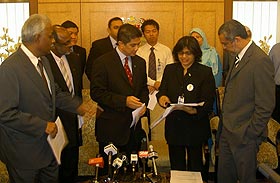
Gayathry and several activists were in Parliament today to hand over a memorandum and petition carrying 3,059 signatures calling on the government to ensure media freedom is respected in the country.
Receiving the memorandum were Pakatan Rakyat MPs, S Sivarasa (PKR-Subang), Charles Santiago (DAP-Klang), Khalid Samad (PAS-Shah Alam), Azmin Ali (PKR-Gombak), Nurul Izzah (PKR-Lembah Pantai) and Fuziah Salleh (PKR-Kuantan).
The government has, in recent days, stepped up efforts to revive the formation of the council and invited top editors and representatives of media interest-groups to meet government officials for a fresh round of discussions on the proposed council.
On Nov 11, the Home Ministry hosted a meeting , chaired by its secretary-general Abdul Aziz Mohd Yusof, with 30 top editors and representatives of media interest groups.
The objective of the meeting was to gather views from top stakeholders of the print, broadcast and Internet media on the formation of a self-regulatory body for the media industry.
However, those who attended the meeting had mixed feelings about the proposed council, feeling it was nowhere near the comprehensive solution needed to move the country forward. Many also expressed reservations over the government's role in the project.
Set up select committee on media freedom
Apart from the call to reject the media council as proposed by the government, CIJ in their memorandum also urged the government to set up a parliamentary select committee on media freedom.
 The committee will look into removing all "unjustified restrictions on freedom of information and freedom of expression" and also "promote pluralism in the ownership and orientation of media".
According to Fuziah, Pakatan MPs have long urged the government to set up various parliamentary select committees on various issues but to no avail.
"They always tell us that there is no budget to set up select committees so instead they tell us to set up parliamentary caucuses," said the Kuantan MP.
The problem with parliamentary caucuses said Fuziah, is that they only consist of opposition MPs.
Another suggestion raised in the memorandum was for the government to enact a freedom of information law.
"Only with legal guarantee to freedom of information that corruption may be defeated and Malaysians may hope to enjoy good governance," read the memorandum.


Report this comment
Are you sure you want to delete this comment?
This action cannot be undone.