




G'ovt frees alleged militant tied to 9/11 attackers
The government said today it had released suspected terrorist Yazid Sufaat, who has been detained since 2001 after being connected with the September 11 attacks.
The government said today it had released suspected terrorist Yazid Sufaat, who has been detained since 2001 after being connected with the September 11 attacks.
Home Minister Syed Hamid Albar said Yazid, a member of regional militant group Jemaah Islamiyah who was freed from the Kamunting detention camp in Perak on Nov 24, was now safe to be released into society.
 "He was considered as a threat to public security in Malaysia because he was part of Jemaah Islamiyah, trying to establish an Islamic government within the region," he told reporters.
"I think after holding him for so long, he can be brought back into society but at the same time we will follow closely everyone that may have ideology (of) militancy or extremism."
Syed Hamid did not say whether Yazid, whose extradition had been sought by the United States after his detention, was under any restriction order that would oblige him to report to police.
A Home Ministry official told AFP that Yazid was released three weeks ago.
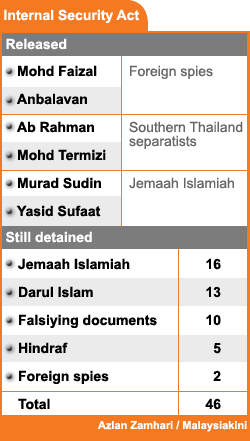
The minister said five other Malaysian and foreign nationals were freed in December after being held without trial under the Internal Security Act (ISA) - a law which human rights groups are pushing to have abolished.
He said that two were Malaysians who had been accused of espionage, two were Thai separatists and the fifth was another JI member. The home ministry official identified him as Murad Sudin.
Yazid a US-trained biochemist
The United States' 9/11 Commission Report has said that Yazid, a US-trained biochemist, was tasked by Al-Qaeda to develop a biological weapons programme and spent several months trying to cultivate anthrax at a lab in Afghanistan.
 It also said that in 2000 he hosted at his apartment in Kuala Lumpur four figures involved in the September 11, 2001 suicide plane attacks which killed nearly 3,000 people.
Syed Hamid said that since he had been appointed home minister in March, the number of ISA detainees had been reduced to 46 from 70.
"From time to time the cases will be reviewed and, as they are reviewed, we will look at the file and if it's time to release them we will do that. We will not hold them any longer than necessary," he said.
As well as suspected terrorists, the ISA has been used recently to detain government critics including the nation's top blogger, Raja Petra Kamarudin, who was freed in November under a landmark court ruling.
 Meanwhile,
the Star
quoted Inspector-General of Police Musa Hassan as saying that Yazid was released because "he had shown remorse and repentance after almost seven years of rehabilitation."
Meanwhile,
the Star
quoted Inspector-General of Police Musa Hassan as saying that Yazid was released because "he had shown remorse and repentance after almost seven years of rehabilitation."
"He was released on several conditions. He has to report to the police regularly and cannot leave Selangor without police permission.
"Our officers will also be monitoring him as well as several others who have been released over the past years to ensure they do not go back to their old ways,'' said the police chief.
Decision expected to draw criticism
John Harrison, manager of terrorism research at the S Rajaratnam School of International Studies in Singapore, said the decision was likely to attract criticism from the US and others who may not be convinced Yazid had reformed.
"There's always a suspicion when you say someone's been rehabilitated as to whether they really have or not. Particularly someone like Yazid, who was very senior in Al-Qaeda," he said.
"Certainly the Malaysians seem to think that the steps they have taken have been successful."
Harrison said that the main concern over Yazid was not his close links to the 9/11 hijackers, but about his role in Al-Qaeda's programme to develop weapons of mass destruction (WMD).
"He may have come on to the radar because of the hosting of the 9/11 planning meeting in Kuala Lumpur. But his main area of interest and the main threatening area were the WMD links," he said.
However, he said Yazid's release may be designed to send a signal to other militants considering abandoning their cause that there was an alternative path.
"If they're facing certain indefinite detention, it's a disincentive to those in the movement who want to break with it, but see that the costs are too high," he said.


Are you sure you want to delete this comment?
This action cannot be undone.