


/file/publisher-c1a3f893382d2b2f8a9aa22a654d9c97/2025/09/909174eb5297bc61816eaa2b910dfd96.png)

Malaysian Women in Politics: A Century to Hit 30% Representation, Experts Warn
Despite ongoing efforts, Malaysia faces a daunting task in achieving significant women's political representation, with current trends indicating it could take over a century to reach the 30% target.
This stark assessment came from Yeong Pey Jung from Penang Institute at one of the panel discussions themed Women in Malaysian Politics: Representation, Progress, and Pathways at the recent Gender Outlook Forum 2025, held on 27 August 2025, who emphasised the urgent need for systemic overhauls.
"From 1955 to 2022, there was an increase of female politicians. However, it took us 27 years to have more than 5% women among all politicians, 44 years to go above 10%, and 63 years to come close to 15%.”
“I did a back-envelope calculation, and it will take us another 21 elections for us to have a minimum of 30% women as our MPs, which is more than a century," says Yeong.
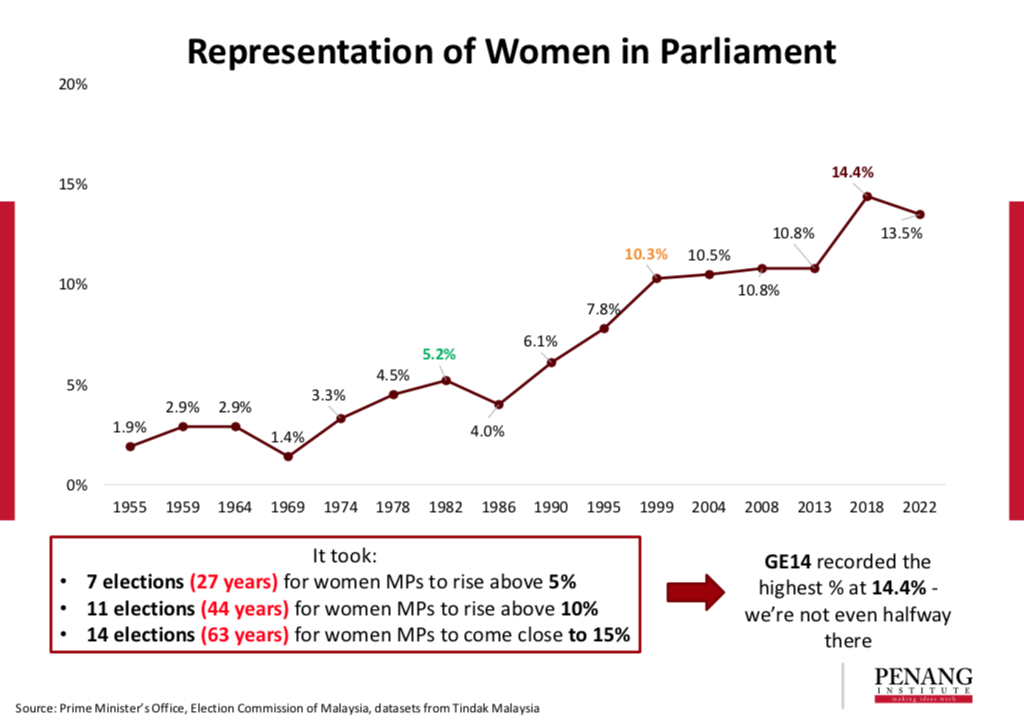
The situation in State Assemblies is even more protracted, as Yeong noted it took "36 years to go above 5%" and "54 years to go above 10%".
“After 15 elections in, we have not even broken 13%, underscoring a systemic issue at the state level,” says Yeong.

Professor Dr. Wong Chin Huat from Sunway University corroborated this grim outlook.
"Malaysia stands at 151 out of about 190 countries in the percentage of women parliamentarians, as recorded by the Interparliamentary Union. That's not something we should be proud of, and our state assembly record overall is an even lower percentage, around 12%," said Wong on Malaysia's low global standing in women's parliamentary representation.
"What we need is to increase women politicians' quotas. If you don't have enough male retirees, forget about raising the number of women politicians. I am one of the strong believers that Malaysia does not lack women talent, but we lack new retirees.”
“We don’t have enough female challengers knocking out the male incumbents from another party in elections, because external replacement only happens when you have tidal wave elections (that bring landslide victories) like 2008 or 2018. We do not have enough internal replacement," says Wong.
Wong Chin Huat also said that Malaysia’s first-past-the-post (FPTP) electoral system is a reason that hinders women's representation.
“The system makes replacement difficult. If you replace the strongest male with a woman you're going to face a lot of resistance,"
Wong suggested a multiple-member seat instead, as "it is very glaring to insist all the candidates have to be men".
The session, moderated by Rusni Tajari of Wanita Berdaya Selangor, also featured Dr. Nur Azyan Shalihah Mohd Shafee, a researcher from the Parliament of Malaysia and USM senior lecturer, Dr. Zaireeni Azmi.
The video of the full panel discussion can be found here.
This content is provided by Westminster Foundation for Democracy.
The views expressed here are those of the author/contributor and do not necessarily represent the views of Malaysiakini.


