


/file/publisher-c1a3f893382d2b2f8a9aa22a654d9c97/2026/07/fc32c002d384717fe7fa987617408e08.png)

Credibility keeps Malaysian media relevant in social media age, says MPI president
KUALA LUMPUR: The rise of social media has not made established Malaysian media irrelevant but has increased the need for professional journalism that can verify claims, provide context and take responsibility for what it publishes.
Malaysian Press Institute (MPI) president and media veteran Datuk Yong Soo Heong (seated third right in main pic) said that, although social media can provide information or even misinformation, journalism still has the duty of establishing what actually happened, why it happened and what evidence supports the account.
“A social media platform is a distribution channel, not a newsroom,” said Yong. “The crucial difference lies in verification, editorial judgement and accountability.”
Yong was speaking in an interview following the Malam Wartawan Malaysia 2026 and the MPI-PETRONAS Malaysian Journalism Awards 2025 held last Friday (17 July 2026) in Kuala Lumpur.
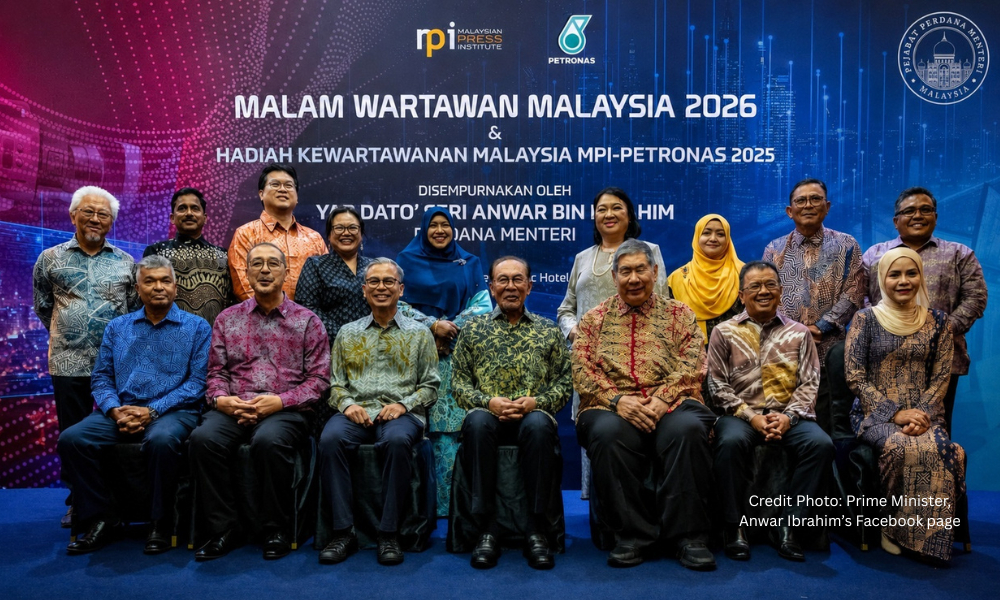
The event, which brought together about a thousand media practitioners, was attended by Prime Minister Datuk Seri Anwar Ibrahim (seated centre) and Communications Minister Datuk Seri Fahmi Fadzil (seated third left) together with MPI officials and VIP guests.
[In the pic above are some of the most powerful people within the nation’s media industry: Seated from left to right: Brian Martin (Managing Editor, The Star), Dr Haji Ainol Amriz Ismail (CEO, MPI), Datuk Seri Fahmi Fadzil, Minister of Communications, Prime Minister Datuk Seri Anwar Ibrahim, Datuk Yong Soo Heong (MPI President), Ir. Norafizal Mat Saad (Vice President, PETRONAS) & Farrah Naz Abd Karim (Group Editor, New Straits Times)].
Standing from left to right – Datuk Kuik Cheng Kang (Head, Sin Chew Media Corporation), Thiaga Rajan (Editor-in-Chief, Vanakkam Malaysia), Ronnie Teo (President, Kuching Division Journalists’ Association), Mariah Doksil (President, Sabah Journalists Association), Datin Paduka Nur-ul Afida Kamaludin (CEO Bernama), Dr Diana Dominic (Information Department, Sabah), Sri Diah Shaharuddin (ex-Kumpulan Karangkraf), Azhari Muhidin (Group Editor, News, TV3) and Zambri Rambli (Editor-in-Chief, Sinar Harian). Pic credit – Prime Minister Anwar Ibrahim’s Facebook page.]
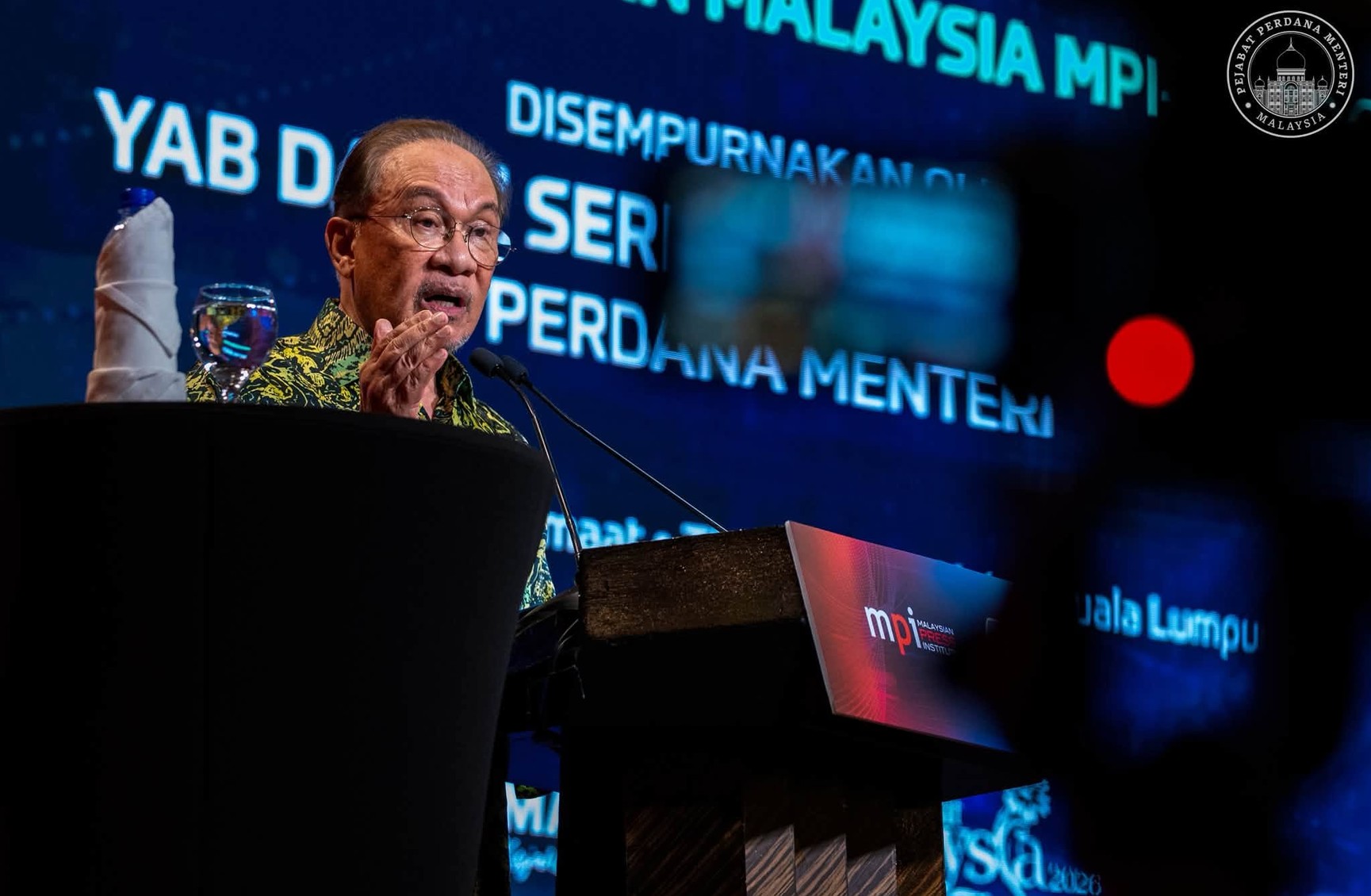
In his address, the Prime Minister urged media practitioners to embrace technology without losing sight of values, ethics and national identity. He also thanked journalists for upholding press freedom and democracy through their reporting, views and constructive criticism. (Pic credit - Prime Minister Anwar Ibrahim’s Facebook page)
Yong’s assessment carries the weight of a media career spanning more than five decades and almost every major stage in the development of modern Malaysian journalism.
He began his career with The Star and The Straits Echo in Penang before joining the Malaysian National News Agency (Bernama) on 15 August 1974. He rose through Bernama’s business news and editorial ranks, becoming editor-in-chief from 2007 to 2012 and general manager and chief executive from 2013 until his retirement in 2014.
He was the first journalist from Bernama’s business news division to rise to the position of editor-in-chief. Yong’s legacy at Bernama is preserved through his portrait, displayed prominently at the centre of the Bernama boardroom alongside those of other former editors-in-chief (pic).
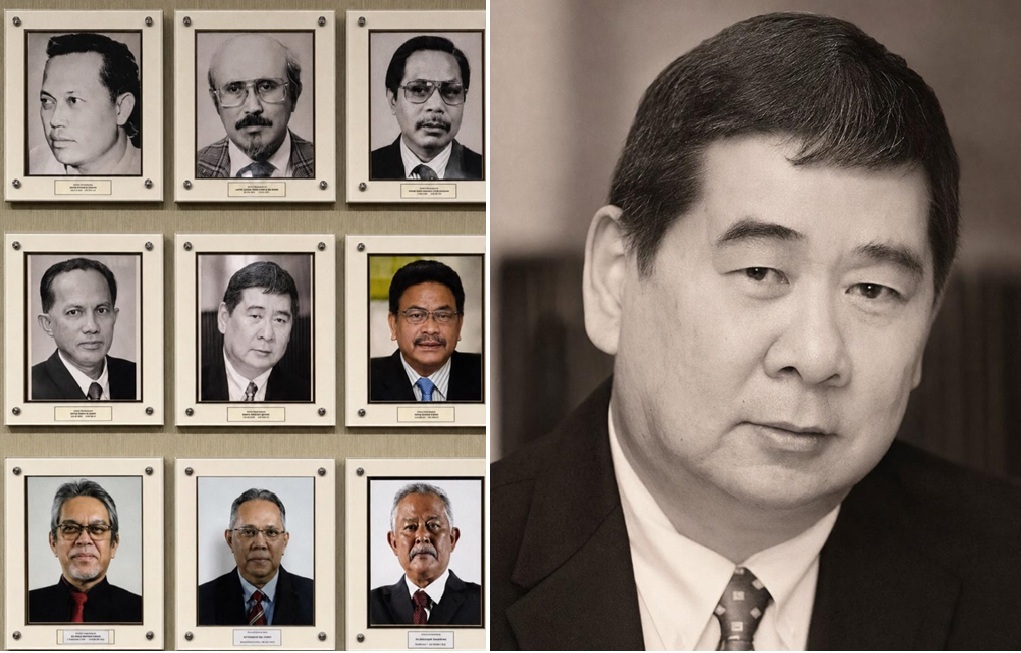
During his years at the national news agency, Yong helped develop its editorial style guide to improve consistency and elevate reporting standards. He also strengthened Bernama’s commercial operations and sought to expand its revenue base, drawing on his experience in economic and business journalism coupled with his extensive network across corporate Malaysia.
Today, he remains actively involved in journalism as editor-in-chief of independent news portal The Weekly Echo. He is also an adviser to the National Press Club Malaysia and was elected MPI President in December 2023.
In 2025, Yong received the HAWANA Award, one of the country’s leading media honours, in recognition of his lifetime contribution to journalism and public discourse.
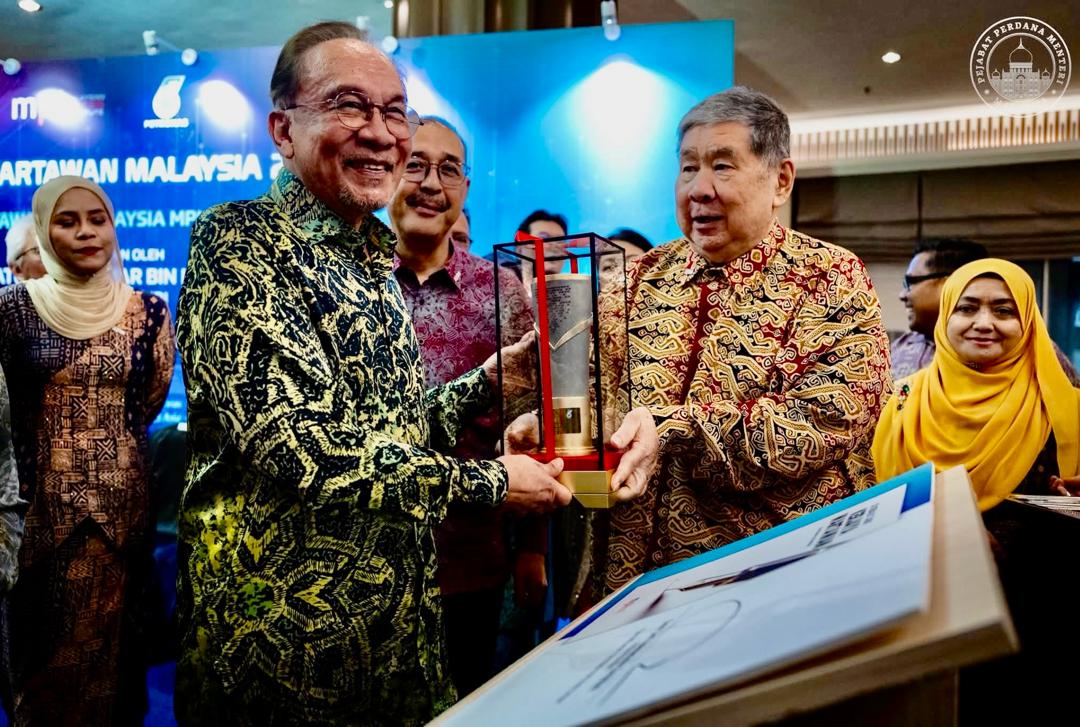
Having experienced journalism in the print, news agency, broadcast and digital eras, Yong said the tools of the profession had changed dramatically but its fundamental responsibility had not.
“When I began, the pace and tools of news gathering were completely different. Today, a journalist can report, photograph, record and broadcast from a single mobile phone. But the most important question in journalism remains the same: How do you know this is true?”
Speed does not replace verification
Yong said social media had transformed public communication in many positive ways. It had enabled information to travel rapidly, given ordinary people a voice and allowed eyewitnesses to draw attention to events that might otherwise have gone unnoticed.
Media organisations themselves now depend on social platforms to distribute their journalism and reach younger audiences. However, the speed at which a claim travels should not be confused with the reliability of the claim itself, he said.
A recent Malaysian Communications and Multimedia Commission study illustrated this distinction.
Between 87 and 90 per cent of respondents aged 18 to 35 first received news updates through platforms such as WhatsApp, TikTok and Facebook. Yet reported trust in information from these platforms was only about 40 to 50 per cent. Trust was considerably higher when respondents turned to television, radio and newspapers.
“Where people first encounter a story is not necessarily where they go to determine whether it is true,” Yong said.
“A responsible journalist may have to contact several sources, examine documents, check dates and figures and give the people involved an opportunity to respond,” he said. “An editor would then question gaps and consider whether the report was accurate, fair and in the public interest.”
Much of this work was invisible to the public but it was precisely what gave professional journalism its value. Yong explained that this responsibility was particularly important in a diverse society such as Malaysia, where an unverified claim touching on race, religion or other sensitive matters could spread quickly and cause lasting damage.
“Professional journalism provides a common base of verified information from which the rakyat can form their own opinions,” said Yong.
Trust must be earned
While credibility remains the media’s greatest asset, Yong said that established news organisations could not expect the public to trust them merely because they had existed for many years.
“Credibility cannot be demanded. It must be earned every day,” he said.
“Audiences are entitled to question reporting that appears partisan, sensational, superficial or too close to political and commercial interests,” he added. “Newsrooms must clearly distinguish between news, opinion and paid content, correct errors promptly and give those criticised a fair opportunity to respond.”
Media organisations must also offer audiences more than information already available from press releases, live broadcasts and official social media accounts.
“The public can watch a press conference or read an announcement directly. Our value lies in asking the next question, testing the claim, providing context and explaining what a development means to ordinary people.”
This required newsrooms to invest in subject expertise, investigative reporting, fact-checking and explanatory journalism instead of competing solely to be first with a headline.
Yong said the decline in newspaper circulation should also not be mistaken for the disappearance of journalism.
The Reuters Institute’s 2025 findings showed that more than two-thirds of Malaysians used social media for news each week, while print use had fallen over the preceding eight years.
“This means that news organisations must adapt how journalism is produced, presented and distributed,” said Yong.
“Newsrooms must meet audiences where they are. That means using short-form video, podcasts, data, graphics, newsletters and social platforms while maintaining the same editorial standards. The format may change but the obligation to be accurate, fair and accountable does not.”
Artificial intelligence in turn could help journalists search documents, transcribe interviews, analyse data and produce content more efficiently. However, Yong cautioned that the same technology could fabricate images and quotations, produce convincing falsehoods and overwhelm audiences with material that appeared authoritative despite never having been verified.
“The answer is not to reject technology. It is to combine technology with human judgement, professional ethics and editorial accountability. A machine can process information at extraordinary speed but it cannot assume moral responsibility for what is published,” he said.
“As MDEC chief executive officer Anuar Fariz Fadzil recently put it: ‘Use AI to think better – not to think for you – and do not outsource your thinking to AI,’” Yong added.
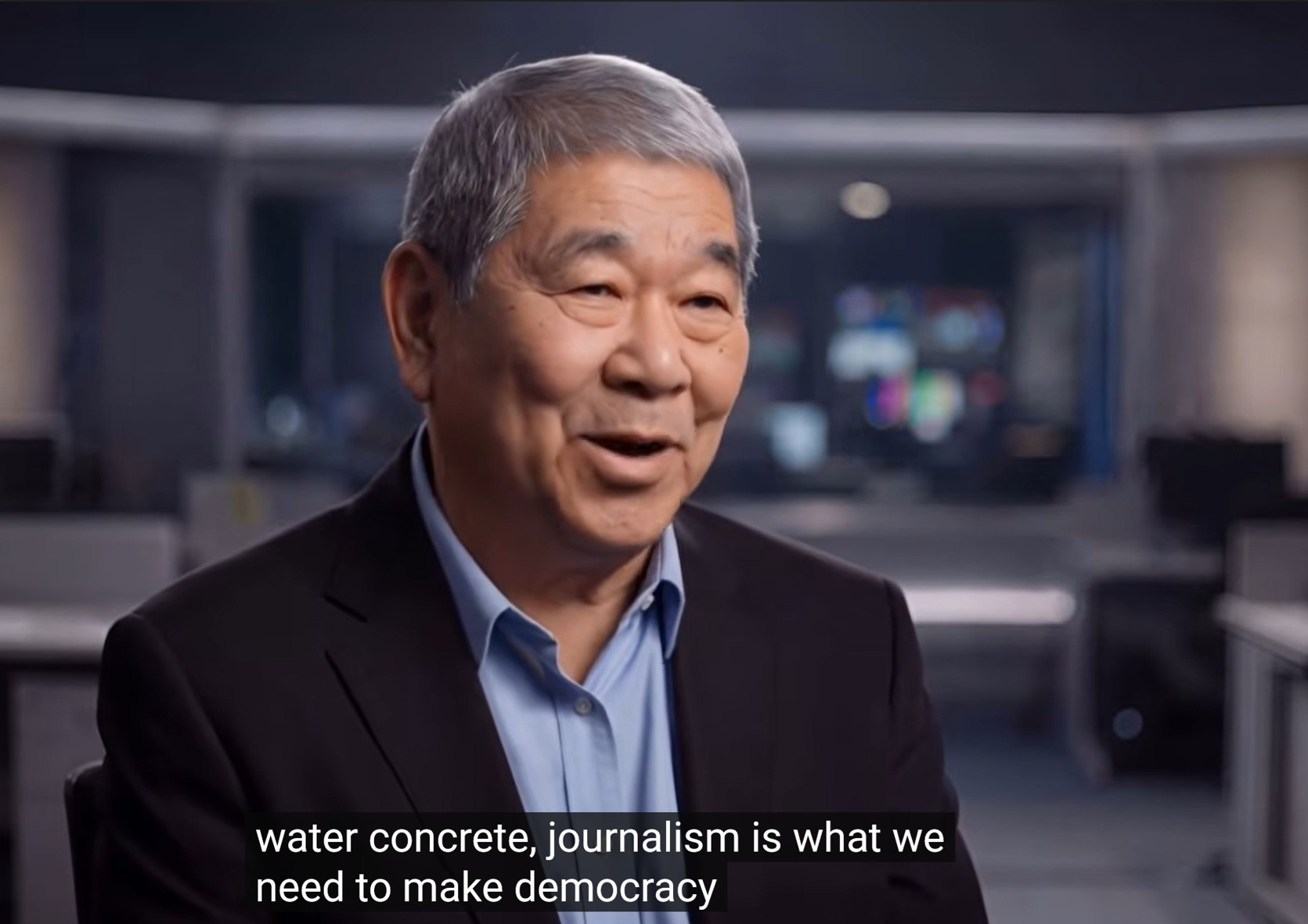
For its part, MPI would continue strengthening training in areas including digital journalism, AI, fact-checking and professional ethics so that journalists could use new technologies without compromising the principles underpinning public trust.
Younger journalists and responsible content creators also had an important place in the future information ecosystem, but visibility and follower numbers could not substitute for accuracy and discipline.
“Whether someone worked in a large newsroom, an independent news portal or produced responsible journalism on a digital platform, the same test applied: Could the audience trust the work?”
Yong concluded by saying that the future would not automatically belong to established media simply because of its history. It would belong to organisations and journalists that continued to demonstrate their value to the public.
“Social media has made information abundant. What remains scarce is information that has been properly checked, placed in context and published by someone prepared to be accountable for it,” he said.
“That is why credible Malaysian journalism is not becoming less relevant. It is more necessary than ever.”
Note: Datuk Yong and The Weekly Echo can be reached by emailing weeklyecho2021@gmail.com or news@weekly-echo.com
Source: This article was contributed by Strategic Communications practitioner Michael Ang. Views expressed are his own.
The views expressed here are those of the author/contributor and do not necessarily represent the views of Malaysiakini.
Interested in having your press releases, exclusive interviews, or branded content articles on Malaysiakini? For more information, contact advertise@malaysiakini.com or advertise@fgmedia.my


Are you sure you want to delete this comment?
This action cannot be undone.