




The Xinjiang problem in the regional context
Ever since my first and only visit to the Xinjiang Uyghur Autonomous Region, China, more than 10 years ago, I have been convinced the ruling Chinese Communist Party (CCP) must put in serious and substantive effort to address the resentment, hatred even, felt by the various Muslim populations towards Han Chinese in the province.
In a largely Han Chinese market, a lady was kind enough to warn me against visiting Uyghur places, for "the unruly youths always carry a dagger". I was not bemused, for I had just purchased one as a souvenir from a nearby shop and, looking at the jobless Uyghur men loitering around and the widening income gap between the Han and the Uyghur, I knew why it was so.
Ever since my first and only visit to the Xinjiang Uyghur Autonomous Region, China, more than 10 years ago, I have been convinced the ruling Chinese Communist Party (CCP) must put in serious and substantive effort to address the resentment, hatred even, felt by the various Muslim populations towards Han Chinese in the province.
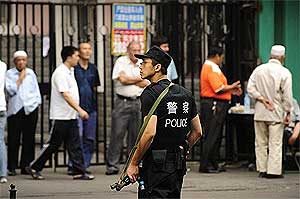 In a largely Han Chinese market, a lady was kind enough to warn me against visiting Uyghur places, for "the unruly youths always carry a dagger". I was not bemused, for I had just purchased one as a souvenir from a nearby shop and, looking at the jobless Uyghur men loitering around and the widening income gap between the Han and the Uyghur, I knew why it was so.
At a food stall, a Uyghur man looked suspiciously at me, trying to figure out if I was a local. He was greatly relieved when I showed him my Malaysian passport and assured him "I am not a Chinese national". He spoke Mandarin with a heavy accent, and conversed mostly in Uyghur with his friends.
The next day, he arranged a tour for me to travel to some rural areas because I had grown tired of the dazzling shopping malls in Urumqi. Unlike the Han-dominant capital city, villages were where I could experience a semblance of original Uyghur culture.
 The recent riots in Xinjiang shocked the Chinese leadership out of complacency. For years, the communists deluded themselves with the belief that, once the local Muslim populations tasted the fruit of economic growth and saw prosperity, they would cherish peace and stability under the CCP.
However, the violent incidents happened in Urumqi, one of the most developed cities in China, rather than in some faraway Uyghur countryside where poverty abounds. On the other hand, the death of two Uyghur workers in Shaoguan of Guangdong province, more than 3,000km away, would have generated wrath of this scale in Xinjiang shows that the deep-rooted ethnic mistrust can no longer be dismissed as being due to "foreign infiltration/instigation".
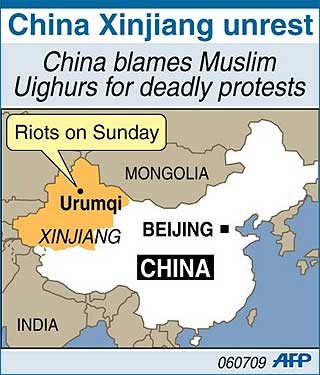 Xinjiang's importance to the territorial integrity and economic development of China is beyond doubt. In 2008, the province became the second-largest oil-producing region, contributing 14 percent of the total oil production in the country. In addition, 1/3 of the natural gas consumed by the Chinese comes from Xinjiang.
According to the State Council, the region also contains rich reserves of minerals, including ore, gold, copper, nickel, lead, zinc, asbestos, salts, limestone and vermiculite.
This aside, Xinjiang's geo-strategic significance cannot be overstated. First, it hosts China's major nuclear test site, ie. The Lop Nor Lake area, where more than 40 missile tests have been conducted since 1964.
Hence, Chinese analysts see the region as important as Nevada to the United States.
Second, Xinjiang borders three Central Asian republics, which are all resource-rich. The close economic relationship between Xinjiang and Kazakhstan has reduced China's dependence on Middle East oil to some extent, while the volatile neighbours such as Pakistan and Afghanistan makes the region an important buffer zone to China's hinterland.
While ethnic hatred is a serious issue in Xinjiang (China's Vice-President Xi Jinping had, prior to the unrest, urged the regional government to do more to resolve ethnic conflict there), the alleged links between Uyghur separatists, such as the East Turkestan Islamic Movement, and al Qaeda also challenge the way the Chinese leadership reacts to violent protests.
A double-edged sword
In this perspective, the Shanghai Cooperation Organization (SCO) comes in handy. The intergovernmental grouping was a brainchild of the Chinese founded in 2001, seeking to enhance cooperation among China, Russia and Central Asia. Its primary concerns are separatism, terrorism , extremism and cross-border crimes, such as proliferation of drug and weapons, as well as human trafficking.
At a heads of state meeting in Yekaterinburg, Russia, last month, the SCO leaders reaffirmed their commitment to fight against illicit drug trade and terrorism, especially in Afghanistan.
One reason why the SCO members take their cooperation seriously is because there are also sizeable Uyghur populations in Kazakhstan and Kyrgyzstan, and the aspiration of the Uyghurs to form a homeland of their own, known as Uyghuristan, could stoke ethnic sentiments in these countries also.
 In the aftermath of Xinjiang unrest, Bolat Nurgaliev, the SCO Secretary-General, issued a
statement reiterating
Chinese sovereignty over the autonomous region, something that Beijing badly needed in the face of intensive international media attention on the issue.
In the aftermath of Xinjiang unrest, Bolat Nurgaliev, the SCO Secretary-General, issued a
statement reiterating
Chinese sovereignty over the autonomous region, something that Beijing badly needed in the face of intensive international media attention on the issue.
When the SCO was formed, many in the West tended to see it as a regional mechanism aimed at subjugating the smaller economies to the dual hegemony of China and Russia. Nearly a decade on, the grouping has proved to be an effective channel to respond to a host of critical challenges, particularly in preventing the spread of firearms, a fact that even the US acknowledges.
But resorting to anti-terrorism is a double-edged sword. While it may help forge greater solidarity among the regional countries when it comes to tackling separatism, overemphasizing this aspect will invariably result in Beijing's shift of focus from the real causes: discriminatory policy implementation and the executive powers that are highly concentrated in the hands of Han Chinese officials, which also foster rampant corruption and exploitation of natural resources in Xinjiang.
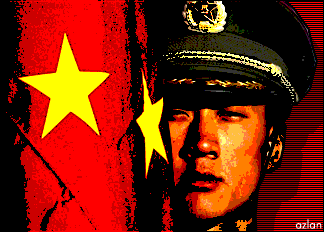 It is especially important for the Chinese leadership to understand stronger religiosity does not necessarily mean ethnic separatism, failing which it could engender more bitterness among the various Muslim communities.
Until and unless these concerns are given due consideration, the pursuit of genuine peace and harmony among the races in Xinjiang will remain an elusive dream.


