




Haiti: Corruption 'kills' more than quake
The impact of earthquakes is far more disastrous in a country when corruption is widespread, people are poor, forests are depleted and the government is not functioning.
Haiti is devastated, 200,000 people are estimated to have died, and without water, food and medical aid more will die. More than a million are homeless and sleeping in the open without tents. The republic of Haiti was hit by an earthquake of a magnitude of 7, on 12 Jan.
The impact of earthquakes is far more disastrous in a country when corruption is widespread, people are poor, forests are depleted and the government is not functioning.
Haiti is devastated, 200,000 people are estimated to have died, and without water, food and medical aid more will die. More than a million are homeless and sleeping in the open without tents. The republic of Haiti was hit by an earthquake of a magnitude of 7, on 12 Jan.
The TV cameras and journalists, who arrived faster than the aid, are still there telling the world the heartrending stories of the impact of the quake and that the situation is unparalleled, worse than hurricane Katrina and the Asian Tsunami.
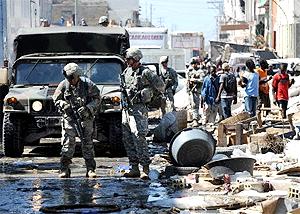 The United States military has taken control of the airport in Port-au-Prince, the capital of Haiti through a memorandum of understanding with whatever component of government that is functioning. Reports suggest there are" more soldiers than aid."
US military planes have been given priority for landing at the airport and planes with aid have been turned away by the US military.
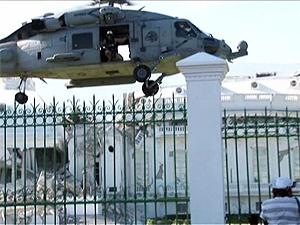
Many buildings that have collapsed include the Presidential Palace, cathedral, churches, government offices, hotels, homes , schools and hospitals.
Heartrending reports of death, rescues, survival, destruction, scavenging and fighting for water and food are accompanied by reminders that Haiti is "the poorest country in the western hemisphere, a basket case of corruption, violence and gangs."
The backbone of the Haitian economy consists of plantations, sweatshops and export processing plants largely owned by firms from the United States, France and Canada.
Sixty miles away from Port-au-Prince, as corpses decay in the streets and Haitians scramble for water and food, a luxury liner from Florida berths at a beach, in a picturesque wooded peninsula of Haiti. The area has been privatised, the benefits of which have certainly not trickled down to Haitians.
Corruption, deforestation, debt, slavery, revolution and exploitation have impacted Haiti, says Alex von Tunzelmann, a historian who is writing a book on Haiti. Today, Haitians are victims of poverty, illiteracy, environmental disasters and deprived of development such as infrastructure.
A glimpse into 500 years of the history of Haiti tells us why Haiti is "a basket case", why disasters take so much toll on its people.
Christopher Columbus discovered what was then known as Ayiti as the native Taino people called it. Columbus claimed it for the Spanish but by 1665 , the French occupied it.
 To exploit the natural resources of Haiti, millions of slaves were trafficked and abused. Some of these abuses were most horrific, life expectancy of slaves was 21 ,
They were " drowned in sacks, crucified on planks , thrown into boiling cauldron of cane syrup". Following a rebellion when about 10,000 died, Haiti became the first independent black state on Jan 1, 1804. Independence came with an enormous debt.
"Haiti had to pay reparations in gold to France (value of US$21 billion today) . Haiti had to borrow money from American, German and French banks at exhorbitant rates. By the time the reparations and interest were paid off, Haiti was destitute and trapped in debts," according to von Tunzelmann. ( Guardian UK ).
But the establishment of the first black independent state had some tangible consequences for the US. It denied Napoleon Bonaparte a foothold in the Caribbean and led him to sell New Orleans and the Louisiana territories to the US which occupied Haiti for two decades in the early 20 century.
Corruption, coups and dictatorships ravaged the country. One of the most corrupt and repressive regimes was that of Papa Doc Duvalier who took control of Haiti in 1957.
For 20 years , the Duvaliers looted the country, ran a personal militia who killed, raped and tortured thousands of Haitians.
During the dictatorships of the Duvaliers, international aid agencies lent millions for development projects that were abandoned or never started. A familiar story of many corrupt nations, we have often heard.
When Baby Doc fled, he took millions and left a corrupt and broken government unable to stop coups and social unrest.
"The west has truly funded corrupt governments in the past," wrote Regine Chassagne recently. She has Haitian origins and is from the Montreal based rock band Arcade Fire.
Fragile public institutions
Corruption results in weak institutions and poor governance structures. Such a situation leads to the exploitation of natural resources like land and forests.
Today Haiti is a food deficit country as 98 percent of its forests have been depleted. As a result, soil erosion is serious because there are not enough trees to hold the top soil.
Without forests and trees, the impact from hurricanes and consequences of flooding are devastating. In 2008, deadly storms destroyed most of Haiti's agricultural land.
During the Asian Tsunami, coastal areas where mangrove swamps had disappeared, suffered significant damage.
"Earthquakes do not kill, buildings do,"said an elderly survivor looking at a building that was still standing after the 2005 earthquake in Pakistan.
 Buildings do not crumble when construction rules and regulations are enforced by authorities. In an environment where corruption is endemic, the construction sector is particularly at risk from corruption.
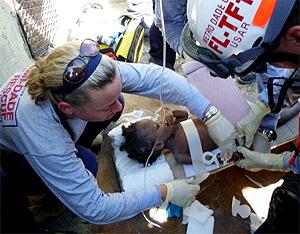
Most buildings have collapsed at Puerto-au-Prince and areas like Leogane resulting in tragic loss of lives, life threatening injuries, homes and livelihoods. Jacmel, renowned globally for its artistic festivals, is in ruins.
Several analysts and journalists have pointed out that impact of natural disasters is less in the Dominican Republic, Haiti's neighbour, because of its lush forests and quake-proof buildings.
They are right. Haitians are too poor to afford quake-proof materials for their building needs.
Disaster management is another area prone particularly to public sector corruption. In the context of Haiti, the fragile public institutions have not been able to build its infrastructure such as roads, communications, water, energy and hospitals.
Without these infrastructure, the capacity for emergency disaster management is challenged as we see in the current catastrophe.
A major concern voiced by Safe the Children Fund is the trafficking of children during disasters as has been seen during the Asian Tsunami and other disasters. When parents are killed, orphaned children are left to fend for themselves in the streets.
Orphaned and homeless children of Haiti are most vulnerable. Human trafficking is an indicator of corruption.
A global philanthropic appeal has been launched for aid and donations to Unicef, American Red Cross, United Nations , Catholic Welfare Services, etc.
Haitian communities, diaspora and individuals are organising self-help activities and it is these community efforts that must be supported.
It will take years for Haiti to rebuild its economic and social fabric. But for Haiti to get out of its misery and socio-economic inequalities, it must fight corruption.
JOSIE M FERNANDEZ is currently an Asian Public Intellectual Fellow, director of Philanthropy Asia, researcher and engages with Transparency International Malaysia in anti-corruption measures. An educationist, Josie moved on to citizen's advocacy as founder president of ERA Consumers and regional director (Asia Pacific) for Consumers International.
She holds a masters degree in development management from the Asian Institute of Management, Philippines. Working on sustainability, philanthropy and anti-corruption actions are some of her current passions besides writing.


Are you sure you want to delete this comment?
This action cannot be undone.