




Only the tip is visible
Democratic elections require substantial resources. Money is needed to finance political activities, political parties, candidates and elections.
Democratic elections require substantial resources. Money is needed to finance political activities, political parties, candidates and elections.
The monetization of politics is a phenomenon that many democracies are confronted with as it leads to political corruption.
Elections in Malaysia sadly has degenerated into contests of who can provide the millions, unlimited gifts such as hampers, food, drinks, entertainment...
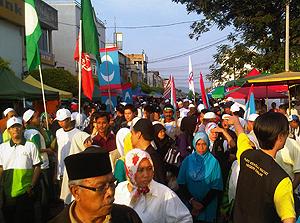 Money has captured the political process as the reports on elections both in the government controlled and private media indicate.
For example, there is no transparency and accountability of where all the millions spent in Hulu Selangor are coming from. Who are the donors? The taxpayers? Who bankrolls political parties and their candidates? Corporations? Organised groups?
Malaysians have right to know the facts on electoral financing in Malaysia.
At the Transparency International - Malaysia Conference on political financing in November 2009, the deputy chairman of Election Commission made the following remark:
"... financing an election campaign is the most costly activity incurred by political parties anywhere. Funds are needed for printing campaign literature, election publications and campaign materials including banners, flags, logos/symbols, posters, to organise meetings, political rallies and other purposes in the effort to win votes... Where does this campaign money come from and how much is actually spent?"
"These are two of the many questions in everyone's minds, including the EC's. No one would be able to provide the right answers to those questions except the candidate himself."
Election expenses in Malaysia are covered by the Election Offences Act, 1954. Under this law, the limit campaign expenditure for a parliamentary seat and a state assembly seat is RM200,000 and RM100,000 respectively.
There are weaknesses in the law. The law only regulates expenditure incurred between nomination day and polling day.
Expenses incurred by political parties for candidates in elections are excluded in the law. A very important form of campaigning is excluded too, i.e advertisements related to political parties and candidates in the media.
In Malaysia, elections are contested and won by candidates backed by political parties. This was very obvious in the Hulu Selangor by-elections.
Many TV viewers of prime time news asked, "Where is the candidate?" as the TV screens focused on the prime minister and deputy premier in the last few days of the campaign for the by-elections in Hulu Selangor.
People power the only hope
The existing laws do not control the expenditure of political parties. There are no legal requirements for political parties to disclose the amounts they spent on electoral campaigns.
Additionally, political parties are not required, under the law, to submit audited accounts, which include key information, i.e. the amount of donation received and the name of donors, to the Registrar of Societies.
There is limited opportunity for the public to scrutinise the party accounts.
Such situations create an unequal playing field in electoral contests. The rich political parties are almost certain to absorb the expenses of their candidates.
Independent candidates and those from financially weak political parties will in most situations have to bear their own expenses.
The buying of votes through bribery is a serious offence under the Election Offences Act 1954.
However, it is hard to prove the existence of such corrupt practices through court proceedings.
Thus far, there has been only one case where the election result was declared null and void because of the existence of vote-buying practices.
The Bukit Begunan case, otherwise known as Donald Lawan v Abang Wahed b Abang Muzi & Oct 2 [1997] is a rare case in recent years where a corrupt practice was successfully challenged.
Therefore, legislative reforms are needed to prevent vote buying and political corruption.
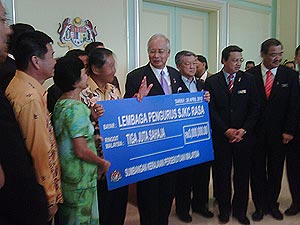 Additionally, there is no clear boundary between bribery and "development grants", which are often distributed by the ruling government during the eve of general and by-elections.
Grants such as promises to build hospitals, to develop abandoned land and to approve to build schools on the next day after winning elections raise questions on the effectiveness of existing laws.
The older generation of voters particularly in rural areas sometimes view development grants as philanthropic giving by a benevolent government.
They do not see access to healthcare, education, water and other basic needs for survival as their fundamental rights.
It is imperative, therefore, that citizens support advocacy actions by NGOs and other to stop political corruption, a growing phenomenon that may contribute to a further dip in Transparency International's corruption perception index.
Legislative and institutional reforms, voter education and strict enforcement of election and the Malaysian Anti-Corruption Commission Act 2009 are among the key solutions that Malaysia should be pursuing to rid itself of money politics.
JOSIE M FERNANDEZ is currently an Asian Public Intellectual Fellow, director of Philanthropy Asia, researcher and engages with Transparency International Malaysia in anti-corruption measures.
An educationist, Josie moved on to citizen's advocacy working with national/international NGOs. She holds a masters degree in development management from the Asian Institute of Management, Philippines. Working on sustainability, philanthropy and anti-corruption actions are some of her current passions besides writing.


Are you sure you want to delete this comment?
This action cannot be undone.