




High-speed broadband at last
Followers of my IT writings know that I've been advocating high-speed broadband for the longest time. I've wrote about it in columns, spoke about it at talks, and I even included a whole chapter on it in my 2003 book, ‘Transitions’.
To quote myself from that book: ‘Broadband is the critical infrastructure of the 21st century. The road towards a knowledge economy should be paved with fat pipes.’
Followers of my IT writings know that I've been advocating high-speed broadband for the longest time. I've wrote about it in columns, spoke about it at talks, and I even included a whole chapter on it in my 2003 book, ‘Transitions’.
To quote myself from that book: ‘Broadband is the critical infrastructure of the 21st century. The road towards a knowledge economy should be paved with fat pipes.’
I watched with envy as countries like South Korea, Japan and Singapore ramped up their broadband offerings. I longed for the day when I too could truly cruise the information superhighway.
That day has come. When TM's high-speed broadband, known as UniFi, became available in my neighbourhood, I immediately signed up through the phone. No going to any physical office. No long queues. Just a phone call.
The customer service officer, a knowledgeable and friendly lady named Faz, guided me through the registration process. I opted for the 20Mbps package, which costs RM249 per month. For details of other packages, check out Unifi's website .
I was a little bit surprised when she told me that the technicians would have to drill a hole through my wall to pull in the fibre optic wires.
 Installing UniFi is nothing like installing Streamyx, which is delivered through the phone line. A UniFi installation involves site survey, ducting, piping, electrical work and equipment configuration.
The installation process was like a mini-renovation. After surveying the room where I want the set up to be installed, they sketched out a map of how they plan to pull in the wires. I signed off on it and the drilling started.
For the heck of it, I decided to tweet about the process. The amount of feedback I got told me lots of people were interested in high-speed broadband too.
Mafiz Seth, a telco consultant, tweeted some advice: ‘Once completed, make sure they clear the rubbish or dust from drilling works. Mine was satisfactory except the cleaning part.’
 Selangor EXCO member Elizabeth Wong
(right)
chipped in by tweeting: ‘Follow @oonyeoh as he tweets and documents the #unifi installation process :).
Selangor EXCO member Elizabeth Wong
(right)
chipped in by tweeting: ‘Follow @oonyeoh as he tweets and documents the #unifi installation process :).
That immediately got me a bunch of new Twitter followers. I realised I had a live audience so I kept them updated throughout the whole installation experience, which lasted slightly over three hours.
First came the IPTV. That worked fine. Then, the IP phone service. Worked fine too. Finally, the Internet access. I launched my browser with bated breath. It worked!
"Try YouTube ," the installation guys suggested. That worked fine. To be doubly sure, I went to Apple's trailer page and launched some high definition videos. They played smoothly.
"I'm a happy camper," I tweeted.
Some people have asked me whether the Speedtest results for overseas servers are anywhere close to the one located in Malaysia. The answer, of course, is that they won’t be.
But to quote Mafiz, who signed up for the 10Mbps package: "As long as YouTube works, I'm fine. I'm not the kind that always checks Speedtest to ensure I'm getting what I'm paying for."
My sentiments exactly. I just want to be able to surf and download stuff at fast speeds. And UniFi gives me that satisfactorily.
Package deal
It's worth mentioning that UniFi is a package deal that comes with IP phone and IPTV services.
The IP phone kind of useful. Calls to TM fixed lines are free nationwide while calls to mobile phones cost only 10 sen. My mother immediately started using the phone to call her siblings in Kelantan and spoke for hours. She's been using the phone every day since.
I don't have much use for the IPTV though, because the channels are just not that interesting to me. I understand that 8 Mbps have been separately allocated for that. If I could have my way, I'd rather do without the IPTV and have that extra 8 Mbps added to my 20 Mbps!
But these are small gripes. What was more of a concern to me was the so-called 'caps' or fair usage policy that TM has the right to impose. In my case, it's 120Gb per month, which seems like a lot but it's not really so if you are a power user.
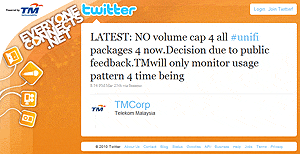 When UniFi was launched in March, netizens across the country voiced strong objections to the caps through blogs,
Facebook
and
Twitter
. To TM's credit, it listened to the cyber chatter and tweeted a message
(right)
within days of the launch.
When UniFi was launched in March, netizens across the country voiced strong objections to the caps through blogs,
Facebook
and
Twitter
. To TM's credit, it listened to the cyber chatter and tweeted a message
(right)
within days of the launch.
Actually it's not a cap as you will still get Internet access even if you breach your package threshold but the speed will slow down to 10 percent. That's 2 Mbps in my case, which is ridiculous.
Since TM was savvy enough to notice the initial outcry over its fair usage policy, it should also realise the importance of keeping early adopters like me happy.
To quote tech blogger Edwin Yapp : "By doing so, TM will likely gain the respect of more customers - existing and potential - and come up a true winner instead of possibly alienating the very people that could make its UniFi service a success, as it might have done so in the past with its other services."
OON YEOH is a new media consultant with an upcoming book on social media. He invites you to connect with him via Twitter and Facebook .


Are you sure you want to delete this comment?
This action cannot be undone.