




What will our political leaders leave us?
Once you’ve hit 50 or more, you’ll hear news of long-lost friends coping with critical illness, some with not too long to live. Obituaries in the papers, previously inconsequential, now mean something. Parents, once our protectors are now our dependents. Children have become the carers. Siblings, once our partners-in-crime, running roughshod through the kampung , are now old, overly cautious, that spark of spontaneity snuffed by age.
Once you’ve hit 50 or more, you’ll hear news of long-lost friends coping with critical illness, some with not too long to live. Obituaries in the papers, previously inconsequential, now mean something. Parents, once our protectors are now our dependents. Children have become the carers. Siblings, once our partners-in-crime, running roughshod through the kampung , are now old, overly cautious, that spark of spontaneity snuffed by age.
Indeed, age changes perspectives. We begin to ask questions that we wouldn’t even think about in our teens. Every deed was a dare. Anything was worth a shot. Everyone was a fair friend despite the occasional tiff over turf rights.
 Growing old and seeing friends, parents and siblings pass on makes one wonder about what we’d leave behind when our time comes. Those who have long left us, and those we only know of, how do we remember them today? Our past statesmen for example?
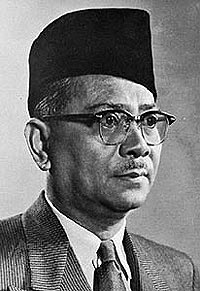
I recall in 1976, my attempt, as a naive journalism intern, to snap a profile interview with Tunku Abdul Rahman ( left ) at his home in Penang. I didn’t even get past the security gate. That was at Western Road, I think. But for many years, I read his columns ‘As I See It’ and ‘Looking Back’.
The Tunku’s columns, written bitingly while he was chairman of The Star , were often critical of the government and the way it handled race, social justice and economic parity issues. Journalism at The Star in the early 70s to ’80s was relatively robust. It was indeed ‘The People’s Paper’ until Operasi Lalang in October 1987.
I remember the Tunku - ‘prince with the heart of a commoner’ - as the exemplary statesman, truthful in speech, bold in deeds. He connected with the people across race and religion.
My grandfather was a great Tunku fan. He would often read to us about the Tunku from reports in Sin Chew Jit Poh . One of the stories he’d repeat often was the Tunku married a Chinese, although it was not uncommon then for Malay, Chinese and Indians to get along as well as they did. I had Malay and Indian friends who spoke fluent Hokkien, and me, a sprinkling of Tamil.
‘...try and help them’
But after May 13, 1969 friendships made as children were gradually stained by projected fears, suspicions and prejudices from the adults, which prevail to this day among many Malaysian families.
On May 14, 1969 the Sydney Morning Herald , reported in part: ‘ … Tunku Abdul Rahman sobbed as he went on nationwide television to plead with rioters to end fighting. His voice breaking down as he spoke, the Tunku pleaded for the nation to obey military and police orders ‘for the love of the country and the love of one another and the racial harmony enjoyed in the past’.’
In an interview in 1988 with K Das, a Malaysian correspondent for the Far Eastern Economic Review , the Tunku, reflecting the need for an affirmative policy for Malays to avoid a repeat of May 13, 1969, said, as quoted: ‘Whatever happens, I feel that in the whole economic progress, you've got to take the whole country with you, you've got to pay more attention to those who have less and those who are a little inexperienced in this type of work. You have got to try and help them.’
 ‘But you cannot, so to speak, benefit one section of the people at the expense of another. That is the thing we must not do. I think on the whole, the Chinese and others are quite happy to help the Malays along and so we must not hurt their feelings or show discrimination in any sense in this matter, but try and bring them all along together and get them to try and help Malaysia,’ the Tunku said.
More than 20 years on, whither the Tunku’s legacy for inclusiveness, statesmanship, integrity and proactive cross-cultural engagement?
One’s legacy is certainly marked by one’s decisions taken in defining moments for the greater good. I remember fondly Mohamed Khir Johari, education minister in 1968. That was the year ‘Inche Khir Johari’ decided to allow students who obtained Grade B (that was me) and Grade C in the LCE (today’s SRP) to be promoted to Form Four. What joy that was, although short-lived. Entering Form Four without my kampung buddies - who failed their LCE – took some time to get used to. But I managed.
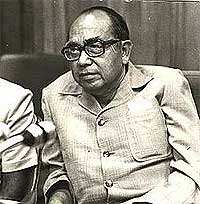
I remember the Tunku’s successor in 1970, Abdul Razak ( above ) as the first Malaysian leader since independence to visit China. The imagery of Abdul Razak shaking hands with Chairman Mao is as vivid today as it was in 1974. That handshake symbolised to my grandfather, and millions of Malaysian Chinese like him, a restoration of friendships between Malays and Chinese at home.
Sodomy, murder, extremism
Those are the few political leaders I remember well. Since 1978 when I started my first reporting job in KL, successive leaders had certainly left their mark, but they pale against the legacy of their predecessors in bringing Malaysians together.
Today, the indelible stains on the political landscape left by our retired and current ‘leaders’ are media clamp downs, rampant corruption, white elephants, pork-barrels, political patronage, nepotism, cronyism, ‘sodomy’, politicians who get away with murder, religious extremism, farcical judiciary, government-sanctioned discrimination by race and religion, declining standards in education, incompetent public service, rising crime - and more corruption.
Indeed, what legacy will our retired and current political leaders leave us? Is there no leader worthy of the benefit of our doubt? Can the current leaders, based on their politics and choices they make today, confidently say they have fought a good fight, ran a good race and did what was good for the people? Who will we remember as a ‘righteous leader’ who tore down the walls that continue to divide Malaysians?
 For now, I seek inspiration from Tunku Abdul Rahman’s speech to the Indian Association in Penang on Oct 4, 1959, two years after independence: ‘A country like Malaya is not easy to administer. With the plurality of races and creeds so used, under the British administration, to think in term of their own community there was no common loyalty for this country. Each community has been thinking only of his own interest and the loyalty of each in large measure has been to the country of his origin.
‘The only good thing about the people of Malaya was that they bear no ill-will towards one another. Each one goes his own way without interfering with the customs or trade of the other, at the same time they join one another in most of the activities common to their own particular race or creed. Thus, during the Hari Raya festival, people of other races enter into the spirit of festivity and so it follows with Thaipusam, Christmas and Chinese New Year.
‘Happily with this characteristic forming the background, we can easily pursue the policy that ‘in diversity we find unity’and it is on this understanding that Malaya entered the threshold of independence. We have found with independence our attitude towards this country and towards one another have changed. Whereas in the old days we used to think in terms of each community, today we are beginning to think of ourselves as Malayans; of people whose loyalty is to Malaya and Malaya alone. Malaya's well-being happiness and prosperity depends entirely on us; on how we think and on what we are prepared to do for her.’
While there’s time
Meanwhile, there’s a brighter side to living in Malaysia - if we discard the dark side of Malaysian politics. We’re not exposed to earthquakes and flash floods. We’re not looting, trafficking drugs or blasting each other on the streets with shotguns. There’s traffic jams but air quality is relatively cleaner than Manila, Bangkok, Delhi or Jakarta. We have clean water.
Our kids can go to school. We can afford to employ foreign maids. We have relatively cheap broadband connections. Our KLIA is still one of the best airports in the world. MAS is one of the best and safest airlines; and the average family can now afford to travel - on AirAsia.
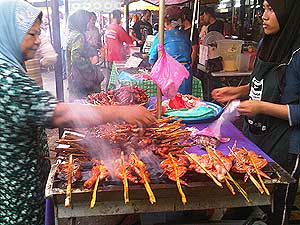 Our eco-diversity, food and shopping outlets still bring in top tourist dollars. Eating out is relatively cheap. Our hospitals have sufficient beds and doctors still save lives. And, on average Malaysians can live to ‘three score and ten’ – as many of our leaders will. Indeed, Malaysia’s a good place to live – unless our leaders destroy it through bad governance, which as things do, is already happening.
Our leaders should seriously reflect on what legacy they’ll leave behind while there’s still time to redeem themselves.
DR ERIC LOO left Malaysia for Australia in 1986 to work with the print media. He currently lectures at University of Wollongong, Australia, and also mentors international journalism students via UPIU, run by United Press International. He is founding editor of Asia Pacific Media Educator. His recent books are Best Practices of Journalism in Asia (2009); and Journalism in Good Faith: Issues and Practices in Religion Reporting (co-authored with Mustafa K Anuar, 2009). Email: eloo@uow.edu.au


Are you sure you want to delete this comment?
This action cannot be undone.