




The all-new Facebook Groups
The thing about social media is that it changes so incredibly fast that it's really hard to write a book about it. When Chris Leong, and I started working on our book on social media for business, it was to have been called ‘Be My Fan & Follow Me’.
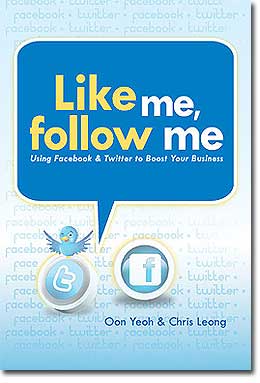
At the time, Facebook had ‘Fan Pages’ but just as we submitted our draft to the publisher, Facebook eliminated the word ‘Fan’ and replaced it with ‘Like’. So, instead of being a fan of a Page, you like a Page. That forced us to changed the title of our book to ‘Like Me, Follow Me’ which in retrospect is a positive thing because it's a shorter, catchier name.
W
 ithin months of publication, Facebook made a small section of our book obsolete. We had devoted a whole chapter on Facebook Groups. That chapter will need to be substantially revised if we ever publish a second edition because of the changes Facebook has just introduced to Groups.
The changes are a positive thing. They help to differentiate Groups from Pages. Previously, it was really hard to tell the difference between the two. The most common question I get from people who want to create a business presence on Facebook is: ‘Should I create a Page or a Group?’
Superficially Pages and Groups looked very similar, with the main difference being that Groups allow mass-messaging while Pages do not; and that Pages allow for customised Apps while Groups do not. There were other minor differences but none really worth highlighting.
With the launch of the new version though (already rolled out in Malaysia), the differences will be clearer.
Now, it's obvious that Pages are meant for companies to use for branding, communication and customer engagement purposes. Groups are not. While companies can certainly create Groups, they are really no longer suitable to be used as a platform for business purposes.
Rather, Groups are designed to make online social networking more closely resemble real-world networking.
In the real world, you have many different social and business networks and often times, they don't intertwine much. In some cases, they are totally distinct.
Mini-networks now possible
When I look at my networks, I find this to be true. I have an ICT network consisting of people who are interested in all things tech. I have a political network comprising political animals. And I have a judo network made up of people whose favourite movie is ‘Fight Club’. There's very little overlap.
The ICT guys usually have no interest in politics. The political guys are usually not that tech savvy. And neither the ICT nor the political guys are into judo.
Yet, on Facebook everyone is lumped into one network. So, when I post judo stuff, the non-judo guys would find the content totally irrelevant. And when I post political stuff, it induces yawns amongst the judo and ICT guys. You get the drift.
 With the introduction of the new Groups, that should be a thing of the past. Within my network, I can now have mini-networks catering to different interests.
New features include Group Chat (where everyone in the Group can join in the conversation); Docs (where everyone can collaborate on a common document in real time; and Mailing List which sends mail alerts to everyone once a new update is made. None of these was available under the old Groups.
A natural question is what happens to the old Groups you had set up? They still exist and Facebook will continue to support the old format for existing Groups. However, any new Groups formed will feature the new format.
In case you're wondering if you an easily or automatically convert the old Groups into the new format, the answer is a surprising ‘No’. The only way to do this is to create a new Group and to manually cut and paste old content to the new one.
It's worth highlighting that Groups have an opt-out feature, meaning that anyone in your network can create a Group and add you in it. You of course would be alerted and you can choose to opt out, if you want to. But you can't stop anyone in your network from creating Groups and adding you to them.
This, to me (and I'm sure to many people) seems like an obvious invasion of privacy but Facebook says it's similar to tagging of photos. Anyone in your network can tag you on photos. And so it is with adding you to Groups. Strange.
Of course you can leave any Group any time. And once you leave, people cannot add you to that Group again.
The privacy issue notwithstanding, I think the new Groups is a good move because the old Groups was way too similar to Pages. This new approach, which more closely mimics real life social networks, is a welcome development.
You can try it for yourself by creating a Group .
OON YEOH's new social media book 'Like Me, Follow Me' is published by MPH. You can connect with him via Facebook and Twitter .


Are you sure you want to delete this comment?
This action cannot be undone.