




Is the era of paywalls dawning?
The New York Times has decided to erect a paywall for its online content. Announced just last week, the paywall would first be imposed on Canadian readers and by March 28, it will roll out to the rest of the world.
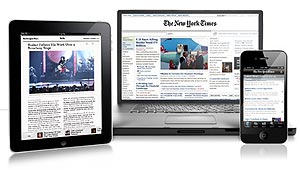
It’s not a strict paywall in the sense that readers will still be allowed access to 20 articles a month for free. However, if they want to read more than that, they will have to get a paid subscription (this applies to the website as well as phone and tablet apps).
The New York Times has decided to erect a paywall for its online content. Announced just last week, the paywall would first be imposed on Canadian readers and by March 28, it will roll out to the rest of the world.
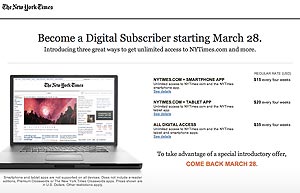 It’s not a strict paywall in the sense that readers will still be allowed access to 20 articles a month for free. However, if they want to read more than that, they will have to get a paid subscription (this applies to the website as well as phone and tablet apps).
People who subscribe to the print edition of the paper will naturally have unlimited access.
For those who want a digital subscription, there are three options. At US$15, you get website plus phone app access. For US$20, you get website plus tablet app access. Lastly, for US$35, you get website plus phone and tablet app access.
 Is the fee too high? Some industry observers think so. New media guru Steve Outing is one of them. “Yes, the
New York Times
is a great news organisation producing the best journalism in the world,” he says. “But faced with those fees when there are so many other quality news websites a click away, a small percentage of
nytimes.com
visitors will pay.”
Is the fee too high? Some industry observers think so. New media guru Steve Outing is one of them. “Yes, the
New York Times
is a great news organisation producing the best journalism in the world,” he says. “But faced with those fees when there are so many other quality news websites a click away, a small percentage of
nytimes.com
visitors will pay.”
In order for the NYT to stay the “paper of record” (some would say it’s the most influential paper in the world), the paper has decided to adopt a lax policy with regard to its articles shared via Facebook, Twitter, search engines, blogs and other social media sites are free (although free Google links are limited to five a day.)
If a reader clicks on a link found through these ways, they will be able to read the article for free even if they’ve already gone over the 20 free-article quota.
Limited paywall scheme
This latest attempt by the NYT to charge for content is generating a lot of publicity in light of the fact that print publications are suffering across the country. But it’s hardly the first time NYT has tried to charge for content. In 2005, it attempted a limited paywall scheme called TimesSelect , which basically required people to pay if they wanted to read articles by columnists. That unpopular scheme was scrapped by 2007.
Giving content away for free online would be fine if online ads could command the kind of revenue that print ads can. But ironically, although web ads are more accountable (you can know exactly how many impressions or clicks are attained), they cost a fraction of print ads.
So charge it must. But how much money can it make?
PaidContent.org , a specialist website dedicated to the issue of paid online content, has done some complex calculations to determine potential revenue, and as it turns out, the prospects for the NYT are surprisingly good.
If PaidContent.org ’s projections are correct, the NYT stands to earn at least US$100 million a year in additional revenue. And that’s assuming subscribers are opting for the most basic subscription of US$15 a month.
“A blend of subscriptions would push sales higher. And, the number of subscribers could be significantly greater, as well, considering that a higher percentage of people might be willing to pay for all of the Times ’ digital content than for just a piece of it - even though the price is higher too,” the site says.
It’s worth noting that PaidContent.org ’s projections are just for US subscriptions. There’s also the rest of the world to consider.
Who knows whether NYT new paid initiative will actually work? Only time will tell but with print media gradually dying, it really has no choice but to try this.
If the NYT subscription scheme proves to be a success it would pave the way for other papers to start charging for their online and app versions. I’m sure newspaper publishers across the US and indeed, around the world, are watching the great NYT experiment with great interest.
OON YEOH is managing editor of AsiaReach Media. You can f ollow him on Twitter.


