




Anwars politics of convenience, compliance and conviction
A day after Anwar Ibrahim was released, Philip Bowring, a journalist in Hong Kong, wrote an article in the International Herald Tribune , Which Anwar walks free? Bowring - a keen observer of Malaysia who knows Anwar personally - cannot be asking the question in a rhetorical manner.
Over the last five years, Bowring, in addition to other pieces on Asia, has penned 11 articles on Malaysia alone, all of which were published in the Tribune ; with another special report on the rivalry between Mahathir and Anwar for Prospect , a respectable British magazine.
 As Bowring wrote: " ...now that Anwar has been released and the sodomy conviction against him overturned, will he remain a hero to those who believe in human rights, racial equality, freedom of speech and religion? Will the man whose six-year incarceration became such a focus of civil society campaigns fight for those same rights? Or, after a decent interval, will it be business as usual for one of Malaysia's most outstanding, charismatic politicians? Which will win out, Anwar's idealistic sentiments or his history of opportunism?"
To Anwar`s supporters, some of whom have developed a 'emotive bond' with him during his six-year imprisonment, Bowring's doubts about Anwar's integrity must seem exaggerated. How could Anwar, who has been detained twice under the Internal Security Act (ISA) be anything else other than a principled politician?
Moreover, Bowring seems to have ignored the fact that beliefs and preferences often change in the course of a person`s life.
The onus to change falls squarely on politicians and policymakers too. When famed British economist John Maynard Keynes was accused of changing his mind, for instance, he replied. "When the facts change, I change my mind. What do you do, sir?"
A day after Anwar Ibrahim was released, Philip Bowring, a journalist in Hong Kong, wrote an article in the International Herald Tribune , Which Anwar walks free? Bowring - a keen observer of Malaysia who knows Anwar personally - cannot be asking the question in a rhetorical manner.
Over the last five years, Bowring, in addition to other pieces on Asia, has penned 11 articles on Malaysia alone, all of which were published in the Tribune ; with another special report on the rivalry between Mahathir and Anwar for Prospect , a respectable British magazine.
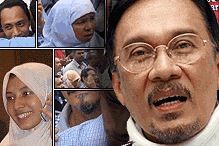 As Bowring wrote: " ...now that Anwar has been released and the sodomy conviction against him overturned, will he remain a hero to those who believe in human rights, racial equality, freedom of speech and religion? Will the man whose six-year incarceration became such a focus of civil society campaigns fight for those same rights? Or, after a decent interval, will it be business as usual for one of Malaysia's most outstanding, charismatic politicians? Which will win out, Anwar's idealistic sentiments or his history of opportunism?"
To Anwar`s supporters, some of whom have developed a 'emotive bond' with him during his six-year imprisonment, Bowring's doubts about Anwar's integrity must seem exaggerated. How could Anwar, who has been detained twice under the Internal Security Act (ISA) be anything else other than a principled politician?
Moreover, Bowring seems to have ignored the fact that beliefs and preferences often change in the course of a person`s life.
The onus to change falls squarely on politicians and policymakers too. When famed British economist John Maynard Keynes was accused of changing his mind, for instance, he replied. "When the facts change, I change my mind. What do you do, sir?"
Changing strategy
Now that Anwar would be banned from electoral politics until 2008, compelling him to build his strength in international society, Anwar is bound to change his strategy to re-engage with the Malaysian electorate too.
Indeed, as a former social reformer with a populist Islamic base - before being catapulted to the role of a minister who held the agriculture, education and finance portfolios respectively - it was inevitable that Anwar's views in the past would oscillate with his executive tenure; as between protecting the farmers, whose worldviews are parochially domestic, and backing up the financiers, whose values often pivot on the importance of internationalisation.
Nevertheless, Bowring`s question of Anwar goes beyond the latter`s policy positions. It harks back to Anwar's form of politics, which has been known to shift between convenience, compliance and conviction. These are the 3 Cs that have simultaneously excite and repel people who have been following his career.
The first was displayed most vividly when Anwar, despite using an Islamic platform harnessed from his days in Abim (Malaysian Islamic Youth Movement) to oppose the government on a variety of issues, was persuaded by none other than Mahathir himself to join Umno in 1982, much to the chagrin of PAS, the Islamic party closer to his convictions then.
Abim, established by Anwar in 1971 along with a group of university graduates, advanced a vision of an Islamic society. Abim attracted many educated Muslim Malays who were eager to develop themselves, their country and community, without sacrificing their Islamic identity.
Indeed, Abim grew from strength to strength, as Dr Louay Safi, a former deputy director of the International Institute of Islamic Thought in Malaysia, made known in an interview to the journal of Middle East Affairs :
"Between 1971 and 1981 Abim grew rapidly to become a power to be reckoned with, partially due to its non-political status at a time of state intolerance toward Islamic political organisations, and partially due to the dynamism of Anwar Ibrahim who served as its president from 1972 to 1982. It is estimated that the movement grew from about 9,000 in 1972 to 35,000 by 1980. Anwar's resignation from Abim in 1982 to run for public office under the banner of Umno rather than PAS, threw the movement into disarray, took the steam out of it, and practically put an end to its rapid growth."
Pursuing the Islamic agenda
Once in Umno, Anwar also exhibited - and used - the second politics of compliance to entrench his position in the party further. Given his role as a member of the cabinet, Anwar went along with Mahathir in cracking down on some of the key institutions in the country.
Once again, Bowring was most perceptive on this score:
"Nor can Anwar claim any past credit for trying to keep the judiciary independent of the politicians. Mahathir's single most important extension of arbitrary executive action was his 1988 sacking of the Chief Justice (then called Lord President) and four other judges following decisions which were politically inconvenient. Malaysia has not been the same since. Anwar was party too to the erosion of states' rights, press freedom and the powers of the Malay sultans. In short, many believe that whatever his personal inclinations, for years he has been too close to the development of Malaysia's brand of democratic authoritarianism to lead a reform movement."
To be sure, Anwar has also manifested a third form of politics that has deeply appealed to the middle-class Muslims in particular. As a devout Muslim, Anwar has used his (Islamic) conviction to pursue Islamic agendas.
Some of these initiatives have resulted in the formation, and at one stage, the generous financing of the International Islamic University of Malaysia (IIUM), which is now arguably one of the best universities in the country and region.
Anwar`s refusal to cave in under the pressures and brutality of the Mahathir regime also served to underscore the strength of the former`s conviction.
As Anwar now recovers from his back surgery in Munich, no one would be able to answer Bowring`s original question of 'Which Anwar walks free?' except Anwar himself.
Yet, Anwar clearly is comfortable with Islamic issues, and sees himself playing the role of what Antonio Gramsci called 'the organic intellectual', to bridge the chasm between the Muslim world and the West after September 11.
Indeed, in a recent interview with Thomas Fuller of the Tribune , Anwar has confirmed the importance of such a role to 'win the hearts and minds of Muslims' to make up for the failure in military solutions in the War on Terrorism.
Which Anwar do we want?
This only partially explains the future international role of Anwar, however. What remains to be seen is whether Anwar, six years after being detained, can 'read' the Malaysian public precisely, both across the non-Muslim and Muslim divide, to argue that reformasi is still what Malaysians need, and are collectively after.
How this reading is rendered will define whether Anwar will once again choose the politics of convenience, compliance or conviction.
More important, the choice will also be made based on the confidence with which Anwar can best foment new bases of populist support beyond the traditional support he receives from middle-class Muslims, and his own constituency in Permatang Pauh in Penang.
In this sense, in answering 'which Anwar will walk free?' Malaysians also have a choice to decide 'which Anwar' do they want him to be?
By attending his speeches, by contributing to Keadilan (Justice Party), indeed by supporting Anwar morally, they could get the Anwar that has historically straddled between the 3 Cs.
For what it is worth, it should be mentioned that there are only two types of politicians, according to German sociologist, Max Weber. Those who join the political fray as a matter of vocation, akin to a religious calling, and those who yearn for office as a matter of profession, hence, self interest. There could of course be a cross between the two ideal types.
The three forms of politics exhibited by Anwar correspond to a hybrid, which makes the 'real' Anwar somewhat difficult to discern, although not impossible to understand. This is why Bowring's question falls short, as it seeks to ask about Anwar's previous and future choice without understanding Anwar's overall career in a better light.
Nevertheless, from the standpoint of political science, what is deserving of greater scrutiny is whether the electoral system in Malaysia compel the 'production' of more than one 'Anwars', which the voters either consume, or reject.
PHAR KIM BENG is author of the Eye Eye You column in malaysiakini . He graduated from the International Islamic University in 1994 as a Muslim convert, having previously been a Buddhist. He has travelled around the world studying at the University of Notre Dame, where he understood the beauty of Catholic scholarship, the University of Cambridge, where he learned the importance of British education, and later the University of Tokyo, where he learned his survival Japanese.


Are you sure you want to delete this comment?
This action cannot be undone.