




Pacific War in Msia, Spore remembered (Part 4)
Why did the British political and military authorities not arm the Chinese in Peninsular Malaysia and Singapore earlier to defend the territory in central and northern Peninsular?
Are the contributions and sacrifices made by Britain's s Indian troops who stayed loyal to the cause of the Allies till Liberation as well as Indians in Peninsular Malaysia and Singapore who chose to fight on as underground partisans sufficiently documented and recorded in history?
Historian Karl Hack shares his observations and thoughts on these, and other questions in the conclusion of a four-part series .
Why did the British political and military authorities not arm the Chinese in Peninsular Malaysia and Singapore earlier to defend the territory in central and northern Peninsular?
Are the contributions and sacrifices made by Britain's s Indian troops who stayed loyal to the cause of the Allies till Liberation as well as Indians in Peninsular Malaysia and Singapore who chose to fight on as underground partisans sufficiently documented and recorded in history?
Historian Karl Hack shares his observations and thoughts on these, and other questions in the conclusion of a four-part series .
Malaysiakini: Since the 1931 Mukden (Shengyang) 'incident' where the imperial Japan's Kwantung Army rampaged and took over Manchuria and then the 1937 Marco Polo Bridge 'incident' and Nanjing Massacre, the absolute majority of Malayan Chinese on both side of the left-right as well as Chinese-English educational divides had become hostile to Japan. Why did the British military or political authorities not organise them militarily earlier in, say, 1939 (after Germany had invaded and occupied Poland, and Britain and France declared war on Germany) or immediately after July 25, 1941 when French Indochina had been in de facto Japanese control, to defend Peninsular Malaysia and Singapore?
Had the Malayan Chinese been organised militarily earlier and with sufficient war-fighting resources, wouldn't the Japanese advance have been resisted and delayed in northern or central Malaya?
Dr Karl Hack : Louis Allen's book 'Singapore 1941-1942' (London: Davis-Poynter, 1977) has some intelligent reflections on this. Some have argued that the eastern war was a racial war, and an imperial power could hardly call on its Asian subjects to defend themselves en masse , without undermining its very raison d'etre . So the reasons are seen as imperial and racial.
Others have argued that the inter-war colonial government had classified both the Guomindang (Chinese Nationalists) and Communists as alien movements, orientated not mainly to Malaya, but to China. That and the fact the two organisations themselves were initially inimical to each other, made them potentially dangerous friends. So the reason became political.
 Then again, what was the result of Britain helping to train guerillas in 1942, and later the MPAJA from 1943 to 1945? If one accepts that this helped underpin the later Malayan Emergency, one can answer there were also credible security reasons for caution.
However, assuming the imperial, political and security objections had been quashed, was military doctrine of the time such that using large-scale guerrilla resistance was likely? This did not happen in the defeat of France in 1940. Britain was only just expanding its capability to train for guerrilla and unorthodox warfare, with some reluctance in the military to divert too many resources to these areas. So the reason becomes tactical and doctrinal.
Then, assuming the racial, imperial, political, security and doctrinal barriers had been overcome, there was the economic barrier. Malaya's rubber and tin sold to the United States, making it the 'dollar arsenal' for an almost bankrupt British Empire. Malaya produced security in economic, cash terms, and this meant keeping most men in the mines, not in the military.
Perhaps, just perhaps, all these barriers could and should have been overcome, and the weapons and training made available, without over-diluting resources for regular troops. The armchair tactician in me aches to know what effect that might have had in delaying Japanese movements, just as the humanitarian in me recoils from imagining the additional reprisals and massacres it might have called forth.
According to Peter Elphick's tabulation, almost half of Britain's roughly 87,000 troops defending Peninsular Malaysia and Singapore were Indians. While some deserted or were instigated to join the Japanese-sponsored anti-British and anti-Allied groups, many chose to be loyal to the anti-fascist cause and were interned as prisoners of war in Changi in Singapore and Pudu in Kuala Lumpur or sent to work as slave labour to build the Death Railway on the Thailand-Burma border. Others like RG Balan worked with the Communist Party of Malaya and Malayan People's Anti-Japanese Army as an underground Tamil publicist. Are they any academic works done to reconstruct the war experiences and great sufferings of those brave Indians?
Not nearly enough has been done on those who did not join the Indian National Army (INA). A full account of Indian prisoners of war (POWs) who refused to join the INA is (to the best of my knowledge) sadly lacking. Christopher Bayly and Timothy Harper have just published 'Forgotten Armies: The Fall of British Asia', 1941-1945 (Penguin, 2004), but we still await the result of ongoing research into Asian labour on Thailand's 'Death Railway'. I wonder, are there regional students out there who are ready to research these areas, bringing Asian perspectives to bear?
The Japanese invasion and occupation of Peninsular Malaysia, Singapore, Sabah and Sarawak were resisted by, among others, thousands of British and Australian troops, some of whom perished but many survived internments, tortures and hard labour. How do the survivors and their offspring in Britain and Australia remember the war and resistance in this part of the world?
 There is a sense of their sacrifices never having been fully honoured, and their achievements having been overshadowed by association with one of the greatest military defeats the British Empire ever suffered. This has been made worse every time old accusations of failures are dredged up, something we discuss in our Chapter 6, 'After the Battle'. In addition, however, there is sadness at lost comrades, and a desire by relatives to know, to understand, and to assimilate into their picture of their family members, events which many veterans loathed to talk about in detail. Some veterans' children want to know more. They visit Singapore's Changi Chapel and Museum, and leave notes there dedicated to their relatives' experiences and sacrifices. Perhaps a number of veterans and descendants will return next year, for the 60th
anniversary
of the end of the war, in August to September. But no answer can do justice to the range of emotions and feelings, especially about the 'Death Railways', where POWs and Asian labourers died in such huge numbers: 16,000 British, Dutch, Australian and American POWs alone on the Thai railway.
There is a sense of their sacrifices never having been fully honoured, and their achievements having been overshadowed by association with one of the greatest military defeats the British Empire ever suffered. This has been made worse every time old accusations of failures are dredged up, something we discuss in our Chapter 6, 'After the Battle'. In addition, however, there is sadness at lost comrades, and a desire by relatives to know, to understand, and to assimilate into their picture of their family members, events which many veterans loathed to talk about in detail. Some veterans' children want to know more. They visit Singapore's Changi Chapel and Museum, and leave notes there dedicated to their relatives' experiences and sacrifices. Perhaps a number of veterans and descendants will return next year, for the 60th
anniversary
of the end of the war, in August to September. But no answer can do justice to the range of emotions and feelings, especially about the 'Death Railways', where POWs and Asian labourers died in such huge numbers: 16,000 British, Dutch, Australian and American POWs alone on the Thai railway.
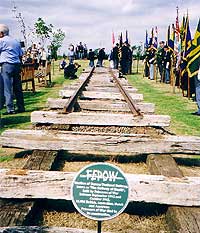
I remember, in 2001, being in the church of St Martin-in-the-Fields, on Trafalgar Square in London. I was there for a wedding. But after the hymns and the vows, there in the corner, beyond the pillars, I discovered a little wood and glass case. In it were a few bolts from the Thai railway, and a dedication. And in 2003, I received a package of photographs and cuttings on another piece of the railway arriving in England. On Feb 15, 2002 a group of veterans and children, laid a section of the Thai Railway, which had been shipped all the way from Asia, to an arboretum in Staffordshire. I wonder how many other towns in England have a little piece of Thailand in them? A few words cannot express what brought these fragments, these symbols of suffering more than 7,000 miles, from jungle to English field. The best I can do is to point readers towards starting points for the voices and stories of veterans and their children. Sites such as the FEPOW website (Far East Prisoners of War Association), the Australian Broadcasting Company's 'No Prisoners' site and the Australian War Memorial's site , which also features an online journal.
Germany had offered its unqualified apology to the people of Europe, especially the Jewish people who suffered so much from the Holocaust like in Auschwitz, long ago but Japan has still not done so to the people of Asia-Pacific. What do you think are the causes for the different attitudes and psychology between Germany and Japan?
Nazism as an ideology and movement eventually encompassed the attempted genocide of the Jews, and the virtual enslavement or displacement of Slavs in central and eastern Europe. Most Germans can feel disgust with these aspects, even if some might feel Germany had legitimate fears, grievances and aspirations: fears about the Soviet Union, grievances against the 'unfair' treaty which settled World War One and aspirations to expand to include all Germans from surrounding territories into one German state.
One can speculate on several ways in which Japanese, some Japanese, might attempt to justify a contrast between Germany and Japan.
Japanese aggression might still be seen by some, if only intuitively, as first and foremost a continuation of the Meiji Restoration and response to Western imperialism and economic restrictions, with the results as 'excesses' rather than aims. In this case, they may doubly recoil from accepting the war in entirety, and so their ancestors' contributions to it, as beyond all credit.
Japanese aggression might, by some, thus be presented as aiming at political, economic and military ends first and foremost, with oppression and 'cleansing operations' against populations inclined to resist by guerrilla methods as by-products.
It is not my intention to accept, or even analyse, such approaches, or the many others possible. Except to say that there is a big difference between individual outrages, and systemic abuse. Outrages will happen in war, but any government that tolerates these, indeed allows if not encourages their systematisation in cases such as that of the comfort women, has a real case to answer. One can and should argue about how far Japan, and Japanese education, adequately addresses these issues. George Hick's little book, 'Japan's War Memories: Amnesia or Concealment' (Aldershot, 1997) is a good introduction to some of these issues. At our conference in Singapore next September, we hope to include at least one panel on Japanese war memories.
Do you have any plans to visit Peninsular Malaysia to conduct more research on the subject?
For the moment, I am very busy with other projects. These include an edited book on 'Colonial Armies in Southeast Asia', a conference to mark the 60th anniversary of the end of the Asia-Pacific War and an edited book on Singapore as a global city. I am also anxious to tackle some big questions. For instance can Iraq's present and future best be illuminated by looking at lessons from the British Empire, from counter-insurgency campaigns such as Malaya and Vietnam, or at the way naming and framing conflicts, for instance as 'civil', 'civilisational' or 'anti-terror' war, drives events? There is so much history which needs to be done, and so little time.
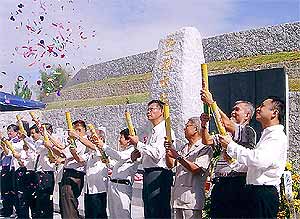 But I did get to Malaysia last December for a ceremony just north of Kuala Lumpur, at the Xiao En Yuan Memorial Park in Nilai, to rededicate a memorial to the 'September Martyrs': the MCP and MPAJA members surrounded and killed by Japanese forces near Batu Caves in Sept 1942. The monument symbolises much of what we have been talking about. Its original site was lost to development, reflecting the struggle to preserve memory. And the rededication was a mainly Chinese-language event, attended by anti-Japanese veterans, so preserving passion and authenticity, but in the process failing perhaps to truly penetrate at a national, trans-communal level. There are no easy answers to these tensions between authenticity, emotion and connection to events on the one hand, and the need to translate and share memory on the other.
Perhaps, as the 60th anniversary of the end of the war closes in, there will still more developments in Malaysia. Perhaps some of these will address these issues. As an historian one always keeps one's ears and eyes open for just such developments, and the passport and the pen at the ready.
JAMES WONG WING ON is chief analyst of Strategic Analysis Malaysia. He is a former DAP member of Parliament for Kampar (1990-1995) and a former columnist for the Sin Chew Jit Poh Chinese daily (now Sin Chew Daily). He read political science and economics at Monash University in Melbourne, Australia.


Are you sure you want to delete this comment?
This action cannot be undone.