




Liberalism and faith
For many, ‘liberalism’ in what is often described as a ‘plural’ society like Malaysia has meant anything from John Locke’s belief in the individual’s right to life, liberty and property to the broader assertion that liberalism, as a political philosophy, ‘supports ideas and programmes such as freedom of speech, freedom of the press, freedom of religion, free markets, civil rights, and democratic societies’.
But what is liberalism largely seen as in the context of contemporary Malaysia?
From the way our political leaders, our religious pundits, some of our mainstream media, and even our education system have begun to put it, liberalism seems to have shifted from being seen as something neutral, desirable even, to something that is negative and not suitable for Malaysian society.
This is similar, I would say, to the way ‘democracy’ was criticised in the 1980s and 1990s as being an invention of the West, a tool meant to continue subjugating us to Western interests.
Then there’s this concept or assumption of a ‘plural society’. Despite the many valid scholarly critiques of this description of Malaysian society, it is one that still enjoys wide currency.
Pluralism implies equal, competing voices and centres, and a free market of ideas competing in a fair environment. This, for quite some time now, has become rather doubtful in Malaysia.
Competing voices, ideas and practices there certainly may be, but it would be unwise, indeed delusional, for us to believe that they exist in a fair environment. In many, many cases, there is indeed no level playing field.
Take the media system in Malaysia, for example. Since the 1980s at least, there has been oligopolistic control over the mainstream media.
The tentacles of the ruling parties, especially Umno, are spread far and wide, ably aided by the virtually all-encompassing 1984 Printing Presses and Publications Act (PPPA) and the increasingly (ab)used 1998 Communications and Multimedia Act.
And not to mention, of course, the Sedition Act.
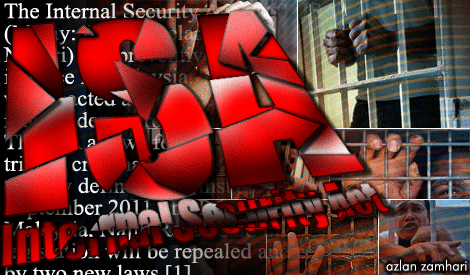 It used to be said, especially in the bad old days of the Internal Security Act, that there’s freedom of speech in Malaysia but NO freedom after speech.
But now, despite a short period of respite, it would seem that even such limited freedoms are being taken away by what appears to be a desperate regime that blocks news websites that provide crucial information, suspends publications that don’t toe the line, and detains respected, flea-bitten journalists for no valid reason, save to intimidate them and others.
It is also hardly a fair environment when we look at the education system - one that provides homogenised fare for the masses, arguably with the aim of dumbing our children down, rather than liberating their minds.
Then, of course, there’s the judiciary, once reputed to be one of the finest and fiercely independent in the region if not the world, but now the less said about the better.
And when we locate what I would kindly call this ‘mess’ within the wider context of a political economy that is rife with practices that scream ‘inequality’, I think we would find it quite difficult to call ours a ‘plural society’.
Liberalism and whose faith? And whose version of that faith?
Recognising the lack of plurality in Malaysia allows us to ask a number of questions of the term ‘faith’.
Is there plurality of faiths? If there isn’t, which faith dominates? Whose version of that faith dominates?
Does this dominance lead to a benign situation where other faiths are not only recognised and tolerated but, more importantly, seen as legitimate and respected?
If it doesn’t, is it the fault of the faith, the followers, and/or the keepers and ‘controllers’ of the faith?
Knowing this non-plurality (or inequality of the position of different faiths) enables us to recognise power relations.
In this regard, let us address some of the main issues often raised about liberalism and faith in contemporary Malaysia.
First, the myth of Malaysia being a liberal society. Two clear facts rubbish this myth - impediments to freedom of speech and inequality before the law.
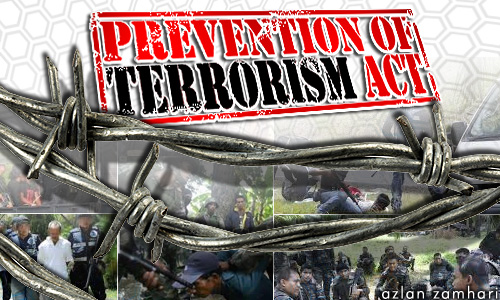 Freedom of speech remains a myth when we have, among others, the PPPA, the Sedition Act, the Security Offences (Special Measures) Act (Sosma), the Prevention of Terrorism Act (Pota), PPPA, and now Section 124C of the Penal Code (`attempting to topple the government’).
Then, there’s the myth of equality before the law - opposition politicians, civil society members, dissidents, are even now hauled before the courts; civil servants have been ordered to remain silent, and, more recently, top civil servants have not only been silenced but also have been removed from office.
Hence, what currently exists in Malaysia is NOT the purported greater freedom that a liberal society provides, but the lack of a liberal environment.
It is precisely this environment that is leading to greater polarisation and the construction of narrow ethno-religious silos.
This has led to a lack of exchange and interaction between different, aggrieved, indeed oppressed groups and communities.
Divide and rule is evidently still the mantra of the regime.
Within this environment, greater exchange, greater understanding - which can only come about through acknowledging and respecting each other - is needed.
Not greater control (political, cultural, religious, ethnic).
It is perhaps the only way forward if genuine liberation, genuine participation by all Malaysians is what is envisioned.
It is freedom that is required, NOT control.
Is liberalism incompatible with faith and religion?
It is often asserted by some hardnosed quarters in Malaysia these days that liberalism is incompatible with their version of their religion.
But surely it rt really depends on what one’s perception of one’s religion and its role in society is? For many it’s a choice between liberation, the freeing of human beings, on the one hand, and control.
Sure, there are grey areas in between.
But right now, unless there is political will - which we see very little of among our ruling politicians and their apparatchiks in our religious organisations, our education system and, certainly, in our media - we appear to be drifting towards greater repression than liberation.
Faith and religion are being manipulated by this class of individuals to legitimise their control, to further their self-interests.
In so doing, aware that liberalism, if not something more radical, would indeed challenge that hegemony, defy that control, those, certainly those dominating faith and religion in this country, will invariably disparage, deride liberalism - or indeed anything remotely questioning that control.
Bearing this in mind, I would like to leave it to a wise and, certainly, sad Malaysian, Philip Lok, former president of the Council of Churches of Malaysia, who wrote in The Malaysian Insider (Sept 16, 2015), in the aftermath of the red shirts rally of hate in Kuala Lumpur:
“But for me, there is nothing we can boast of, if my fellow Malaysians are living in fear of one another. There is nothing to celebrate if Malaysians are still differentiated by the colour of their race and the faith in their hearts. There is nothing to rejoice over, if freedom to live together as one ‘bangsa’ is still a distant dream.”
This is a truncated version of a paper presented at the Ideas/IAPS/UNMC ‘Liberalism Conference - Trends, Challenges and Future Prospects’. Sept 19, 2015, Kuala Lumpur, Malaysia.
ROM NAIN is a media analyst and academic who is weary of incompetent, unethical leaders and their apologists and spin doctors in the media who try to get away with murder while professing to rub shoulders with God’s angels.


Are you sure you want to delete this comment?
This action cannot be undone.