




One for the heroes
As I surfed the channels, struggling with the difficult question of whether to watch the world crumble on CNN or settle for a cartoon, I stumbled on a Hindi movie instead, which kept me hooked for the next 180 minutes.
This was the 'Legend of Bhagat Singh', a remarkable audio/visual biography on the life and death of one of India's most celebrated freedom fighters.
As I surfed the channels, struggling with the difficult question of whether to watch the world crumble on CNN or settle for a cartoon, I stumbled on a Hindi movie instead, which kept me hooked for the next 180 minutes.
This was the 'Legend of Bhagat Singh', a remarkable audio/visual biography on the life and death of one of India's most celebrated freedom fighters.
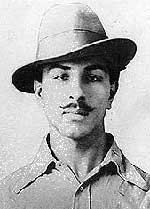 A story of how a young man, with a burning desire to free his motherland from colonial rule, confronts the empire head on and pays with his life, defiantly, at the tender age of 24.
"Look, I shall grow guns all over," a three-year-old Bhagat had told his father, according to records, when the latter spotted the youngster planting something in the fields in his village.
Now this should give you an idea of the path this freedom fighter would choose in order to free his homeland from the shackles of imperialism.
In the movie, he dismisses the possibility of negotiations with the enemy on the ground that talks between the strong and the weak are just not possible.
But Bhagat, who became totally immersed in pro-independence activities at 16, was no ordinary militant blinded by patriotic zeal. He was an intellectual, who devoured books on Communism and revolutionary ideas.
Militarism, Why Men Fight, Soviets at Work, Collapse of the Second International, Left-Wing Communism, Mutual Aid, Civil War in France, Land Revolution in Russia, Historical Materialism, were among the books he had requested for in a letter to a friend from jail.
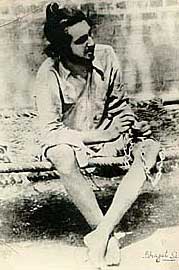 While imprisoned, Bhagat gained immense popularity after news of a hunger strike launched by his comrades and him for better living conditions was published in the press.
It is said that at one point his popularity even rivaled that of Mahatma Gandhi, whose path for liberation was structured around the principle of non-violence.
Defiant till the end
On Oct 7, 1930, the court sentenced Bhagat and two of his comrades, Sukhdev and Rajguru, to death by hanging after they were found guilty in a trial, known as the Lahore Conspiracy Case.
It is said that Bhagat had requested to be shot as a soldier but this was rejected.
Five months later, they were hanged. The revolutionaries had reportedly laughed when led to the gallows and shouted defiantly 'Inqalab Zindabad' (Long live the revolution).
'They lived as warriors and died as warriors,' was how one website described that historic event.
A few days after their deaths, Gandhi wrote a tribute to them, which read:
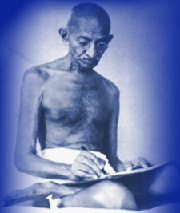 "Bhagat Singh and his two associates have been hanged. The Congress made many attempts to save their lives and the government entertained many hopes of it, but all has been in a vain.
"Bhagat Singh did not wish to live. He refused to apologise, or even file an appeal. Bhagat Singh was not a devotee of non-violence, but he did not subscribe to the religion of violence. He took to violence due to helplessness and to defend his homeland.
"In his last letter, Bhagat Singh wrote 'I have been arrested while waging a war. For me there can be no gallows. Put me into the mouth of a cannon and blow me off'. These heroes had conquered the fear of death. Let us bow to them a thousand times for their heroism.
"But we should not imitate their act. In our land of millions of destitute and crippled people, if we take to the practice of seeking justice through murder, there will be a terrifying situation. Our poor people will become victims of our atrocities."
Immortalised heroes
More than half a century later, after India gained its independence, for which many great men and women had shed their blood, the country is still locked in destitution and torn by communal and religious strife.
Did Gandhi inadvertently create a 'monster'? Would Bhagat's idea of a Communist India been the panacea for the nation's current problems?
The answer to these questions is 'No'.
History has shown that both democratic and Communist nations have headed towards destruction, there is no single perfectly workable doctrine.
And why is this so?
Simply because in all systems, there are politicians, leaders and dictators, and in them, intrinsic human traits such as greed, envy and ego, which are sure to rear their ugly heads.
So Gandhis and Bhagats may come and go, but as and unless human nature is miraculously re-engineered, the future appears bleak. A bitter pill indeed.
But did these great men die in vain?
No! Gandhi and Bhagat did not come to liberate India, but rather India was occupied in order to allow such men to rise.
So while the country they 'freed' is still struggling in the doldrums, these martyrs live on in the hearts of the people around the world as a source of great inspiration and teaching.


