




A Malay historians perspective of the Pacific War
This year is the 60th anniversary of the end of World War II, including the Pacific War which lasted from Dec 7-8, 1941 to August 15, 1945.
Certainly, many senior citizens in Malaysia and Singapore, like their counterparts in other parts of Southeast Asia, China, the United States, Australia and India, would remember and commemorate the liberation and peace.
Some would also proudly recall to their children and grandchildren their participation, contributions and sacrifices in that worldwide life-and-death struggle on lands and seas, in the air, jungles, urban hide-outs, countryside, torture chambers and detention camps, as well as beneath the seas and oceans.
In multi-ethnic Malaysia and Singapore, the Pacific War was also a period of social, political, economic and ideological upheavals. Peoples were forced by the then prevailing circumstances or situations, real or merely perceived through their respective ethnic, cultural, religious or ideological perspectives, to make political choices and decisions.
Some persevered while other wavered or switched camps in shifting alliances as local circumstances or international situations changed.
This year is the 60th anniversary of the end of World War II, including the Pacific War which lasted from Dec 7-8, 1941 to August 15, 1945.
Certainly, many senior citizens in Malaysia and Singapore, like their counterparts in other parts of Southeast Asia, China, the United States, Australia and India, would remember and commemorate the liberation and peace.
Some would also proudly recall to their children and grandchildren their participation, contributions and sacrifices in that worldwide life-and-death struggle on lands and seas, in the air, jungles, urban hide-outs, countryside, torture chambers and detention camps, as well as beneath the seas and oceans.
In multi-ethnic Malaysia and Singapore, the Pacific War was also a period of social, political, economic and ideological upheavals. Peoples were forced by the then prevailing circumstances or situations, real or merely perceived through their respective ethnic, cultural, religious or ideological perspectives, to make political choices and decisions.
Some persevered while other wavered or switched camps in shifting alliances as local circumstances or international situations changed.
In a not widely publicized monograph published a year ago by the Malaysian branch of the Royal Asiatic Society , Universiti Sains Malaysia (USM) historian Professor Abu Talib Ahmad focuses his investigative studies into the various and differing attitudes, sentiments, opinions and experiences of Malay Muslims in Peninsular Malaysia during the Pacific War as well as the 44 months of Japanese Occupation.
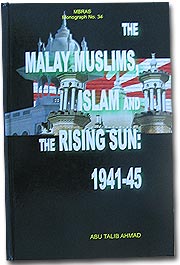 Titled
The Malay Muslims, Islam and the Rising Sun:1941-1945
(Kuala Lumpur, MBRAS Monograph No.34, 2003), the remarkably detailed studies show that Malay Muslims were not monolithic or static in their attitudes, sentiments and opinions towards the Japanese invasion and occupation. Their personal experiences were also different and diverse.
Titled
The Malay Muslims, Islam and the Rising Sun:1941-1945
(Kuala Lumpur, MBRAS Monograph No.34, 2003), the remarkably detailed studies show that Malay Muslims were not monolithic or static in their attitudes, sentiments and opinions towards the Japanese invasion and occupation. Their personal experiences were also different and diverse.
Although dealing with some issues which were considered 'sensitive' in the past, the monograph names many names. The monograph is available for sale in major bookshops in Malaysia.
Recently, malaysiakini interviewed Professor Abu Talib Ahmad via email and asked him to shares some thoughts and broad perspectives on some of the themes of his monographs for public discussion and rational introspection.
The full text of the interview is published here:
Q: What first motivated you to take an interest in the subject and themes now articulated in your monograph titled The Malay Muslims, Islam and the Rising Sun: 1941-1945?
A: I am interested to re-examine the claims by Japanese scholars which had gained wide currency since the early 1960s that Imperial Japan did not interfere in Islamic matters in the occupied areas. Two other issues that attracted me are the much quoted idea that Malays are pro-Japanese and Chinese are anti-Japanese and the last one is the question of collaboration in which include people from all races and from various ideological spectrums. The book has rejected all three issues.
Was it difficult to unearth and research on the many scattered official records and personal memoirs some 60 years after that topsy-turvy period in Malaysia's and world's history? How did you overcome the difficulties?
Archival research is always a laborious affair and what more when it involved various places in Malaysia (Alor Setar, Penang, Kuala Lumpur and Johor Baru) and also the Japanese Foreign Ministry Archives and the Japanese Defence Ministry's Office of War History, both of which are located in Tokyo. Some archives really have wonderful and understanding people as their staff and with these kind of people around archival research is very enjoyable (like Kuala Lumpur, Johor Baru and Alor Setar). Others are very much bound by bureaucratic red tapes like the Office of War History in Tokyo. In the end one needs personal connections to get around which is crucial especially in Japan and also some of the archives in Malaysia.
What caused the Malay Muslims to take up different positions and adopt different attitudes toward the Japanese in 1941-1945?
The Malay intellectuals and other groups took up different positions (either resisting or collaborating with the Japanese) because of various reasons such as ideologies, their conviction of possible benefits with regards their political struggle that could be enhanced from collaboration, and their belief in Japanese propaganda which was ingeniously done.
Before the outbreak of the Pacific War, Japanese propaganda and psychological warfare exploited the anti-colonial sentiments. But the Japanese never fulfilled their promise of granting independence and ceding power to the Malay collaborationists like Ibrahim Yaacob. Why? What were the psychological effects on the Malay collaborationists as the result of the broken promise?
 Japan had always used nascent Southeast Asian nationalism for their propaganda purposes. With regards Malaya there was never any plan to provide independence under whatever guise like in Burma, the Philippines or even Indonesia towards August 1945. It was often left to middle ranking army officers who were in the field in 1941-42 that played or otherwise local independence. Quite often these officers made some promises towards independence which were later over-ruled by higher authority although unfortunately locals had already put much belief in them (middle ranking officers). Independence was ruled out for Malaya because of its military and strategic importance.
The rejection of independence was a severe blow to the Malay Left within the KMM (Kesatuan Melayu Muda or Young Malay Union) group and by mid 1942, some of them had already rejected any further collaboration with the Japanese while many others had lost faith with the invader.
From historical records, it is quite clear that many Muslims in the Middle East supported Germany in both the First and Second World Wars against the forces of Anglo-America and their allies. Do you think that was one of the major sources of ideological and political influence that explains the seemingly widespread Malay-Muslim collaboration with the Japanese?
No I don't think so. I believe Muslims fell prey to German propaganda and their sympathy with Muslims in the Middle East whereas all these powers including the Soviet Union later were imperialists of the first degree.
The decision of some Malay left-wing nationalists to collaborate with Japan was perhaps understandable because of their resentment against British colonialism. However, why did some conservative Malay Muslims also collaborated given the fact that they were rather pro-British and also kept rather happy in the colonial status quo before the outbreak of the Pacific War?
The conservative Malays collaborated with Japan because many felt anger at the inability of the British to provide protection in early 1942 and almost all of these loyal Malays were left practically on their own to face an uncertain life under the new master. Therefore it makes sense for them to collaborate and perhaps to derive some possible benefits while the Japanese still needed many of the Malay administrators to run the country even if their new positions were not more than mere office boys.
There has been a school of Malay nationalist thought that Malays like Lieutenant Adnan Saidi of the British-sponsored Malay Regiment who fought the Japanese invasion under the Union Jack banner was serving the interests of British colonialism. However, from the perspective of the mainstream of world history now, people like Adnan Saidi was in fact heroes in the worldwide struggle against global fascism. What is your own assessment?
I believe Adnan was a loyal defender of Britain and British interests in this part of the world when Britain had yet to spell out clearly the political future of this country. Then there is also the claim by Singapore on Adnan and members of the Malay regiment who fought heroically against the Japanese army at Pasir Panjang. So the tag of heroes can be rather controversial and only served certain interests - in this case the Malaysian armed forces and also the government of Singapore.
Many Malay Muslims like former Foreign Minister (Tan Sri) Ghazali Shafie, who joined the British-sponsored special operations unit, Force 136 have always been honoured for their contribution, but what about those who fought under the banner of the Communist Party of Malaya and Malayan People's Anti-Japanese Army, like Rashid Maidin? Should they not also be accorded recognition and honour?
As for those who were accorded heroes and what not is a political decision. It is the prerogative of the government of the day to decide on who should qualify as heroes. One category of possible heroes for both sides of the causeways is those who resisted the Japanese which many people did.
However the case of Rashid Maidin is rather problematic due to his communist ideology and the fact that he and his MPAJA mates were direct participants in the Emergency. There are not that many people around who could still remember the Japanese period but there are thousands who are still alive who remember very well the emergency and the things that happened to their kin who were either killed, murdered or maimed by the communists. So it is simply impolitic to recognize Rashid Maidin as a hero when UKM efforts to publish the memoirs of two former Malay members of the Communist Party of Malaya had not been favourably received by the general Malay public!
In your assessment, how had the Pacific War and the Japanese invasion and occupation of Peninsular Malaysia and Singapore changed, both positive and negative, the political worldview, consciousness, beliefs and attitudes of the Malay Muslims as a community?
The negative ones:
Social values and emancipation of the Malay youth from traditional values even at the extent of becoming lax in religious values
Division of the Malay intellectuals into left and right
The positive ones:
Intensified the political awakening of the Malays on a wider scale than before the war
The marked change in perceptions/views of the Malay administrators who after 1945 became more identified with Malay interests rather than British interests
The greater emancipation of Malay women especially in political organization which in a way is a continuation of prewar developments especially in education.
This year is the 60th Anniversary of the end of the Pacific War as well as the liberation of Malaya and Singapore. What do you think are the lessons, both positive and negative, to be learned by all Malaysians and Singaporeans from that turbulent and tragic period of history?
Some of the lessons are the need for Malaysians to defend the country without expecting too much assistance from others who might have various motives of doing so. The other is for Japan to re-examine the official view with regards the occupation which is often tagged as the war of Southeast Asian liberation which is erroneous. Japan also must say sorry to those forced to become sex slaves who are still alive.


Are you sure you want to delete this comment?
This action cannot be undone.