



Who will be PM come 2018?
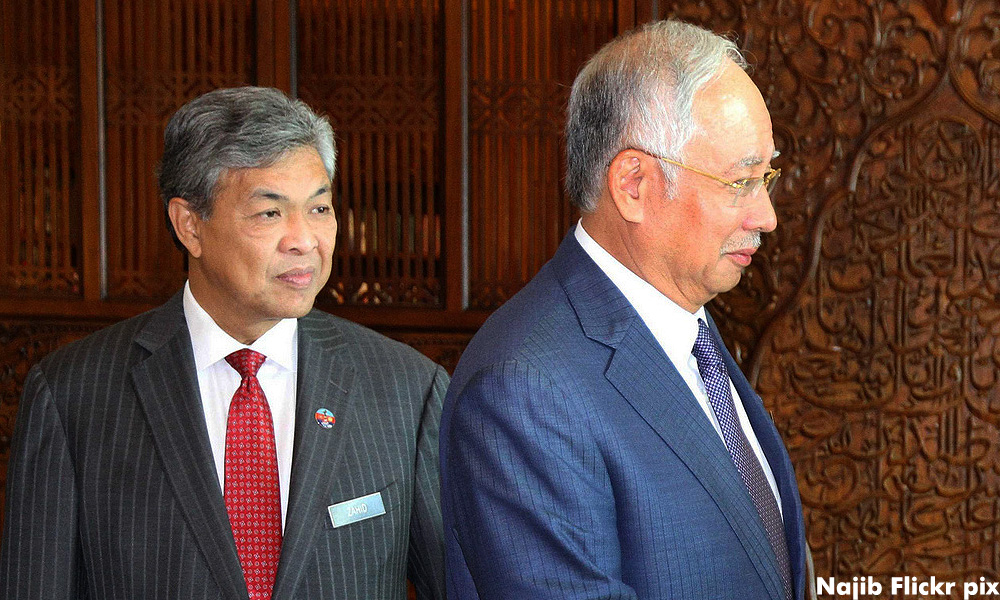
QUESTION TIME There would be three people in contention for the PM’s post after the 2018 general elections that we can see for now - current prime minister Najib Abdul Razak, his deputy after the previous deputy was ousted, Ahmad Zahid Hamidi, and an opposition person.
The opposition figure is likely to be opposition head Dr Wan Azizah Wan Ismail and may eventually turn out to be her husband Anwar Ibrahim, currently in jail, if he obtains a full royal pardon and gains a parliamentary seat in a by-election.
What we are trying to do is to assess the chances of these three figures to become PM in 2018, the year in which polls are most likely to take place, unless the unlikely event of an early polls happens. It would be unlikely because BN most probably won’t call polls early given their current low popularity.
How do the chances of the three stack up? We explained in an earlier article why we thought Najib would not last long and why he would most likely have to give up the mantle in favour Zahid.
According to news reports in October last year, only one of four Malaysians - or 23 percent to be exact - approve of Najib’s government. This is sharply down by about half from nearly one out of two, or 48 percent, in June 2014. Tellingly, Malay support about halved too, hitting a low of 31 percent from 60 percent in June 2014.
Our forecast is for Najib to step down ahead of the 2018 elections, perhaps a year ahead, and allow someone else to lead, almost certainly Zahid, after Muhyiddin Yassin was removed from the key posts of deputy prime minister and deputy Umno president.
The idea is that the new leader will not have the 1MDB baggage to lead Umno and BN into the elections. This will be reminiscent of Abdullah Ahmad Badawi taking over from an unpopular Dr Mahathir Mohamad in 2003 ahead of the 2004 polls when Abdullah chalked up the best election showing ever.
More recently, one is reminded of Adenan Satem and his handsome win at the Sarawak state polls after taking over as chief minister from Abdul Taib Mahmud whose popularity was waning...
QUESTION TIME There would be three people in contention for the PM’s post after the 2018 general elections that we can see for now - current prime minister Najib Abdul Razak, his deputy after the previous deputy was ousted, Ahmad Zahid Hamidi, and an opposition person.
The opposition figure is likely to be opposition head Dr Wan Azizah Wan Ismail and may eventually turn out to be her husband Anwar Ibrahim, currently in jail, if he obtains a full royal pardon and gains a parliamentary seat in a by-election.
What we are trying to do is to assess the chances of these three figures to become PM in 2018, the year in which polls are most likely to take place, unless the unlikely event of an early polls happens. It would be unlikely because BN most probably won’t call polls early given their current low popularity.
How do the chances of the three stack up? We explained in an earlier article why we thought Najib would not last long and why he would most likely have to give up the mantle in favour Zahid.
According to news reports in October last year, only one of four Malaysians - or 23 percent to be exact - approve of Najib’s government. This is sharply down by about half from nearly one out of two, or 48 percent, in June 2014. Tellingly, Malay support about halved too, hitting a low of 31 percent from 60 percent in June 2014.
Our forecast is for Najib to step down ahead of the 2018 elections, perhaps a year ahead, and allow someone else to lead, almost certainly Zahid, after Muhyiddin Yassin was removed from the key posts of deputy prime minister and deputy Umno president.
The idea is that the new leader will not have the 1MDB baggage to lead Umno and BN into the elections. This will be reminiscent of Abdullah Ahmad Badawi taking over from an unpopular Dr Mahathir Mohamad in 2003 ahead of the 2004 polls when Abdullah chalked up the best election showing ever.
More recently, one is reminded of Adenan Satem and his handsome win at the Sarawak state polls after taking over as chief minister from Abdul Taib Mahmud whose popularity was waning.
The most likely scenario is that Zahid will take Umno into the polls in 2018. If that happens, then what he will do is to distance himself from 1MDB, promise, if not the earth and moon, that corruption will be crushed and that he will usher in an era of good government governance and goodwill towards all that the country has never seen before.
The question is whether the country will buy such a pitch and be convinced that someone from Umno who clearly believes in the way that Umno operates with all its scheming, using racial and religious rhetoric to stay in power, and employing patronage and questionable practices to the hilt to enrich key party officials and selected businessmen.
The electorate has been taken in time and time again by such posturing ahead of the elections. The ruling party needs to be changed for any major advance in the government governance structure of the country and to stop the use of race and religion to inflame public sentiment, but will the voting public really think so?
That depends crucially on the strength of the opposition, now divided by the ongoing spat between key components DAP and PAS and even DAP and PKR while PAS splinter group Amanah has thrown another large wrench into the Pakatan Harapan machinery, reducing its hopes of becoming a ruling coalition. And how will the opposition get its message across?
More than even chance for opposition if...
We figure that if Najib steps down in favour of Zahid before the next polls, then there is a better than even chance that Umno and BN will win and the former will become the next prime minister of Malaysia.
But what if Najib does not step down? Considering that his popularity is already at an all-time low and that more and more is exposed day by day over the 1MDB scandal, including links to his stepson and new revelations of government-owned SRC International money going to those linked to flamboyant tycoon Jho Low, he is going to take a lot of flak.
The opposition will have a field day recounting everything wrong that Najib did and even if they do not get their act properly together, they may well be able to pull off a victory. Their chances of that could be better given the strong animosity that 1MDB has provoked in the hearts and minds of most Malaysians.
If Najib does not step down, the opposition has the best chance ever - a more than even chance - of knocking BN, which has been ruling the country uninterruptedly since independence in 1957, off their pedestal.
Overall, considering both possibilities of Najib stepping down and not, it would be fair to surmise that the opposition currently has an even chance of winning the 2018 polls, better odds than they have ever had before.
If they work harder, resolve their differences and cooperate on a common platform of bringing about better government governance and emphasise nation building, then those odds will increase significantly in their favour. But if they allow differences to increase, the odds will move against them.
For those who are more numerically inclined, here’s how we worked out the scenario. We figure that the chances that Najib will step down ahead of the polls is better than even, let’s say 60% - you may not agree but you can use your own figures for the analysis to see how differently the results turn out.
That means 40 percent or 0.4 probability that Najib will lead. If he leads, we guess that his chances of winning in 2018 are only 40 percent or 0.4 (again you can use your own figures for this). In probability theory, we multiply the probability of each event to get the likelihood that Najib will be PM and that works out to 16 percent or a probability of 0.16 (0.4 X 0.4).
The probability that Zahid will lead is 0.6. And we guess in that event, the probability of BN winning increases to 0.6 or 60 percent from 40 percent. Multiply that out and the probability of Zahid being PM is 0.36 (0.6 X 0.6) or 36 percent.
Note that under this scenario the chances of either Najib or Zahid being PM is the sum of their two individual probabilities, that is is (0.16 + 0.36) or 0.52 or 52 percent. That leaves the chances for an opposition leader, that is Wan Azizah or eventually Anwar at 48 percent or a probability of 0.48.
In an analysis like this, and all the errors that are likely, we think 52:48 represents about even odds. Let’s see what the opposition does with such odds and whether they work from right now to increase their odds in the next two years!
P GUNASEGARAM is hoping that the odds go in favour of the country at large.


Are you sure you want to delete this comment?
This action cannot be undone.