




Wolfowitz as World Bank chief - what to expect
 President George W Bush's nomination of Paul Wolfowitz as World Bank president - coming hard on the heels of his nomination of an ardent opponent of the United Nations to be America's UN ambassador - was bound to stir up a storm.
"Will the World Bank now start invading countries?" the wags ask in Washington.
It is inevitable that comparisons are drawn with President Lyndon B Johnson's dispatch of Robert S McNamara, then secretary of defence, to the World Bank in 1967 and much reviled for his role in the war in Vietnam. But there is a world of difference and the comparison demeans McNamara.
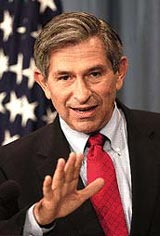 President George W Bush's nomination of Paul Wolfowitz as World Bank president - coming hard on the heels of his nomination of an ardent opponent of the United Nations to be America's UN ambassador - was bound to stir up a storm.
"Will the World Bank now start invading countries?" the wags ask in Washington.
It is inevitable that comparisons are drawn with President Lyndon B Johnson's dispatch of Robert S McNamara, then secretary of defence, to the World Bank in 1967 and much reviled for his role in the war in Vietnam. But there is a world of difference and the comparison demeans McNamara.
McNamara was famous as a 'whiz kid' president of the Ford Motor Company before President John F Kennedy brought him to Washington in 1961 to run the Pentagon. Forty years later and well into his 80s he was still a formidable intellect in Washington; at a dinner discussion on environmental issues two years ago I watched him checking the figures of the presenter on his own calculator and presenting contrary conclusions.
During the Kennedy and Johnson years, he dealt routinely with heads of state and government and had a standing throughout the world, tarnished as it may have been by Vietnam, of which Wolfowitz can only dream. He went on to become a great force at the World Bank for new approaches to development, including using loan leverage to induce countries to reduce military expenditures.
True, he had let his whiz-kid capabilities delude him about the ease with which America might fight a war in Southeast Asia, which is where the comparison with Wolfowitz begins and ends. But by the time Johnson had sent him to the Bank, he had realised his horrible mistake - and wanted to undertake constructive development work. It was almost contrition.
Survival skills
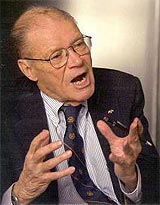 No one would accuse Wolfowitz of stupidity, but the comparison with McNamara (photo) is a step-level confusion. Wolfowitz, until Bush, was a mid-level policy intellectual, perhaps in history mostly famous (in Bush the father's Pentagon) for helping to lay the foundations for new American doctrine designed, as it turned out, mostly to permit Washington to redesign the Middle East in a way favourable to Israel.
He was a student of a great strategist at the University of Chicago, Albert Wohlstetter, but there is no academic opus associated with his career in and out of think-tanks.
What he has shown is survival skills, which no one downplays in Washington. He skillfully jumped from job to job in the Reagan-Bush years, and then landed a deanship of a small graduate school in Washington affiliated with Johns Hopkins University. There his survival skills were most notable in the alleged covering up of what could have been a career-ending scandal.
According to three sources there, two of which had personal knowledge, there was a question of sexual harassment, through his involvement with a student, parallels for which were lethal in that period throughout academe. He was then looking to the job of secretary of defence, and powerful forces allied with him must have intervened to contain the damage.
The wonder is that the story never hit the news: too many journalists with knowledge of it knew just how ruthlessly the 'new gang' in Washington played politics. They wanted to preserve sources.
But leave Wolfowitz's personal life aside; he had at that time endured a divorce and saw the great opportunity for the neo-conservative cause with which by then he was intimately associated. No wonder he must have moved mountains to manoeuvre himself into high position. But this is where the problem begins.
Wolfowitz entered the Pentagon not only with an agenda but with allies intent on carrying it out. The papers they had written in the Bill Clinton interval derived from the strategies they had devised in the first Bush presidency for an aggressive American military capability particularly in the Middle East.
Doug Feith, who has now 'retired' from the job Wolfowitz held in Bush I, to return to his lucrative-and military-related-legal practice, and Richard Perle, long a public supporter and sometime consultant to Israel, with Wolfowitz took every opportunity to manoeuvre American policy into the invasion of Iraq that has led-whatever else it has done-to an almost cataclysmic fall in American standing and prestige throughout the world. Wolfowitz even went so far as to admit that the 'weapons of mass destruction' excuse for the war was chosen merely as the most convenient handle.
Wolfowitz's boss, Donald Rumsfeld, arrived without agenda. He was a mechanic of strategy who thought he could fight wars more efficiently with fewer troops. He just hadn't any idea of what wars and for whom and what. The now notorious threesome, Wolfowitz, Perle, and Feith gave him an agenda that he was only too happy to endorse.

 Vice-president Dick Cheney (
left
) was on board too, and together with their frequent guest Israeli Prime Minister Ariel Sharon (
right
), to whom was virtually delegated control over American Middle East policy in the first George W Bush term, they pulled the president on board for a long and thankless war.
Vice-president Dick Cheney (
left
) was on board too, and together with their frequent guest Israeli Prime Minister Ariel Sharon (
right
), to whom was virtually delegated control over American Middle East policy in the first George W Bush term, they pulled the president on board for a long and thankless war.
Remains unrepentant
The failures in Iraq are far more those of Wolfowitz than of Rumsfeld. Normally, it is in the deputy secretary's office that oversight of plans for implementation of programmes takes place.
The appalling failure to foresee the grim war in Iraq once president Saddam Hussein was toppled, not even having plans to protect the infrastructure much less five millennia of priceless museum treasures, is Wolfowitz's failure.
The garlands of flowers with which American forces were to be met, according to the nominee, shows just how little he understands reality in the 'Third World'.
So to associate Wolfowitz, who remains unrepentant over the disasters over which he presided in Iraq, with McNamara, who arrived at the Bank charged up with innovative ideas for development, is to do a great disservice to truth. Perhaps Wolfowitz can follow McNamara, if he wins acceptance at the bank, in converting great energies to constructive causes.
But to consider the two Pentagon officials in the same league is to know little of the game and its levels. McNamara was a failed world-class intellectual and statesman who retrieved his reputation with great works.
Wolfowitz, from a much lower level of import, still thinks his invasion of Iraq was the right thing. It's rather an imposition on the World Bank to force it to digest as president a man who is world-class only in his chutzpah .
W SCOTT THOMPSON, an adjunct professor of international politics at the Fletcher School of Law and Diplomacy, Boston, is a former assistant secretary of state for the Ronald Reagan administration. He also served as Donald Rumsfeld's assistant at the Pentagon in 1975-76. He lives in Bali and Washington DC.


Are you sure you want to delete this comment?
This action cannot be undone.