




Abdullah CD - CPM's Malay front
Unlike Suriani Abdullah and Rashid Maidin, Abdullah CD, 81, did not have 'exciting' personal experiences to tell, yet his story is critical to an alternative understanding of the history of Malaysia and the Communist Party of Malaya (CPM) since the outbreak of the Pacific War in 1941.
The chairman of CPM since August 1988 has written two Malay-language books on the history of the anti-colonial struggles of the Malay Left and communist party. Perang Anti-British dan Perdamaian ( Anti-British War and peace ) and Darurat dan Kemerdekaan, 1948-1998 ( The Emergency and Independence ) were published in Hong Kong in 1998. Both books had been translated into Chinese.
It is learned that Abdullah CD - whose full name is Cik Dat Anjang Abdullah - has also complete the draft of his personal memoirs in Bahasa Malaysia.
Born in Lambor Kiri, Parit, Perak in October 1923, Abdullah's family was poor. However, he was not only hardworking but also intelligent enough to complete his Standard 7 in Kuala Kangsar's Clifford English School. Before that, he attended the Malay primary school in Parit and English intermediate school in Tapah.
So, even before the outbreak of the Pacific War in 1941, Abdullah was already bilingual. Later, he also learnt Chinese and married to a Chinese, Suriani @ Eng Ming Ching.
Unlike Suriani Abdullah and Rashid Maidin, Abdullah CD, 81, did not have 'exciting' personal experiences to tell, yet his story is critical to an alternative understanding of the history of Malaysia and the Communist Party of Malaya (CPM) since the outbreak of the Pacific War in 1941.
The chairman of CPM since August 1988 has written two Malay-language books on the history of the anti-colonial struggles of the Malay Left and communist party. Perang Anti-British dan Perdamaian ( Anti-British War and peace ) and Darurat dan Kemerdekaan, 1948-1998 ( The Emergency and Independence ) were published in Hong Kong in 1998. Both books had been translated into Chinese.
It is learned that Abdullah CD - whose full name is Cik Dat Anjang Abdullah - has also complete the draft of his personal memoirs in Bahasa Malaysia.
Born in Lambor Kiri, Parit, Perak in October 1923, Abdullah's family was poor. However, he was not only hardworking but also intelligent enough to complete his Standard 7 in Kuala Kangsar's Clifford English School. Before that, he attended the Malay primary school in Parit and English intermediate school in Tapah.
So, even before the outbreak of the Pacific War in 1941, Abdullah was already bilingual. Later, he also learnt Chinese and married to a Chinese, Suriani @ Eng Ming Ching.
Radical Malay anti-colonial group
According to his biographical note printed in the party's publications, Abdullah had since at a young age was inspired by the war launched by legendary nationalist Maharajalela against the British for seeking control over Perak in the 19th century. His idealism was put into practise when the Japanese invaded and occupied Malaya as his education was interrupted.
Abdullah joined the communist-led Malayan People's Anti-Japanese Army (MPAJA) after breaking off with the pro-Japanese elements of his original organisation, Kesatuan Melayu Muda (KMM), or the Young Malay Union, which was also a radical anti-colonial group. Before Abdullah joined the MPAJA, he was the secretary of KMM's Lambor branch.
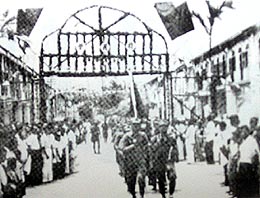 "Not too long after the Japanese occupied Perak, some members of the 5th Independent Regiment of MPAJA had already established some footholds in Lambor, which was a predominantly Malay area. We first joined the Anti-Japanese League before integrating ourselves into MPAJA," Abdullah recalled.
"There were about 100 Malays in the Parit area who became armed MPAJA personnel... Besides protecting the people, we also help them to renovate mosques and organise them to produce food... We boosted the spirit of the people and they became the eyes and ears for MPAJA.".
Abdullah also remembered that his unit in Parit protected the people not only from Japanese soldiers but also common criminals as well as some rogue Kuomintang (China's right-wing Nationalist Party) elements who, on the pretext of engaging in anti-Japanese activities, were actually bandits who stole, robbed and raped.
He also recalled several combat engagements with Japanese troops - in which he was personally involved - along the Perak River.
According to USM historian Professor Abu Talib Ahmad, some other Malay MPAJA personnel were Abdullah Mahmud, Janas, Yatim, Ariffin Chu Yusof, Yeop Tako Kulub Jaya and Putih Mahmud. (see The Malay Muslims, Islam and the Rising Sun, 1941-1945 , Kuala Lumpur, MBRAS, p 125)
On the racial conflicts that occurred immediately after the war had ended, Abdullah blamed it on the "insidious designs" of both the Japanese fascists and British colonialists who attempted to divide and rule by pitting one ethnic community against another, and also by "defaming the MPAJA".
"I have put down my strong observation in black and white in my book Perang Anti-British dan Perdamaian ," he said.
Crackdown on left-wing nationalists
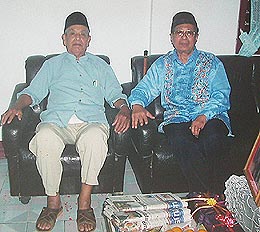 After the war had ended, Abdullah (
photo, right
) also engaged in open activities to accelerate the process of Malaya's independence. For example, in late 1945, he was with Suriani, Rashid Maidin (
photo, left
) and R G Balan in a CPM/MPAJA publicity team touring various places in Perak.
After the war had ended, Abdullah (
photo, right
) also engaged in open activities to accelerate the process of Malaya's independence. For example, in late 1945, he was with Suriani, Rashid Maidin (
photo, left
) and R G Balan in a CPM/MPAJA publicity team touring various places in Perak.
In October 1945, Abdullah and his friends like Mokhtaruddin Lasso, Dr Burhanuddin al-Helmy, Ahmad Boestaman and Ishak Mohamad inaugurated the Malayan Malay National Party, or Parti Kebangsaan Melayu Malaya (PKMM).
That was several months before the formation of another rival party, the United Malay National Organisation (Umno). Later, while Umno was accepted by the British colonialists, PKMM was banned and many of its leaders and members, including Abdullah himself as well as Rashid Maidin, arrested under the 'Emergency' regulations in 1948.
Meanwhile, Abdullah was also active in the trade union movement and was elected a vice-president of the Pan-Malayan Federation of Trade Unions (PMFTU). PMFTU, like PKMM, was banned at the outset of the 1948 'Emergency'. PMFTU's president S A Ganapathy was hanged for allegedly being in illegal possession of firearms and his assistant, Veerasenan, was shot dead on May 3, 1949. Another CPM leader and trade unionist, R G Balan, was detained in 1948 and not released until 1961.
In 1947, Abdullah, together with Dr Burhanuddin al-Helmy, led a Malayan delegation to attend the All-Asia Conference held in New Delhi in India to voice their opposition to British colonialism and struggle for independence. Burhanuddin, an Indian-educated Malay nationalist, later became president of PAS.
In July 1848, Abdullah, together with hundreds of Malays who worked closely with CPM for independence, were detained under 'Emergency' regulations. Like Rashid Maidin, he also escaped into the jungle.
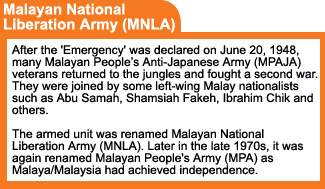 On May 21, 1949, Abdullah, with the blessing of CPM leader Chin Peng, recruited enough Malay nationalist and leftist forces to inaugurate the Malay-majority 10th Regiment of the Malayan National Liberation Army (MNLA) - the communist party's armed unit - in Kerdau, near Temerloh in Pahang.
"When there was no more peaceful avenue and we were persecuted, we had no other option but to fight," said Abdullah.
Poisoned by 'enemy agents'
In 1953-1954, Abdullah led the 10th Regiment to retreat into the Malaysian-Thai border. A year later, he was elected a member of party's central committee and also appointed a member of the powerful politburo. After the defection of former CPM chairman Musa Ahmad, Abdullah was made the CPM chief.
A few years later, Abdullah was one of the three CPM signatories to the 1989 Peace Accords.
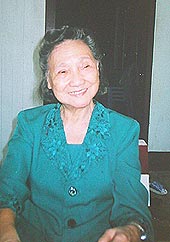 During the 'Emergency', Abdullah was once seriously injured by grenades. According to an account related by his wife, Suriani (
photo
), the couple was poisoned by "enemy agents" in southern Thailand in Sept 1975. As the result of poisoning, Abdullah lost his ability to speak properly for two years.
During the 'Emergency', Abdullah was once seriously injured by grenades. According to an account related by his wife, Suriani (
photo
), the couple was poisoned by "enemy agents" in southern Thailand in Sept 1975. As the result of poisoning, Abdullah lost his ability to speak properly for two years.
Abdullah CD married Suriani in February 1955 whom he met in Ipoh immediately after the liberation of the Perak's town. They gave birth to a daughter who later worked for the party's China-based clandestine radio station, Voice of the Malayan Revolution . The daughter later married a Singaporean Malay and gave birth to a daughter who is now 13 years old.
Living now with his wife, children and grandchildren, Abdullah seems assured of his contribution to the struggle for the freedom of Malaya from British colonialism and Japanese fascism.
Tomorrow: Abu Samah - the ex-British child soldier
JAMES WONG WING ON is chief analyst of Strategic Analysis Malaysia. He is a former DAP member of parliament for Kampar (1990-1995) and a former columnist for the Sin Chew Jit Poh Chinese daily (now Sin Chew Daily). He read political science and economics at Monash University in Melbourne, Australia.


