




Singapore - a modern 'dictatorship?
Since Singapore's Prime Minister Lee Hsien Loong took over from his predecessor Goh Chok Tong, there has been an expectation that Lee would be 'softer' and 'more liberal' than his father, Lee Kuan Yew, but there is also an observation that Goh is more 'liberal' in personal temperament.
 Do these differences in personal traits and characteristics matter in the highly organised machinery of the state and ruling party in Singapore?
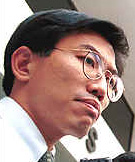
Singapore's opposition leader, Dr Chee Soon Juan speaks to malaysiakini about the unchanged ideological climate, propaganda and power structure in the nation run by the Peoples Action Party (PAP).
Since Singapore's Prime Minister Lee Hsien Loong took over from his predecessor Goh Chok Tong, there has been an expectation that Lee would be 'softer' and 'more liberal' than his father, Lee Kuan Yew, but there is also an observation that Goh is more 'liberal' in personal temperament.
 Do these differences in personal traits and characteristics matter in the highly organised machinery of the state and ruling party in Singapore?
Singapore's opposition leader, Dr Chee Soon Juan speaks to malaysiakini about the unchanged ideological climate, propaganda and power structure in the nation run by the Peoples Action Party (PAP).
Malaysiakini: There is an observation that, while both Singapore and Hong Kong share many similarities like ethnic and cultural backgrounds, the relatively widespread use of English, colonial past, economic foundation and structure as well as prosperity, people in Hong Kong are relatively more vocal, critical, human rights-conscious and willing to defend democracy publicly. Do you think the contrast is true? If so, then what are the causes of the differences?
Chee : The level of dynamism and energy of the Hong Kong and Singapore societies differ like day and night. While the people of Hong Kong are risk takers and fiercely protect their society (against the Beijing government for example), Singaporeans have been conditioned into thinking that without the PAP Singapore will self-destruct. One society has thrived on freedom and the go-getter attitude, and the other on government direction. No prizes for guessing which society will make it in the longer run.
It is said that Malay and Indian Singaporeans are sometimes marginalised in the country's policy-making process, especially those concerning language and education. Is this true? If so, how can the situation be rectified?
I have several Malay and Indian colleagues and friends, and met many more Indian and Malay Singaporeans. A majority of them have indicated that racist policies are institutionalised by the PAP. Because it is political taboo to bring up such issues, society goes on thinking that everything's ok. On the surface it is. Without any public acknowledgment of the problem and attempts to understand the situation of the minority groups, very little can and will be done. The first step to overcoming this problem is to allow open debate on the issues affect the minority groups. All we are doing at the moment is to repress the issues. In reality they haven't gone away.
To what extent is the geopolitical reality that Singapore is a small and vulnerable non-Muslim predominated city-state located between two Muslim giant neighbours contributes to the making of a 'siege mentality' among Singaporeans that see law, order and security as being of higher value than freedom, human rights and democracy?
This is the biggest insult to Singaporeans, that is, the continued beating into our heads that just because our neighbours are predominantly of a different skin-colour, that they are somehow are just waiting for the time to conquer us and make us their slaves.
This is the argument that the PAP is fond of making. It is the most effective weapon to rally the people against an external threat. Unfortunately what is needed are more open political systems where peoples from the region can open exchange views and opinions. This is the best tool to ensure that no major misunderstandings come in between the peoples.
Many observers of Singapore's politics, including Americans, Australians and Europeans are privately puzzled or even incensed by what they perceive to be Singapore's ruling politicians' 'obsessive vindictiveness' against opposition leaders and dissidents like in the legal case against Tang Liang Hoong. Do you think the observation is true? If so, then what are the reasons?
They are puzzled only because they don't realise that the PAP, for all intents and purposes is a dictatorship. Dictatorships are uncomfortable with change and challenges to their authority. They cannot get away from the need to crush all opposition and dissent. The PAP is no different. It is also acutely aware that if they allow more vocal oppositionists in Parliament, more skeletons in the PAP closet will be exposed and it cannot afford that.
Do you think the electoral system and process in Singapore is free and fair? If not, what room is there for reform?
What I think is not as important as what neutral organisations have concluded. The Freedom House says that "citizens of Singapore cannot change their government democratically".
There is an observation that the opposition in Singapore, which is already weak, is also not united or co-ordinated enough to mount serious a challenge to the PAP? Is this observation true?
Very true. Given everything that has gone on over the last four decades and more since the PAP came into power, it would be surprising if the opposition isn't in the state that it is in. With the elections system, media, laws, and ISA the way they are, there is no way that the opposition can be any stronger. Conversely it is through such undemocratic means that the PAP has made itself seem invincible. But I am reminded, as it has been proven true time and again in recent history, that dictatorships always looks good until the very last minute.
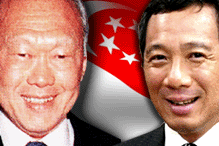 There been an expectation that Prime Minister Lee Hsien Loong is 'softer' and 'more liberal' than his father Lee Kuan Yew, but it is also said that the former premier Goh Chok Tong was even much 'softer' and 'more liberal'. How do you see the new administration of Hsien Loong as compared to those of Kuan Yew and Goh in the past?
Goh is softer and more liberal? I can point out a whole list of developments and events to demonstrate why this is completely untrue. Conversely, whenever I ask people to say how Singapore has become more liberal under Goh's tenure, they are stumped. Why anyone thinks that Hsien Loong would behave any differently from his father befuddles me. No dictatorship has voluntarily and out of goodwill relinquished its power. Political, economic, and social pressure from within the country as well as outside need to be brought to bear on the regime before changes will occur. Anything else is wishful thinking.
How powerful or influential is Kuan Yew still politically?
No one in the establishment will admit that he is a liability if only because he still has his hands on all the important levers of power. No major policy still goes through without his assent. But as long as he continues to run the country as if he was still in the midst of battling the communists, which he never fails to reminisce aloud to Singaporeans, the country is not going to realise its full potential. And given the speed at which global events change, this is very worrying.
Part 2: Singapore - republic of fear


Are you sure you want to delete this comment?
This action cannot be undone.