


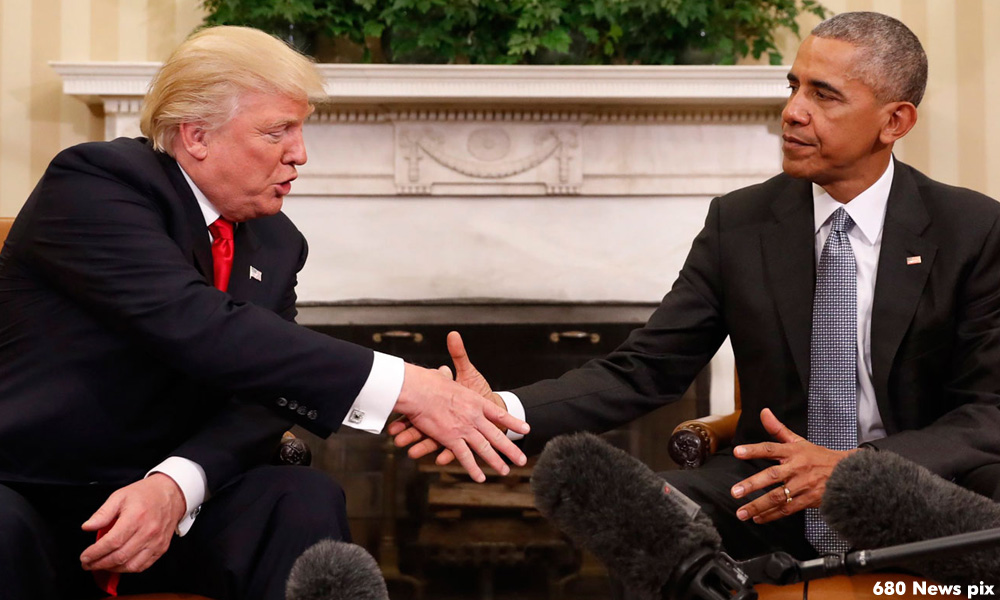

Ascendancy of racial politics - Trump’s predictable victory
The majority of pundits and sophisticated analysts across the globe were shocked by Donald Trump’s victory on Nov 8, describing it as one of the greatest upsets in modern times. The pollsters once again got it absolutely wrong, calling into question their very existence.
Trump’s remarkable victory saw him defeat 16 candidates to secure the Republican nomination with some 14 million votes, which increased to an amazing 60 million votes and 290 electoral college votes to secure the US presidency. Along the way, he carried 30 states in the Union. But I suggest that anyone closely following the 18-month campaign (which Trump calls, with much justification, a “movement”) is not surprised.
So, how did a person who has never held public office, never run for office and is incredibly unqualified and unfit for high office, pull off this remarkable victory? Obviously, there are numerous causes. It is always over-simplistic to attribute a single reason to explain a complex issue.
I suggest that one of the principal reasons was that the majority of white voters, who represented 70 percent of the voters, voted for him: they understood Trump’s code that to make America great means to make “white America great” and the wall on the Mexican border is a euphemism to keep all non-whites out of the country from henceforth.
Hence, race played a pivotal, pre-dominant role in these elections. The race card worked. Race trumped ideology, class, gender and every other issue. If “it’s the economy, stupid” that captured the essence of a previous presidential election, then it is “it’s race, stupid” that is the telling phrase for the 2016 election...
The majority of pundits and sophisticated analysts across the globe were shocked by Donald Trump’s victory on Nov 8, describing it as one of the greatest upsets in modern times. The pollsters once again got it absolutely wrong, calling into question their very existence.
Trump’s remarkable victory saw him defeat 16 candidates to secure the Republican nomination with some 14 million votes, which increased to an amazing 60 million votes and 290 electoral college votes to secure the US presidency. Along the way, he carried 30 states in the Union. But I suggest that anyone closely following the 18-month campaign (which Trump calls, with much justification, a “movement”) is not surprised.
So, how did a person who has never held public office, never run for office and is incredibly unqualified and unfit for high office, pull off this remarkable victory? Obviously, there are numerous causes. It is always over-simplistic to attribute a single reason to explain a complex issue.
 I suggest that one of the principal reasons was that the majority of white voters, who represented 70 percent of the voters, voted for him: they understood Trump’s code that to make America great means to make “white America great” and the wall on the Mexican border is a euphemism to keep all non-whites out of the country from henceforth.
Hence, race played a pivotal, pre-dominant role in these elections. The race card worked. Race trumped ideology, class, gender and every other issue. If “it’s the economy, stupid” that captured the essence of a previous presidential election, then it is “it’s race, stupid” that is the telling phrase for the 2016 election.
Anyone with even a cursory knowledge of the United States will be aware of the critical function of race in its history. After all, they have still not come to grips with the issue of genocide of the Red Indians, the original sons of the soil.
That was followed by the brutality of slavery, which although nominally abolished in 1865 after the Civil War, continued to enslave millions of blacks, particularly in the Deep South where Ku Klux Klan and mob lynching were part of everyday life.
It was only after the landmark decision of the US Supreme Court in Brown vs Department of Education in 1954 that segregation in schools was outlawed. Martin Luther King’s non-violent movement led to the Great Society reforms by President Johnson in 1965, but their implementation was always problematic because it was left to individual states.
A more recent example is the Rodney King beating, famously captured in film, which led to rioting, and also played a seminal part in the acquittal of OJ Simpson, which again divided the nation on racial lines. The current expression of black protest is the Black Lives matter “movement”.
The blacks were never a force
Until the election of Barrack Obama in 2008, the majority whites were not unduly threatened by blacks in the political arena. They were kept in their place. They represented about 15 percent of the population, and slightly less on the electoral roll. The blacks were never a force nationally, and in the few states where they held the balance between Republicans and Democrats, the Republicans would suppress the vote to ensure that as few blacks as possible voted.
 Obama’s residence in the White House traumatised and alarmed the majority of the white electorate, for whom that symbol of power and prestige could not be occupied by a non-white. If such base feelings were actually held by white voters, how then did Obama succeed twice? Perhaps for two reasons: First, after two terms of Bush, the electorate desperately wanted a change. Secondly, both John McCain and Mitt Romney did not engage in blatant racists campaigns, as Trump did in 2016.
To compound matters, Obama is a relatively successful president, who brought dignity to the office. Even his harshest critics would concede that no personal scandal tarnished his presidency, and despite deep hostility from a Republican-controlled Congress, Obama enacted some decent laws. Such a measure of success unfortunately heightened racial animosity, particularly in the Rust Belt. Envy that a black man, who in their eyes is inferior, could actually discharge the duties of high office efficiently deepened the hatred of the red-necks.
Thus, when Trump began his campaign in 2014, he was astute to understand the deep-seated anger and resentment of white voters. The conditions were ripe, and he tapped into them. He also skilfully exploited the brutality and cruelty of ISIS beheading innocent victims and their bombings and murders in Western Europe between 2014 and 2016.
Extreme hate speech against all Muslims
The Syrian refugee problem too was fodder to Trump’s polemic. His extreme hate speech against all Muslims because of the deeds of a tiny group of murderers killing in the name of Islam resonated not just with the whites, but also with non-Muslim Asians, who made-up four percent of the voters in the recent elections, blacks and Latinos. Thus, the minorities who voted in impressive numbers for Trump despite his extreme position against them, may have done so because of his tough position on Muslims.
And finally, Trump’s bigotry against Latinos, which is not confined to the illegals in the United States. It includes pillars of the establishment, like the Mexican-born judge who was assigned to hear one of the multiple cases pending in the courts against Trump and his companies.
History often records people voting against their own self-interest. Millions of non-whites voted for Trump despite his clearly toxic attitude to them. Likewise, women voters. Trump’s misogyny is unparalleled in modern elections where half the voters are women, that is, the targets themselves. Yet nearly half of these victims voted for him. How does one rationally explain such a phenomenon of lambs being led to slaughter, willingly and voluntarily?
It is critical to keep in mind that race, ethnicity and religion have been exploited throughout history. Appealing to the majority in a society containing minorities of a different colour or other identifying features often succeeds. We just need to remember the best known example in the 20th Century: Hitler’s Nazi party gained millions of votes in multiple elections prior to his coming to power in 1933.
Hitler’s violent tirades against Jews, gypsies and other non-Aryans were popular with the majority German electorate. Although he abolished elections after becoming Fuhrer, the Nazis would have comfortably won elections if they had been held in the period 1933 and 1939, despite the concentration camps and violence against the minorities. A current example of a majority in a plural society voting along religious lines is Narendra Modi’s BJP party, which won the Indian general elections by a large margin in 2013 by appealing to the Hindu majority.
Race overshadowing every other factor
Malaysians should be the last people to be surprised about Trump’s racist remarks and his success in appealing to voters along ethnic lines. Malaysia is the perfect example of race overshadowing every other factor in politics and elections.
When Onn Jaafar recommended in 1951 that Umno should open membership to non-Malays, he was severely attacked, and he resigned. That call has never been repeated in the following 65 years. Tunku Abdul Rahman, his successor, realised that political parties have to be communal in our plural society.
MCA and MIC quickly joined Umno to form the Alliance coalition, which broadened to the Barisan Nasional in 1972. Malaya secured Merdeka in 1957 and Malaysia was established in 1963 on the back of racial politics. Sabah and Sarawak were brought into the federation to counter the Chinese in Singapore.
Thirteen general elections have so far been fought in the country on racial lines, with the races voting predictably along clearly demarcated racial lines. It is the absolute norm in Malaysia. And obviously, it has not resulted in any moral opprobrium in Malaysia.
Hence, Trump, without knowing it, was only following the very successful Umno model (no one takes MCA and MIC seriously today), and with tremendous acumen and skill exploited it to the maximum in the United States. So what is blatant and open in Malaysia, is subtle and covert in the United States. But with Trump, no longer so!
A student of history will appreciate that it cascades between peaceful times and difficult periods, sometimes even culminating in wars. The previous century was one of the bloodiest, with two world wars. Claims by societies of racial superiority propelled some of these wars.
Nationalism, which is inherently reasonable and acceptable to differentiate the 200-odd countries that make up the United Nations, should not descend into jingoism, chauvinism or outright racial superiority. Such a descent threatens regional and global security.
Le Pen in France and the neo-Nazis in Germany and Holland will be much encouraged by the Trump victory. The concern for all of us is when the most powerful nation in the world, with the strongest armed forces, enjoying the sole monopoly to print the mighty US dollar at will (as it has since the 2008 global financial crisis) is presided by a demagogue who has demonstrated authoritarian tendencies while simultaneously displaying the racial card, how that nation would actually be governed by him.
How are the non-white minorities in the United States going to be treated in the next four years? What about Trump’s conduct of foreign policy? Finally, can he be trusted with the nuclear button? We certainly live in interesting times as we watch Trump take and exercise power.
TOMMY THOMAS is a senior lawyer, who occasionally writes on political and economic matters.


Are you sure you want to delete this comment?
This action cannot be undone.