




Catch-22, Mr Sothinathan
The foundations of Barisan Nasional (BN) are deeply rooted in communal politics. Race-based parties are the norm in Malaysia. Although in certain societies, such a framework would invoke disdain.
Umno for the Malays (with some minor exceptions), MCA for the Chinese and MIC for the Indians - is the simple and accepted equation in the ruling front.
This formula becomes a tad more complicated when political parties in Sabah and Sarawak are included in the calculation.
Some might disagree, but one certainty in Malaysian politics is that no matter what the party, whichever side of the divide, whatever corner of the country, race is an inescapable and unignorable factor.
This is why the phrase 'Catch-22' (a no-win situation) - coined by the eminent author Joseph Heller - unceremoniously stamped its mark on S Sothinathan.
The foundations of Barisan Nasional (BN) are deeply rooted in communal politics. Race-based parties are the norm in Malaysia. Although in certain societies, such a framework would invoke disdain.
Umno for the Malays (with some minor exceptions), MCA for the Chinese and MIC for the Indians - is the simple and accepted equation in the ruling front.
This formula becomes a tad more complicated when political parties in Sabah and Sarawak are included in the calculation.
Some might disagree, but one certainty in Malaysian politics is that no matter what the party, whichever side of the divide, whatever corner of the country, race is an inescapable and unignorable factor.
This is why the phrase 'Catch-22' (a no-win situation) - coined by the eminent author Joseph Heller - unceremoniously stamped its mark on S Sothinathan.
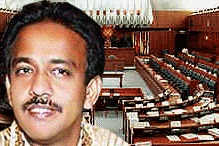 He represented the concerns of his party and community in an institution where the powers-that-be expect the interests of the government - and that of the largest party in the ruling coalition - to have overriding prominence.
For a brief moment, Sothinathan cast aside his deputy ministership and donned the hat of MIC secretary-general instead, a decision that soon proved to be costly.
He gallantly defended the community in Parliament and brazenly questioned the government on why it had singled out Indians on the issue of unrecognised medical students.
His boldness received widespread media coverage and feathers were ruffled. Twenty-four hours later, his wings were clipped.
The cabinet decided to slap the fledgling politician with a three-month suspension from his deputy minister's post.
If he had chosen to remain silent, the Indian grassroots would have been annoyed that their leaders had been cowed into submission, and their critics would have gone for the jugular.
Hence, Sothinathan made a choice and he is bleeding for it.
Racist, racist, racist...
On the same day the MIC politician dug his grave, another agitated government minister repeated the words 'you are a racist' like a mantra in the Dewan Rakyat over the same issue.
 This was none other than the minister-in-charge of parliamentary affairs, Nazri Abdul Aziz, whose temperature peaked when an opposition leader reportedly alluded that former education minister Musa Mohamed was a racist.
When told to withdraw his remark, the enraged minister responded: "I will not revoke it. You are a racist".
He kept shouting the same words - about 40 times in both English and Bahasa Malaysia - as he made his way out from the floor.
Now for a country that prides itself on how racially united its citizens are, accusations of racism or such practice taking place, are rather unsettling.
But to one observer, who claims to view local politics from a pragmatic vantage point, this does not come as a surprise.
"This is the political reality of Malaysia. I would be surprised if such incidents do not occur."
Harsh and undemocratic
Coming back to Sothinathan. To suspend a deputy minister for raising an issue of public concern, which is something expected of an elected representative in Parliament, was harsh and undemocratic.
Instead of addressing his questions, the government chose to punish him for being vocal, or as the pragmatic observer put it, 'forgetting his place'.
By suspending him, will the government exorcise the spectre of racism and prevent it from haunting us again?
Will this move allay, or on the contrary, serve to further fuel such sentiments and grouses?
Was it wise for the ruling front that never tires of using racial harmony as its trump card to bring the guillotine down on a leading politician of a race-based party over an issue concerning his community?
These are some of the questions Prime Minister Abdullah Ahmad Badawi and his administration must face.
On the ground, the episode is viewed simply as one Indian politician being hammered by his Malay superiors for his outspokenness.
This perception does not bode well for a multiracial Malaysia. But as long as politics is defined along the lines of race and religion, such incidents will recur.
In a pluralistic society such as ours and after decades of rhetoric on unity, it would have been ideal if non-Indian politicians had come out strongly against the issue of unrecognised medical students.
Or for that matter, if Sothinathan had demonstrated the same kind of courage for issues affecting other races.
To be fair, there have been instances when politicians here stepped across racial lines to champion a cause.
But sadly, this does not happen often enough.
RK Anand is a member of the malaysiakini team.


