




Haze: The facts you should know
The haze is back - and with a vengeance. The air quality in Kuala Lumpur today is far worse than it was when I was the United States ambassador in 1997, the last time that KL's beautiful skyline disappeared in the smog for over two months.
 Prime Minister Abdullah Ahmad Badawi's government should be congratulated for lifting the "national security/top secret" embargo on the air pollutant index. But telling the people what the API number is only confirms what everyone's body already knows. All you have to do is look at the air and take a deep, smelly, and unhealthy breath, and you know that something is wrong.
When I read malaysiakini 's many articles on the "haze" the past few days, I was surprised that many people say they do not know what to do about the haze or how to protect themselves - even though the haze has returned many times since 1997.
Malaysians have an absolute right to be angry with the Indonesian government, which year after year has allowed its farmers - and more importantly, its timber companies - to take the cheap way out and burn the land, rather than spending the extra time and money that would be required to clear it with machinery and labour, rather than fire.
But being angry at the Indonesians doesn't answer the question of how to protect yourself today.
In 1997 we spent a great amount of time at the US embassy studying the "haze" in order to decide what to do to protect our employees and our families, both American and Malaysian, from a potential health threat. We consulted a number of US government agencies and medical specialists.
I would like to share that knowledge with malaysiakini readers. Obviously, whatever I say might be dated. There might be more up-to-date research. There are others who are far more knowledgeable than I am. But I hope that this will be a start, and that malaysiakini can become a source for practical and accurate information on how Malaysians can protect themselves from the haze.
The haze is back - and with a vengeance. The air quality in Kuala Lumpur today is far worse than it was when I was the United States ambassador in 1997, the last time that KL's beautiful skyline disappeared in the smog for over two months.
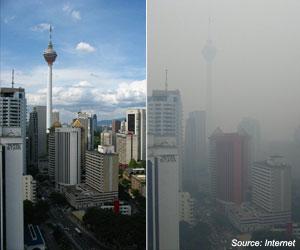 Prime Minister Abdullah Ahmad Badawi's government should be congratulated for lifting the "national security/top secret" embargo on the air pollutant index. But telling the people what the API number is only confirms what everyone's body already knows. All you have to do is look at the air and take a deep, smelly, and unhealthy breath, and you know that something is wrong.
When I read malaysiakini 's many articles on the "haze" the past few days, I was surprised that many people say they do not know what to do about the haze or how to protect themselves - even though the haze has returned many times since 1997.
Malaysians have an absolute right to be angry with the Indonesian government, which year after year has allowed its farmers - and more importantly, its timber companies - to take the cheap way out and burn the land, rather than spending the extra time and money that would be required to clear it with machinery and labour, rather than fire.
But being angry at the Indonesians doesn't answer the question of how to protect yourself today.
In 1997 we spent a great amount of time at the US embassy studying the "haze" in order to decide what to do to protect our employees and our families, both American and Malaysian, from a potential health threat. We consulted a number of US government agencies and medical specialists.
I would like to share that knowledge with malaysiakini readers. Obviously, whatever I say might be dated. There might be more up-to-date research. There are others who are far more knowledgeable than I am. But I hope that this will be a start, and that malaysiakini can become a source for practical and accurate information on how Malaysians can protect themselves from the haze.
What is the Malaysian haze?
This is not like the Los Angeles haze, which is related more to ozone and automobile emissions. In the case of Malaysia, we are talking about smoke and particulate matter that comes from the burning forests of Indonesia.
When you breathe, you are inhaling millions and millions of microscopic particles of dust and ash that end up coating your lungs. Over time, it makes your breathing harder. Some people in 1997 said things like, "I am having a hard time breathing. I feel like I am not getting enough oxygen. I tire very easily. It's like the time I had bronchitis - or pneumonia."
Will it cause permanent damage?
For most people, the answer is no. Our bodies have an incredible ability to rejuvenate. Once you breathe clean fresh air again, your lungs will recover. However, if it happens year after year after year, no one knows what the effects will be. That is why it is important for the Indonesian government to take serious action to remedy the situation.
If Malaysians continue to suffer from the haze year after year, there could be long-term medical consequences, such as an increase in lung disease and lung cancer. But no one knows. This has never happened before.
Who is at risk?
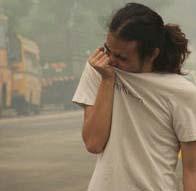 As I said, people in a healthy condition will eventually recover once they breathe clean air again. But some people are at greater risk - people whose lungs are weak or not fully developed.
This means small children, especially under three year of age. It means the unborn children of pregnant mothers. It means the elderly, whose lungs are weaker. It means people with asthma or other lung conditions, or people with a heart condition.
What can you do?
When the air quality is bad, stay indoors. Avoid exercise - even indoors, because it makes you breathe more and take in more bad air.
An air-conditioned environment is best, because it is closed to the outside air. Your air-conditioned office is a better place to be than your non-air conditioned house. But don't forget that you might be exposing yourself to bad air during your commute to and from work. If you are in an air-conditioned car, do not let outside air circulate through the vehicle.
Make sure your house is well sealed, so the bad air has a difficult time infiltrating your home.
Buy at least one portable air filter for your home. Seal one room, such as a bedroom or a living room, and run the air filter in there, so there is at least one place in your home where the air is purer. That should be the room where you sleep.
Be sure to drink lots of water and to keep your throat, nose and eyes moisturised. Use eyes drops and a saline solution to moisturise your nose. Otherwise, the particulate matter will make them dry and could cause separate medical problems. If you wear a mask, then for heaven's sake, wash
it regularly and keep it clean.
Do masks help?
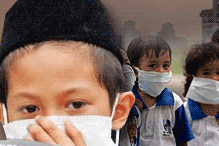 Most of the masks that people wear - surgical masks, plasterers' masks, and so on - are of little value. That is because the particulate matter from the fires is so small that it still can infiltrate those cheaper masks and get into your lungs. While those masks can keep out the larger particles, the smaller ones go straight through.
The only masks that are truly effective in keeping out the microscopic particles that can coat your lungs are similar to military gas masks, which are hard to find, and more expensive.
What about spraying water?
Spraying water from the rooftops of Malaysia's high-rises provides 15 minutes of relief, but mostly it wastes water. It is a great photo opportunity for the papers and RTM, but it will not solve the problem. And if the monsoon rains come late, it means that there will be a water shortage, so it is better to save and use the water for better purposes.
Can the fires be put out?
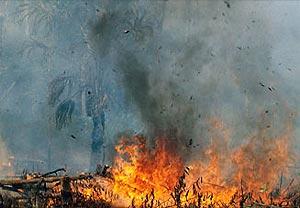 The amount of land on fire in Indonesia is so great that only Mother Nature can extinguish the fires - through the monsoon rains. Fire fighters, cloud seeding, and aerial spraying all can help reduce the fires, but they cannot totally quell them.
There will be good and bad days in KL and elsewhere, but that is not because the fires have been reduced. It is because the winds shift from day to day. Today KL is suffering, but Penang is clear. Next week it could be the reverse - it all depends on the wind and weather conditions.
What is the long-term solution?
Today the skies in Jakarta most probably are blue - for they are below the winds. The awful effects of their inaction are exported northward - to Malaysia and its neighbours. That is why they don't seem to care.
Over the longer term, the only solution is for more pressure on the Indonesia government. But that won't happen this year. For now, my Malaysian friends need to take action to prevent any medical harm to themselves.
Once this threat has passed, when the monsoon rains comes and extinguish the fires, it will be easy to forget - once again - about the cause of the haze and 'move on'. Asean brotherhood and the doctrine of non-interference will take over again.
I hope that does not happen.
Unless the governments of Malaysia, Singapore, Thailand and Brunei - the countries whose people are affected year after year by Indonesia's actions - make a serious, sustained, and concerted effort to deal with the problem, the haze will be back.
JOHN R MALOTT was US ambassador to Malaysia during the Great Southeast Asian Haze in 1997. He is now living in Alexandria, Virginia.


Are you sure you want to delete this comment?
This action cannot be undone.