



Closely examining Anwar's worldview
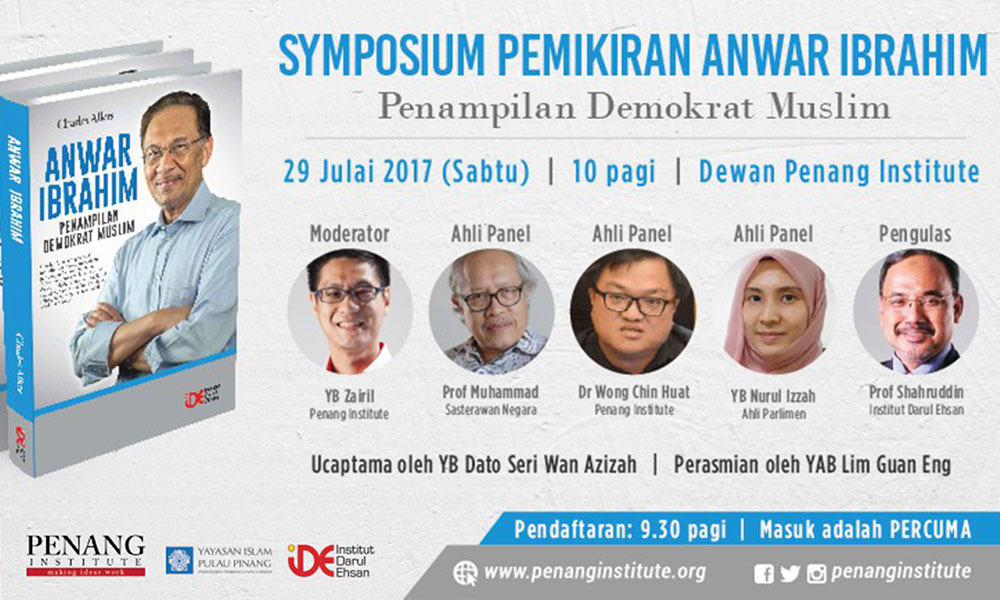
COMMENT | It is hoped that tomorrow's symposium on Anwar Ibrahim's worldview – the German word for it, weltanschauung, is apter in the circumstances – at the Penang Institute will go beyond bromides to deal with the substance of his political philosophy.
Anwar is arguably the most intellectual of politicians to have put himself up for leadership of this nation.
The word “intellectual” here is employed in the following sense: familarity with the best that has been thought and said in the history of the world.
Anwar has sought, in the last two decades at least, to give the Asian contribution to humankind's intellectual legacy new life and urgency...
COMMENT | It is hoped that tomorrow's symposium on Anwar Ibrahim's worldview – the German word for it, weltanschauung, is apter in the circumstances – at the Penang Institute will go beyond bromides to deal with the substance of his political philosophy.
Anwar is arguably the most intellectual of politicians to have put himself up for leadership of this nation.
The word “intellectual” here is employed in the following sense: familarity with the best that has been thought and said in the history of the world.
Anwar has sought, in the last two decades at least, to give the Asian contribution to humankind's intellectual legacy new life and urgency.
His book “Asian Renaissance”, published in 1996, was an attempt to to show that the streams of intellectual speculation seeded by such diverse Asian thinkers as Jose Rizal and Rabindranath Tagore were adumbrations of a reglowing of the intellectual patrimony of the East that, he hoped, would drive the continent's quest to lift up its poor and downtrodden.
Incisive examination
On the edge of his seventh decade of life (Anwar will be 70 on Aug 10) and at the start of his sixth as a political activist, Anwar's thoughts deserve incisive examination.
The immediate stimulus to the effort is the launch tomorrow at the Penang Institute of the Malay translation of “Anwar Ibrahim: Evolution of a Muslim Democrat” (Anwar Ibrahim: Penampilan Demokrat Muslim) by an American academic, Dr Charles Allers.
It is the first comprehensive attempt by any author to expose and examine the public pronouncements and policy stances of Anwar from the time of his emergence as the leader of Abim (The Malaysian Muslim Youth Movement) in the early 1970s to his current apotheosis as leader of the opposition in Malaysia.
The book was published in 2014, two years before Rached Ghannouchi gave the phrase “Muslim democrat” pith and moment when the world-renowned Islamic scholar from Tunisia told his party, Ennahda, at its congress in May last year, that “we are leaving political Islam”. He added: “We are Muslim democrats”.
Ghannouchi was the leader of Tunisia's Islamists who rose to power on the wave of the Arab Spring in 2011 but were compelled to make common cause with secular forces in the country to keep their place in the country's ruling coalition.
En route to the accommodation that ensured the coalition's electoral success, the Islamists had to drop their theocratic imperatives.
Hence the newfangled Ghannouchi formulation: “We are leaving political Islam…we are Muslim democrats.”
Beacons for Muslim-majority
Anwar lauded Ghannouchi's stance in an opinion piece on Dec 13, 2016, in British newspaper The Guardian, where he wrote: “While this ideal may be still nascent in the Middle East, in Southeast Asia, the success of Indonesia and the relative progress of Malaysia can make them beacons for Muslim-majority countries globally.”
Of course, here, the reference to Malaysia was in connection with the situation in the country before the spate of repressive acts of the executive branch of government began after the May 2013 general election.
No doubt, the term “Muslim democrat”, deployed by Ghannouchi and endorsed by Anwar, would thrill those, especially in the West, who would like to think that Islam can be rendered compatible with democracy.
These people, like Allers, will see in an Islamic-oriented political activist like Anwar an exponent of Islam's compatibility with democracy.
West-East convergence
From his intimation that the 12th-century Islamic jurist Al-Shatibi's insistence on maqasid al shariah – protection of life, property and economic well-being of the people – as essential prerequisites for the imposition of Shariah was an antecedent of the “life, liberty and the pursuit of happiness” of the US Declaration of Independence, to his citing of an Egyptian writer who observed that the French Revolution's call for “liberty, fraternity and equality” corresponded with the Islamic emphasis on “adyl” (justice), Anwar has looked for convergence between the ideals of the West and East.
This has lent a global aura to his presence in the political arena, because Islam's compatibilty with democracy, or its lack, is a world-historical issue and likely to stay that way for at least the rest of this century.
Skeptics may look askance at the term “Muslim democrat”, because the religion's inescapable distinctions between believers and non-believers, and its discrimination among male and female believers, are roadblocks to rendering the faith compatible with democracy's egalitarianism.
These and other aspects of the "Muslim democrat" should properly come under the scope of tomorrow's symposium.
TERENCE NETTO has been a journalist for more than four decades. A sobering discovery has been that those who protest the loudest tend to replicate the faults they revile in others.
The views expressed here are those of the author/contributor and do not necessarily represent the views of Malaysiakini.


