




Koizumi caught between a rock and a hard place
When Junichiro Koizumi became prime minister in 2001, he revelled in popularity over his bountiful hair and playboy looks. But the Japanese also placed their faith in Japan's cool dude to lift the economy out of its 11-year slump. No pain without gain, Koizumi warned.
 Today Japanese are still feeling the pain, not from Koizumi's reforms, but from a meagre upturn. Five years on, Asia's most powerful industrial behemoth looks like a puffed-out dragon.
Forget Koizumi's gang-busting popularity start: the crash-through politician looks to have crashed himself. His latest economic reform move - to privatise Japan Post, which hoards 331 trillion (US$3 trillion) in savings and life insurance accounts - hit the wall in mid-August.
His party, the ultra-conservative Liberal Democratic Party, still controlled by geriatrics who lord over a complex patron-client system, cut him off at the knees. Koizumi finally lost his cool and called a snap poll.
Will voters let him sell off Japan Post? Not easily.
When Junichiro Koizumi became prime minister in 2001, he revelled in popularity over his bountiful hair and playboy looks. But the Japanese also placed their faith in Japan's cool dude to lift the economy out of its 11-year slump. No pain without gain, Koizumi warned.
 Today Japanese are still feeling the pain, not from Koizumi's reforms, but from a meagre upturn. Five years on, Asia's most powerful industrial behemoth looks like a puffed-out dragon.
Forget Koizumi's gang-busting popularity start: the crash-through politician looks to have crashed himself. His latest economic reform move - to privatise Japan Post, which hoards 331 trillion (US$3 trillion) in savings and life insurance accounts - hit the wall in mid-August.
His party, the ultra-conservative Liberal Democratic Party, still controlled by geriatrics who lord over a complex patron-client system, cut him off at the knees. Koizumi finally lost his cool and called a snap poll.
Will voters let him sell off Japan Post? Not easily.
For starters, Koizumi, whose reforms agenda has been dodgy at best, has gotten ahead of himself. His reform bills may have passed through the Lower House but only by five votes. So what was Koizumi thinking when he tried to crash them through the insidious Upper Chamber?
There his enemies waited. Led by Mikio Aoki, the strongman who controls the most powerful LDP faction and his 22 hardline backers, it stopped Koizumi dead in his tracks - and for more than one reason.
Money-mandarins
Koizumi has long wanted to reform his fractious and corrupt ruling party. But now he wants to dismantle it altogether.
"I will smash the old LDP and I will create a new one," Koizumi defied the party's leadership group after the vote.
"I will not join hands with the old LDP. The party will not endorse anyone who voted against these bills."
But Aoki had a job to do: preserve the LDP for the faceless money-mandarins who run it from behind bamboo curtains. Koizumi should have read Japanese history, especially the LDP's, more closely. He may be party president but he never ran it, any more than he will be able to shred it.
Moreover, Koizumi's economic management record is his Achilles' heel. The LDP has kept 63-year old Koizumi in the job only for the lack of a suitable replacement. And leadership credentials will be Japan's Achilles' heel going forward. Still, none of Koizumi's economic reforms have advanced substantively because the party's hard-nosed geriatrics were not willing to risk their own and the money-mandarins' financial interests. Besides Koizumi's reforms are as wonky as his insipid leadership.
Koizumi has singularly failed to stabilise the chronic budget deficit that has been buffeting Japan's financial sector since the bubble economy burst in 1989. And the spectre of a bank-driven plunge remains.
Desperate measures
Fifteen years of economic indolence has put Japan's gross public debts at over 150 percent of gross domestic product and for years, Koizumi has been sitting on his hands. That's not all. Years of Keynesian pump-priming measures haven't worked, either. And don't blame Japanese for not spending the income tax-cuts they have been given since 1999. The LDP government has failed to provide any clear sign of sustained economic growth.
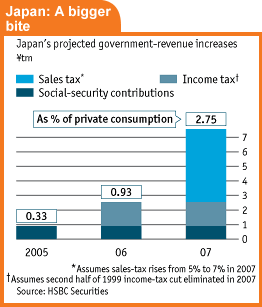 A desperate Koizumi will roll back income-tax cuts by half next year. The other half will probably be purged in 2007. But his attempts to boost tax revenue are anything but plain. What's clear, though, is that Japanese are about to feel more pain.
Take pensions. Koizumi managed to pass a law last year that will steadily raise national pension-fund premiums (which are split between workers and their employers), from 13.58 percent of salary to 18.3 percent in 2017. But wait: he will also index pensions payouts to two vital demographic factors - life expectancy and labour market growth.
The net effect of these moves will be that seniors' pensions will be cut - wait for it - if people live longer than expected. Or if fewer workers are able to support them. What's more, Koizumi is banking on these outcomes to cushion the effect on public finances.
But if he keeps slashing public spending, and takes away income-tax cuts, where's the spark for a languishing economy? Japan export-led growth is a shadow of its former self. More and more Japanese firms relocating production to lower-cost economies like China, Vietnam, central Europe and South America.
Last chance?
Koizumi is going to have one last roll of the dice which will decide if he quits or is tossed out by his LDP foes.
Unlike Japan Post, whose privatisation he has always advocated, Koizumi had backed away each time from the politically vexed issue to upping private consumption sales tax to boost the depleting government's coffers. This year it has risen by one-third of a percentage point. It is expected to climb by one percent next year and by a whopping 2.75 percent in 2007, taking it to about 7 percent.
But that depends if Koizumi survives this year, although LDP rules require him to step down by September next year. That's far too long for the cagey but powerful finance ministry to wait; it wants to raise taxes now. If Koizumi relents to LDP hardliners and the ministry, he may survive - but the economy won't.
A repeat of the 1997 disaster also hovers with just such a move, which will stifle domestic demand ahead of any real economic expansion. But if new taxes soar much higher as pension premiums rise and tax rollbacks kick in, Japan's still recessed economy could easily slip into another - and much longer - deflationary spiral.
Either way, Japan will have no winners - thanks to the prevailing lunacy that afflicts the antediluvian LDP and its intransigent old fogies.
MANJIT BHATIA, an academician and writer, is also research director of AsiaRisk, a political, economic and risk analysis consultancy in Australia. He specialises in international economics and politics, with a focus on the Asia-Pacific.


Are you sure you want to delete this comment?
This action cannot be undone.