



Asset declaration: Moral courage in the dark world of politics
COMMENT | At every social event I attend, talk will inevitably veer into politics.
“There are very few politicians who are clean. I think he is one of them,” I say.
The woman I am talking to is middle-aged, wealthy and successful. Her hair is curled in locks that disguise her age, her makeup simple, her speech polished. But even a person like her is not immune to political gossiping.
She leans to me and says, “Let me tell you something, young man: there is no clean politician. Zero.”
“Yes, but he is clean, I know that for a fact.”
“They surely take money from behind. Someone pays them.” She stares with eyes that urge me to believe her.
After all, why wouldn’t I?
Most of us perceive political parties to be “extremely corrupt”, according to Transparency International’s Malaysian Corruption Barometer (MCB).
This isn’t shocking, as Yale Law School professor Susan Rose-Ackerman has found that most people throughout history have been governed by corrupt rulers who placed personal financial interest above public good.
The late former British prime minister Winston Churchill famously said in 1947 that it would be “ridiculous” to expect the House of Commons to have no interests or associations of any kind...
COMMENT | At every social event I attend, talk will inevitably veer into politics.
“There are very few politicians who are clean. I think he is one of them,” I say.
The woman I am talking to is middle-aged, wealthy and successful. Her hair is curled in locks that disguise her age, her makeup simple, her speech polished. But even a person like her is not immune to political gossiping.
She leans to me and says, “Let me tell you something, young man: there is no clean politician. Zero.”
“Yes, but he is clean, I know that for a fact.”
“They surely take money from behind. Someone pays them.” She stares with eyes that urge me to believe her.
After all, why wouldn’t I?
Most of us perceive political parties to be “extremely corrupt”, according to Transparency International’s Malaysian Corruption Barometer (MCB).
This isn’t shocking, as Yale Law School professor Susan Rose-Ackerman has found that most people throughout history have been governed by corrupt rulers who placed personal financial interest above public good.
The late former British prime minister Winston Churchill famously said in 1947 that it would be “ridiculous” to expect the House of Commons to have no interests or associations of any kind.
The dark world of politics
There are illegal, semi-legal, and legal means to be corrupt when holding political office.
Politicians may extract money from citizens and businesses in return for influencing the bureaucracy in a certain way. This is much easier in our country, where politicians sit on corporate boards.
For lower-level politicians, favours, quid pro quos and horse-trading are prevalent. Their heightened profiles give politicians better access to all kinds of information and this will likely make them susceptible to various forms of corruption.
In their book, “The Civic Culture: Political Attitudes and Democracy in Five Nations”, political scientists Gabriel Almond and Sidney Verba surmised that this lack of trust generated by actual and perceived corruption has a corrosive effect on democracy. A democracy of the people, by the people, for the people loses its meaning.
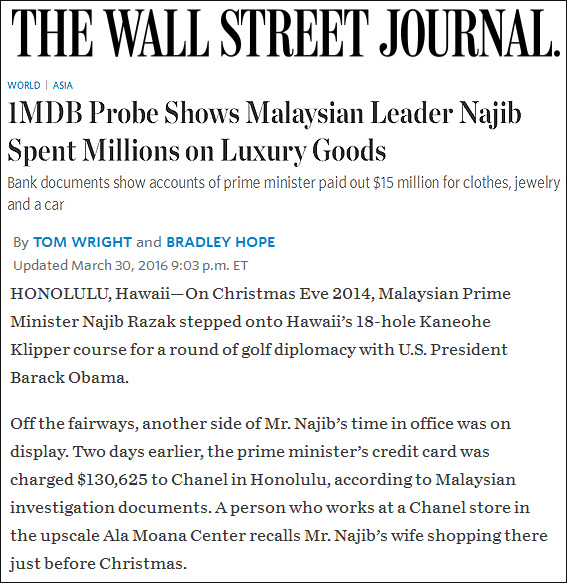
It doesn’t help matters that our leaders are troubled with allegations of corruption and have become a laughing stock, even for leaders of seemingly corrupt countries in Africa.
And in an environment where politicians are presumed to have “taken money” until proven otherwise, asset declaration becomes the morally imperative thing to do.
Asset declaration in Malaysia
By putting out in the open all assets, big and small, with detailed categories of cash, financial instruments, cars, lands and other valuables, it gives us a window into the world of politics we regard as murky and obscure.
Declaration of assets not only allows us to critically examine past, current and future sources of wealth in determining actual corruption, but it also enables us to change the perception that politicians are corrupt.
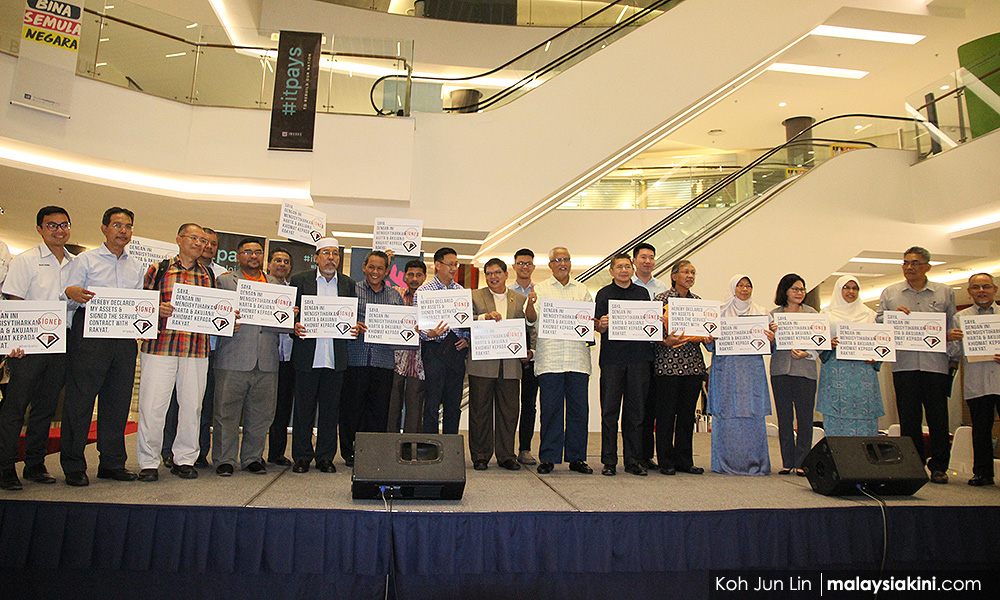
The 30 politicians who decided to declare their assets publicly on Sunday night have done something of historic proportions, marking the first and largest initiative of its kind in Malaysia.
While it is true that this is something the people should expect from politicians who handle public funds, we should never underestimate the amount of moral courage that is required to do so.
It is morally courageous because the men and women decided to declare their assets to uphold the morally right principle of transparency and accountability, despite the risks that would follow.
Moral courage
The privacy of a politician is voluntarily given up when asset declaration details nearly everything material in that person’s life.
If it is known that a politician is wealthy, there is risk to personal safety, as noted by Universiti Utara Malaysia senior lecturer Md Shukri Shuib. We are naturally uncomfortable sharing how much we earn or how much our family has in our common lives. I know in particular the Chinese never like to mention it. I couldn’t imagine declaring my assets to the public.
If it is known that a politician is poor, there is a risk of embarrassment and shame. There may be some who might ridicule them for making the insensible decision to join politics, and it would place them in a vulnerable position to be influenced by special interest groups.
If it is known that a politician is just getting by, he or she could possibly be personally condemned for not doing enough in life, if our economy is a measure of one’s abilities.
Either way, you will be damned. Political opponents will use your personal life against you. But it is because the choice is difficult either way, that the decision to declare it anyway, because of the overarching moral principle of transparency, makes it morally courageous.
Undeniably, declaring assets is neither a guarantee of a competent politician, nor an absolute guarantee of incorruptibility. But this is monumental because it represents something we want to see - it speaks to our dormant dreams.
The courageous 30
What the 30 men and women have done is to remind us that we should never concede to the terms of the game, because life is not resolved in the favour of the dirty and corrupt.
When you take morally courageous decisions like that, it reminds us that we should never only live for ourselves and our egoistic desires. Instead, we should value community and common solidarity. One action might inspire another, and another might inspire 30, and 30 might inspire a cultural change.
Near my workplace, there is a popular newspaper stand. Cars and people drop by every day to pick up newspapers. What for, I wonder. To listen to politicians’ half-truths and full lies? To complain about how bad things are in politics? To enter again the room of politics - the room of darkness?
But today I reserve my judgment. Because if a small group of politicians is willing to do what is morally right, then maybe - just maybe - this time it will be different.
JAMES CHAI works at a law firm. His voyage in life is made less lonely with a family of deep love, friends of good humour and teachers of selfless givings. This affirms his conviction in the common goodness of people: the better angels of our nature. He tweets at @JamesJSChai.
The views expressed here are those of the author/contributor and do not necessarily represent the views of Malaysiakini.


Are you sure you want to delete this comment?
This action cannot be undone.