




History, whose history?
'Facts are sacred, opinion is free.' - C P Scott, a liberal journalist
A few years ago, Jiang Zemin, then still the president of China, was stung by a question about Hong Kong democracy. Unable to hold his temper, the image-conscious president jabbed his finger in the air and shouted at a group of Hong Kong journalists, accusing them of 'being too simple' and 'sometimes naive'.
Finding the journalists yet to be seasoned by maturity, Jiang went on to say that 'I have seen a lot and need to teach you about life', pretty much as many a man in his mid life crisis loves to do.
After this episode that laid bare the tetchy character of the supreme leader at the time, several self-amusing lecturers and professors of journalism and media studies at the Baptist University began to refer to the department as 'the Department of the Simple and Naive'.
Jiang, for all his prestige and authority as the leader of the most populous nation on earth, failed pathetically to appreciate the fact that there exists such thing called independent journalism. The Chinese government, long used to the docile media at home, is never well-disposed to anything 'independent', and the press is still among the most jealously guarded industries in the country.
'Facts are sacred, opinion is free.' - C P Scott, a liberal journalist
A few years ago, Jiang Zemin, then still the president of China, was stung by a question about Hong Kong democracy. Unable to hold his temper, the image-conscious president jabbed his finger in the air and shouted at a group of Hong Kong journalists, accusing them of 'being too simple' and 'sometimes naive'.
Finding the journalists yet to be seasoned by maturity, Jiang went on to say that 'I have seen a lot and need to teach you about life', pretty much as many a man in his mid life crisis loves to do.
After this episode that laid bare the tetchy character of the supreme leader at the time, several self-amusing lecturers and professors of journalism and media studies at the Baptist University began to refer to the department as 'the Department of the Simple and Naive'.
Jiang, for all his prestige and authority as the leader of the most populous nation on earth, failed pathetically to appreciate the fact that there exists such thing called independent journalism. The Chinese government, long used to the docile media at home, is never well-disposed to anything 'independent', and the press is still among the most jealously guarded industries in the country.
Horrid manipulation
Another field that is subject to horrid manipulation and distortion is no doubt history. For decades, the communists, making a full use of their omnipresent and iron rule, have been hugely successful in downplaying, if not erasing, the decisive role of the nationalists in the eight years' struggle against the brutal Japanese invasion of the 1930s and 1940s. For two generations now, the people in China have been taught to believe in nothing but one ultimate truth, that the communists made greater sacrifices than anyone else in resisting against the militarist Japan in the first half of the 20th century.
In recent years, the independence movement in Taiwan that continues to gain ground and remain formidable has forced the Beijing authorities to rethink its discourse on the anti-Japanese war. In a move that clearly bows to the challenge posed by Taiwan separatists, the communists have finally decided to acknowledge the pivotal role played by the nationalists in winning the war against the Japanese invaders.
Still, several anti-Japanese veterans, now residing in Taiwan, refused to return to the mainland and take part in the self-congratulatory celebration hosted by the Chinese Communist Party in Beijing as they sought to avoid being manipulated by their erstwhile enemies.
Worse, Beijing's extensive celebration of the 60th Anniversary after World War II is clouded by a new biography of Mao Zedong, in which its authors Jung Chang and Jon Halliday argue that Mao was more interested in pulling the leg of Generalissimo Chiang Kai-Shek than fighting the Japanese. It is an admirable effort to debunk the myth created around Mao.
Granted, the Japanese government and the rightwing extremists have been shameless and irresponsible in their attempt to whitewash Japan's WWII atrocities. But for the Chinese communists to accuse the Japanese of being 'despicably oblivious to history' is as good as the wok calling the kettle black.
This is not to drive a wedge between the communists and the nationalists as suggested by some humdrum analysts, who take delight in nothing other than chanting their ultra nationalist spells. If one is gravely concerned about historical discourse, it would be hard for one to uncover the hidden history of the defeated Malayan communists in Malaysia in order to accord them with respect, which in my view is both right and necessary, while turning a blind eye to the appalling falsification of history by the Chinese communists.
Emotional bickering
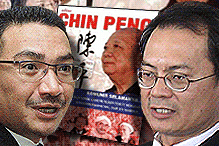 In this respect, the recent row over the alleged denial of the position of Tunku Abdul Rahman as Bapa Merdeka by Ronnie Liu of DAP exposes to the full the dilemma of Umno Youth, which is clearly destitute of laudable ideology and incapable of rational thought (and I shall not repeat the clownish wielding of the keris by its western-educated leader here).
Seeing the fracas of Umno Youth hasting to paint the DAP scarlet, while the DAP appeared to be more anxious than ever to prove itself whiter than snow, I cannot help lamenting over our mediocre politicians who have been sinking into emotional bickering and quarreling.
Instead of engaging each other in debate and discourse on the history of Malaysia, Pemuda Umno and the DAP appeared to be more interested in making police reports against the 'niat jahat' (wicked motives) of their rivals. For one moment, the corruption-tainted police in Malaysia must come under the delusion that it is credible and capable enough to mediate between politicians on both sides of the political divide.
What was so obnoxious about Liu's argument that Umno was not the real fighter for Merdeka? After all, there are scholars questioning the excessive appraisal of Winston Churchill's role during WWII, with some calling him an 'enthusiastic imperialist'. Have one seen a Tory ultra go after the critic with a spear in his hand?
For the British, their war over historical interpretation is often confined to writing and debating, with Scotland Yard being spared the nightmare of having to handle reports lodged by politicians, which in the context of Malaysia are as exciting as a cold roti canai.
And what is so repugnant and sinful if one, such as myself, does not look up to the Tunku as the founding father of the nation? And why must Umno continue to take most of the credit for Malaysia's independence from British rule despite its years of corrupt administration and mismanagement?
Conspicuous silence
Why are Umno politicians still obstinate enough to not acknowledge the historical fact that it was the communist-led forces, not Umno founders, that fought against the Japanese occupation in the early 1940s, paving the way for the British withdrawal from the Malay Peninsula in 1957?
In China and Malaysia, the day when national histories can be debated in an open and healthy manner appears to be light years away. In both countries, monopolisation on historical interpretation has long been a prerequisite for the ruling elites to entrench and safeguard their vested interests.
The most worrying sign, to me, is that there is a conspicuous silence on the part of the mainstream academia in Malaysia. It is as if the scholars of history have willingly traded their academic independence for job security and benefits.
Chen Duxiu, a founder of the CCP and a leading light of the May Fourth and New Cultural Movement in the early 20th century, once made a trenchant statement that 'the main obstacle to academic development in China is the ignorance of the sacredness of academic freedom on the part of the intelligentsia'.
How surreal, that these wise words of Chen are as valid in the 1920s China as they are in modern-day Malaysia. Are we still surprised to see a flurry of politicians rushing to lodge police reports over history?


Are you sure you want to delete this comment?
This action cannot be undone.