


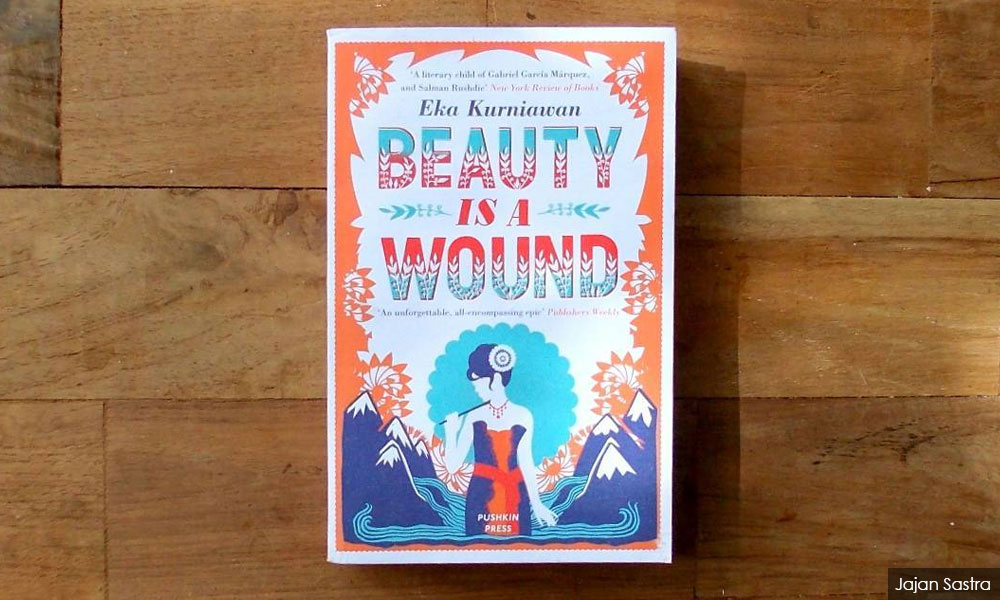

'Beauty is a Wound': A portrait of modern Indonesia
I took some time from this column to go back to what I have always loved doing most since I was a child: reading.
Of late I have been working on several manuscripts, a collection of 400 poems, a book on educational theory, a book-length analysis of Malaysia’s road to the Islamic state, a collection of cultural-philosophical essays, and memoir of growing up in Johor Bahru in the hippie 60s, and my favourite, a novel.
So, I have been busy. And I have missed my column and my fellow brilliant commentators who have never given up educating us on the need for Malaysia to be a better society. I’d like to share a book I had just finished reading and analysing, ‘Beauty is a Wound’ (or ‘Cantik itu luka’), by Eka Kurniawan, a promising and engaging Indonesian author.
Here is my critical reading of that important Indonesian novel, post-Pramoedya Ananta Toer.
I propose chronicling a nation's pattern of mega-change is an aspect of the novel that is worth exploring as an instance wherein the author crafts the philosophical underpinning of the story of the birth and growth of Indonesia a country sold into prostitution by the forces that march history, and how the worldview of the nation is shaped primarily by the pathological condition metaphored by prostitution.
In the protagonist Dewi Ayu the portrait of the new nation as a prostitute and in Conrad Kliwon (chapter 7) the life force that tried to save the nation from being forever being a whore...
I took some time from this column to go back to what I have always loved doing most since I was a child: reading.
Of late I have been working on several manuscripts, a collection of 400 poems, a book on educational theory, a book-length analysis of Malaysia’s road to the Islamic state, a collection of cultural-philosophical essays, and memoir of growing up in Johor Bahru in the hippie 1960s, and my favourite, a novel.
So, I have been busy. And I have missed my column and my fellow brilliant commentators who have never given up educating us on the need for Malaysia to be a better society. I’d like to share a book I had just finished reading and analysing, "Beauty is a Wound" (or "Cantik itu luka"), by Eka Kurniawan, a promising and engaging Indonesian author.
Here is my critical reading of that important Indonesian novel, post-Pramoedya Ananta Toer.
I propose chronicling a nation's pattern of mega-change is an aspect of the novel that is worth exploring as an instance wherein the author crafts the philosophical underpinning of the story of the birth and growth of Indonesia, a country sold into prostitution by the forces that march history, and how the worldview of the nation is shaped primarily by the pathological condition metaphored by prostitution.
In the protagonist Dewi Ayu, the portrait of the new nation as a prostitute, and in Comrade Kliwon, the life force that tried to save the nation from being forever being a whore.
I find this notion of ethos and pathos "worldview of the tragic-existentialism" recurring, in a story elegantly weaved with elements of mystical magical Javanese symbolism, well-controlled plot, yet presented in the genre of time-space collapse, inspired by the complexity of the subplots of the Ramayana and Mahabharata, the elements of the theatre of the absurd or French surrealistic/ symbolic/ absurdist theatre, some elements of Javanese syncretistic thinking, and most importantly, in the tradition of the spirit of Raden Adjeng Kartini - the legendary feminist-educator-liberator of the mind - the voice given to women, perhaps true to the idea of motherland or ibu pertiwi in which women hold more than half of the earth at every epoch in history.
These are the broad techniques and themes employed in crafting "Beauty is a Wound."
Indeed, I believe, the title signifies the pathos associated with being beautiful, or even exotically and ecstatically and even more so, in this story the exhilaratingly erotically beautiful, as beautiful as the prostitute Dewi Ayu, who, like young and prideful Java and later Indonesia was relegated to become a prostitute to the Dutch, and later to the Japanese, and later to her own "nationalists" and much later by the military-regime-turned civilian-rule of General Suharto.
Thus, the portrait of Indonesia as a prostitute whose saviour is communism, the latter destroyed by the purge which saw the mass graves of hundreds of thousands of communists killed by the US-CIA-backed Suharto. So that colonialism can continue in newer but less visible form. In the novel, pride led to the suicide of the communist leader, Comrade Kliwon.
In my close readings of this seminal chapter on the metaphoring and chronicling of the mega-change of Indonesia, albeit through the prostitutionalising of the nation, I draw instances of Eka Kurniawan’s use of the philosophising-chronolising device, in chracterising Comrade Kliwon, as literary device and subtext.
Portrait of Indonesia as prostitute
Reminiscence of the writing of the once 14-year-imprisoned-50s-writer Pramoedya Ananta Toer (“Prem”) in seminal works such as ‘Keluarga Gerilya’, ‘Bumi Manusia’, ‘Cerita dari Blora’ - those that presented the point of view of the revolutionary fighters of Indonesia aka the "communists" - Eka Kurniawan's characterisation of Conrad Kliwon is one of sympathy in tone of the Marxists and the communists, as if continuing the legacy of "Prem" or Pramoedya.
Throughout, the classic arguments of the International Workers of the World and the Marxist-Leninist Third International is revisited, giving today's readers a reminder of what was Indonesian history about and how the struggles between the natives, the nationalists, the communists, and even the Islamists, overseen like a panopticon and synopticon of imperialism (Dutch, Japanese American) continue to define the theme of emerging nation-states such as Indonesia.
And like a cycle of human and social progress, there is the high and low tide of revolutionary waves of change in all its bloody and bloodless consequences. Eka Kurniawan attempted to present a history lesson of the birth of Indonesia, as how Salman Rushdie skilfully did with the birth of India and Pakistan in his novel ‘Midnight's Children’.
In Eka Kurniawan's work, to be beautiful is to be cursed and raped as to be Indonesia is to be exploited and ravaged and raped as well. To be raped then leads to be giving birth to deformities and monstrosities, as in the march of history and the inevitability of the perpetual birth of civilisational insanity.
"No one knew how Comrade Kliwon ended up becoming a communist youth, because even though he had never been rich, he'd always been a hedonist." (page 161).
Herein lie the thesis of this chapter in Eka Kurniawan's ‘Beauty is a Wound’ that tells the story of Indonesia during the formative years of becoming a republic, of what I call "the portrait of modern Indonesia as prostitute" (with apologies to James Joyce's "portrait of the artist as a young man" and the Filipino playwright Nick Joaquin's "portrait of the artist as Filipino").
He led a gang of marauding neighbourhood kids, stealing whatever they could get their hands on for their own enjoyment: coconuts, logs, or a handful of cacao beans that could be eaten on the spot. One night before Eid, they would steal a chicken and roast it, and then the next day they would find the chicken's owner to ask for forgiveness. (page 161)
There is a sense of foreshadowing of what the nature of transformation the young man, later Comrade Kliwon is to undergo, leading the way to his fascination with Marxism and later to be a member of the Indonesian Communist Party, the seeds of the metamorphosis could be shown in the idea that Kliwon is a thief yet with a conscience, in which perhaps in the idea of the march of socialism towards communism via the global agenda of the Third International, the rationale of stealing from the rich and taking away their property is clear: destroy capitalism and say that it an inevitable historical progress or the march of history in order for the perfect Communist state to emerge as a "kingdom of god", a modern supra-trans-millennialistic movement guided by the Hegelian-philosophy-inverted, served by the philosophy of history conjured by Marx (and Engels) - see historical and dialectical materialism as fundamental twin concepts of Marxism and Praxis.
Here the author, Eka Kurniawan, is giving the readers a history lesson on the influence of communist ideas in Indonesia at the onset of Independence.
AZLY RAHMAN is an educator, academic, international columnist, and author of seven books. He grew up in Johor Bahru and holds a Columbia University doctorate in International Education Development and Master’s degrees in five areas: Education, International Affairs, Peace Studies Communication, and Creative Writing. Follow him on Facebook, Twitter and his blog.
The views expressed here are those of the author/contributor and do not necessarily represent the views of Malaysiakini.


Are you sure you want to delete this comment?
This action cannot be undone.