


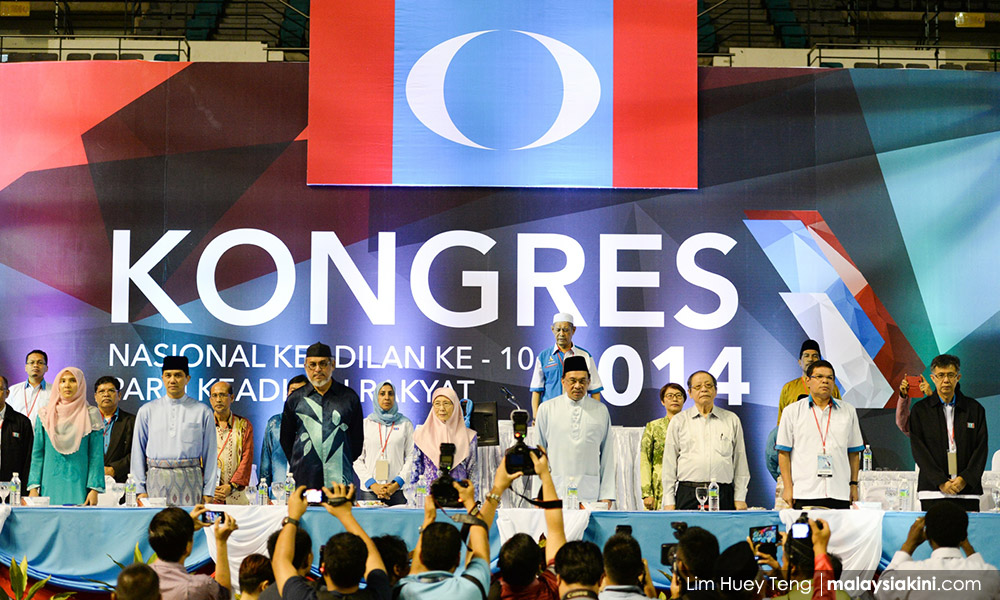

PKR needs to focus on unity and stability
COMMENT | PKR has always endeavoured to position itself in the center of opposition politics. Now more than ever, with all of Harapan parties set to use the PKR logo in the coming elections, PKR finds itself in a place of prominence and scrutiny.
In many ways, they have all the right qualities to be the anchor party in the opposition coalition - they are the most genuinely multiracial party in Malaysia, and represent a good cross-section of ideologies and backgrounds.
Diversity in a political party works best when it in turn is anchored in a clear set of values and principles. In this regard, PKR does seem to be lacking somewhat.
In the absence of such values and principles, internal division within a political party tends to be organised along personality lines.
Many leaders within PKR have been dismissive of reports of internal conflict within the party - more often than not calling such reports mere fabrications by BN-owned mainstream media.
This particular dismissal and excuse is a little old and tired. It would perhaps be unfair suggest that PKR is in complete and total internal disarray, as only an insider could speak accurately to such issues, but what is externally observable does raise some concerns.
Chaos and mess
Firstly, there is the haphazard manner in which the candidates were announced. Where most other parties hold big events - celebrations almost - to announce their candidates, PKR opted to only release the final list to the media.
Then, there is the manner in which the candidates themselves were notified. The picture of disorganisation, chaos and constant last-minute changes and confusion does not reflect particularly well.
Perhaps this may have been a more minor matter, had it involved a relatively small component party. When it comes from the party that sees itself as the very forefront of the opposition, things are a little different.
PKR in particular suffers from a deficit of confidence when it comes to united leadership and stability....
COMMENT | PKR has always endeavoured to position itself in the center of opposition politics. Now more than ever, with all of Harapan parties set to use the PKR logo in the coming elections, PKR finds itself in a place of prominence and scrutiny.
In many ways, they have all the right qualities to be the anchor party in the opposition coalition - they are the most genuinely multiracial party in Malaysia, and represent a good cross-section of ideologies and backgrounds.
Diversity in a political party works best when it in turn is anchored in a clear set of values and principles. In this regard, PKR does seem to be lacking somewhat.
In the absence of such values and principles, internal division within a political party tends to be organised along personality lines.
Many leaders within PKR have been dismissive of reports of internal conflict within the party - more often than not calling such reports mere fabrications by BN-owned mainstream media.
This particular dismissal and excuse is a little old and tired. It would perhaps be unfair suggest that PKR is in complete and total internal disarray, as only an insider could speak accurately to such issues, but what is externally observable does raise some concerns.
Chaos and mess
Firstly, there is the haphazard manner in which the candidates were announced. Where most other parties hold big events - celebrations almost - to announce their candidates, PKR opted to only release the final list to the media.
Then, there is the manner in which the candidates themselves were notified. The picture of disorganisation, chaos and constant last-minute changes and confusion does not reflect particularly well.
Perhaps this may have been a more minor matter, had it involved a relatively small component party. When it comes from the party that sees itself as the very forefront of the opposition, things are a little different.
PKR in particular suffers from a deficit of confidence when it comes to united leadership and stability.
“Shitstorm” is an unfortunately vulgar term, but I’m hard-pressed to find another that better describes the Kajang Move and its aftermath.
The themes involved then were a lack of cohesion, the changing of leaders for unclear reasons, and an overall feeling that the left hand at best did not know what the right hand was doing, and at worst was trying to cut off the right hand.
As we go into the 14th general election, the signs are perhaps not quite as bad yet, but they aren’t particularly good either.
Good or bad moves?
Some observations may be worth making regarding the final candidate list, and some of the more prominent moves.
PKR vice-president Nurul Izzah Anwar’s move to Permatang Pauh may be seen by some as a bit odd, as it moves one of the party’s theoretically more prominent leaders to what is arguably the safest seat in the nation.
One potential explanation is that the cloud of past scandal still hovers over threateningly, and there may be concerns that these will emerge again during the election, costing Nurul Izzah significantly in any greyer seats.
Her replacement in Lembah Pantai, Fahmi Fadzil, should be a good fit as his time as Nurul Izzah’s aide should have resulted in important ties with the community.
I feel the fielding of Saifuddin Nasution in two different states, Kedah and Penang, is not a particularly good move.
Theoretically, if a candidate must be fielded in both a parliamentary and state seat, the best options will likely be a state seat within the parliamentary constituency, or at least one that is nearby and/or within the same state. Otherwise, one imagines the representatives would be spread too thin.
On the theme of service, Malaysiakini’s interesting article on incumbent Hutan Melintang assemblyperson M Kesavan depicted him as an individual with very strong ties with the community.
It is sad that individuals like this keep being moved out of their constituencies, rendering an enormous chunk of the investment the representative has put into their constituency mostly worthless.
Kesavan is instead being sent to Sungai Siput, which is doubly wasteful, because he would then be in a four-cornered fight with PSM’s very well-regarded sole parliamentarian, Dr Michael Jeyakumar Devaraj.
Lastly, I was surprised to read of incumbent Rawang assemblyperson Gan Pei Nei being dropped as a candidate. As always, there may be a whole lot of details that we in the public are not privy to. From my limited personal interactions of old however, she always struck me as a good public servant, and was not surprised to read about Teng Chang Khim giving a similar testimonial.
Central importance of stability
The recent absolutely ridiculous rules by the Election Commission regarding whose faces may be used on posters is another indication that this might indeed be a close election.
We must remember that should there be a change in government, it will be the first in our nation’s history, and Malaysians will be watching closely.
One of the most important things for a new government to do is to demonstrate stability and some sense of continuity.
If the very first non-BN government is plagued with the kind of problems Selangor saw in 2014, fence-sitting Malaysians may be put off from voting for anyone besides BN for a long time to come.
If there are last-minute conflicts and fighting just before or just after the elections, it will be disastrous - and an opening for all sorts of shenanigans.
Harapan as a whole should thus make every effort to ensure that Plan A is followed. Staying a slightly flawed course may in this case be better than trying to constantly make changes, no matter the potential theoretical improvement.
NATHANIEL TAN is grateful for the years of a strong, resilient and happy marriage to the best wife in the world.
The views expressed here are those of the author/contributor and do not necessarily represent the views of Malaysiakini.


I think it is a bit late now to concentrate on unity and stability. The damage is done. This was to be the grandest (last chance) hope for regime change in Malaysia and Harapan has squandered it of its inherent stupidity - far more than it did in 2013. Wan Azizah's claim that there are no factions in PKR/Harapan is really daft. That's because she claimed there was only one "camp" in PKR and that is hers. Which means PKR is faction-ridden. Factionalism is par for the course in all party politics but when they go to war with one another in ways that floods back memories of the 2012 power struggles, you know this time it's a hopeless situation from which to come back. People, at this stage of the game, would see this as a turn off when everybody is looking for certainty and stability in their economic lives. And neither UMNO-BN nor Harapan can provide these sureties. The loser is the country called Malaysia, ripped asunder by idiocy, stupidity, greed and egotism. Really dumb asses on both sides of politics.
A party not build on sound principles and foundation, will ultimately self destruct as everybody will be at each others throats. The rules and orders in PKR is a laughing stock as nobody even care to obey. When DSAI is no longer calling the shots in PKR, it will be history...