



Mujahid and the challenges of moderation
COMMENT | Race and religion are among Malaysia’s most common hot-button issues. People care a lot about them and passions often flare up whenever these issues are in the public discourse.
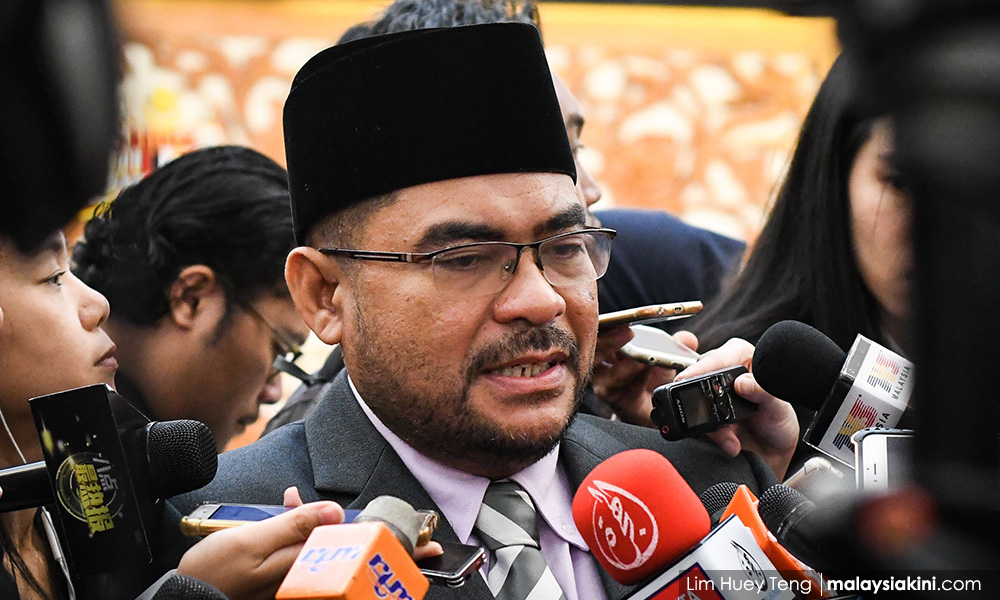
In this regard, minister in the Prime Minister’s Department for religious affairs Mujahid Yusof Rawa (above) is certainly in the hot seat, with a great deal of attention focused on what he does and says.
In watching what he has and hasn’t said in the first few weeks of his new job and the reactions thereto, I think we can start to identify a number of trends.
I find the most interesting among these to be the manner in which people from extreme ends of the spectrum have completely different views about Mujahid.
A number of progressives, including a number of fellow columnists here at Malaysiakini, have been quite critical of Mujahid, expressing cynicism, citing a lack of boldness or commitment or criticising policy announcements.
At the other end of the spectrum, there is likely significant backlash towards Mujahid from more conservative factions, fearing that he is too liberal and harmful to the position of Islam and Islamic values in the country.
One interpretation of this is that Mujahid has ...
COMMENT | Race and religion are among Malaysia’s most common hot-button issues. People care a lot about them and passions often flare up whenever these issues are in the public discourse.
In this regard, minister in the Prime Minister’s Department for religious affairs Mujahid Yusof Rawa (above) is certainly in the hot seat, with a great deal of attention focused on what he does and says.
In watching what he has and hasn’t said in the first few weeks of his new job and the reactions thereto, I think we can start to identify a number of trends.
I find the most interesting among these to be the manner in which people from extreme ends of the spectrum have completely different views about Mujahid.
A number of progressives, including a number of fellow columnists here at Malaysiakini, have been quite critical of Mujahid, expressing cynicism, citing a lack of boldness or commitment or criticising policy announcements.
At the other end of the spectrum, there is likely significant backlash towards Mujahid from more conservative factions, fearing that he is too liberal and harmful to the position of Islam and Islamic values in the country.
One interpretation of this is that Mujahid has, in fact, achieved the ‘Goldilocks point’ with regard to walking the middle path of moderation.
It is common for people with the strongest views on either end of a given spectrum to be the most vocal. This is particularly true of those concerned with what might be broadly termed more ‘cerebral’ and value-oriented issues than with day-to-day ones like the cost of living - the chattering classes, as deputy defence minister Liew Chin Tong once liked to call them.
Along spectra like these, those who are more inclined to the centre tend to be a little quieter.
I think it is a terrible habit to keep thinking of oneself as representing the silent majority in the middle, so I will as always avoid making that claim.
I also don’t deny anyone their right to advocate their point of view and express whatever dissatisfaction they feel, wherever they stand on the spectrum.
All that said, perhaps there is a small gap to fill in public discourse - one which balances out all the “You’re not 'x' enough” comments with a “Maybe taking this middle road is, in fact, a pretty good guiding principle for now.”
This is not to make politically motivated comparisons or to fawn over the new government, but rather a discussion concerning what ways might be the best of available options to approach certain problems in this new Malaysia we find ourselves in.
In doing so, let’s have a look at three issues - LGBT, the proposed Religious and Racial Hatred Bill, and the Islamic Development Department (JAKIM).
LGBT - one step forward
I think Mujahid’s view on LGBTs in Malaysia is the best example of an attempt to walk the middle road amidst different communities with very polarising views.

My exposition of this debate is based less on my personal convictions than on my thoughts on how we can navigate this controversy.
I wish for a world in which LGBTs would never suffer any kind of discrimination whatsoever. I believe in a world already so lacking in love, the last thing we should be doing is telling people who they aren’t allowed to love.
I can certainly understand the frustration of the LGBT community when people tell them to be patient or not be too demanding or that they have to give up certain things for political expediency.
I wouldn’t dream of telling them any of the above. Nevertheless, I do view Mujahid’s publicly expressed views on this matter to be a significant step forward.
Mujahid echoes the views recently put forward by Perlis mufti Mohd Asri Zainul Abidin, which states that the private lives of LGBT individuals do not come under the purview of the state, that their conduct is between them and God, and that they cannot be denied their rights in any area of their lives which they live in a lawful manner.
Certainly, I can see and understand why this alone may not be enough for the LGBT community, who would probably appreciate not being referred to or thought of as sinners and subject to all manner of direct or indirect discrimination.
That said, in my own humble opinion, these positions coming from a mufti and a minister for Islamic affairs would be all but unimaginable only a few months ago.
Do I feel like we need never progress beyond this point? No. Do I feel that this is still a huge, significant step forward? Yes.
We don’t need to fete Mujahid or anyone else or give them a medal or a parade. Nor should we take whatever strides forward as earning ‘immunity’ from criticism in any other statement or action.
I think it is only fair, however, to recognise the significance of this change in policy, and perhaps to at least acknowledge that it is a step forward in the right direction, however incomplete it is for the moment.
More legislation not the way
I believe that the motivation for the Religious and Racial Hatred Bill is a decent one, and I acknowledge Mujahid’s effort to be inclusive, in saying that the bill is intended to protect all religions and races from being insulted.
However, I am not completely convinced that this is the best possible path to take to achieve the stated goals.
First and foremost, I do not believe that the journey to national harmony will be aided greatly by a focus on punitive measures.
Ultimately, the unity of our nation will be built on real relationships between real people, and a discontinuation of decades of using race and religion as a means to create political identities and conflict.
I think this is where we need to focus our efforts on.
Punitive measures may provide a modicum of a deterrent in what people say out loud in public, but it won’t have any effect (or perhaps even the opposite effect) on what they say in private, and - more importantly - what they feel in their hearts.
I agree with Kua Kia Soong that the word "hatred" should also not be in the bill. It was the first thing that jumped at me, and it immediately brought about negative connotations.
At the end of the day, I don’t think it’s more laws that we need, but better use of existing laws, and better policies.
Judging Jakim
There has also been a fair bit of debate about the Islamic Development Department (Jakim).
Another esteemed columnist, S Thayarapan wrote the following excerpt in one article and quoted it again in another:
“Jakim director-general Mohamad Nordin Ibrahim claimed that his department’s new approach – tolerance – was brought upon by a conversation he had with Prime Minister Dr Mahathir Mohamad. But what does this really mean? It seems to me - and maybe it does to you - that all Jakim does is harass people who have 'slipped' from the path.

“Have they ever attacked religious extremism which is a more of threat to this country? Have they sanctioned hate speech? Have they warned Muslims that there are external forces out there which are attempting to subvert the democratic institutions of this country or enemies who would destroy democracy from within? Instead, what they have done is target Shia adherents, labelled dissenting Muslims as 'liberal', selectively enforced their edicts, estranged the Malay community from the non-Malay community, but most importantly, decried excessive laughter.”
I can certainly empathise with Thayarapan’s frustrations. Still, I think we should employ some logical consistency with regards to our assessment of Jakim under the new government.
I agree that Jakim has been misused in the past and that more than a number of its actions were highly questionable and detrimental to national unity. I think, however, that we should wait and see whether Jakim makes the same mistakes today, in the here and now.
I also feel that it may be misplaced to expect Jakim to do things that it is not really in any way designed to do such as speak out against any and all statements that may be related to the sensitivities or races and religions (though of course, they should be held accountable if guilty of making any such statements).
If Jakim is up to its “old tricks”, then, by all means, let us raise a fuss. If it has not repeated its mistakes, however, then perhaps it would be unfair to merely assume that their continued existence will result inevitably in the same behaviour.
Mujahid has expressed his desire that such agencies have a change in philosophy - to promote an Islam that is ‘friendly, not fiery’.
Perhaps it is fairer to give them some time to see if Jakim under the new government manages to live up to this.
If we get robbed twice in two days, there is no end of complaining about the police. If we went two decades without getting robbed once however, it would still not cross the minds of many to “credit” the police.
It’s still early, but perhaps we should think of the lack of any big controversy related to Jakim since GE14 in a slightly similar vein.
Some levels of cynicism I can of course understand, but whatever our own personal feelings, surely we must practice the same objectivity and evidence-based assessments that we wish to see in others?
Radical moderation
One other issue that should be examined here is the question of child marriages. However, this article is long enough as it is, and that topic may deserve an entire piece on its own.
Suffice to say for now that I am glad that the government’s position is that child marriage must eventually be forbidden by law. We hope that their actions will validate their words, sooner rather than later.
All in all, I think Mujahid has been handed a very difficult task and will continue to face pressure from all ends of the spectrum.
I imagine he knows that’s what he signed up for though, and so far he seems to be doing what he can without complaint.
The term ‘radical moderate’ is sometimes bounced around in our current day and age. It tends to refer to people who lean towards the centre of many debates, but who do not identify with the passive connotations of the word ‘moderate’.
Perhaps that is what we need, at this stage of Malaysia’s development - people with a commitment to moderation, whose passion for that commitment is anything but moderate.
NATHANIEL TAN was shocked to learn about the incredibly sexist Articles 14(1)(b) and 15(1) of the Federal Constitution and hopes they will be amended. He is eager to serve, and can be reached at nat@renyi.net
The views expressed here are those of the author/contributor and do not necessarily represent the views of Malaysiakini.


