


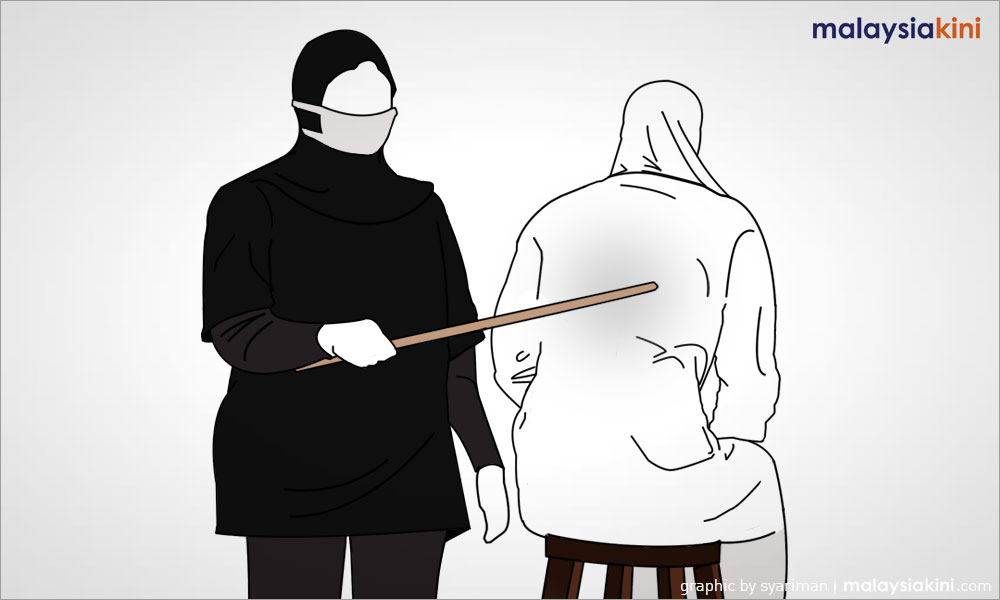

Terengganu caning episode needs fair reporting
COMMENT | The controversial caning by the Terengganu Syariah High Court of two unnamed women needs to comply with rules and ethics of fair and accurate reporting in the interest of our “open” justice system.
I selected 16 news reports, both local and foreign at random. They all complied with the court’s decision not to name the two women. Other than that, I found that most of them ignored the basic rules of fair and accurate reporting, particularly for court reporting.
Most alarming was that only one (a Bernama report carried by Utusan Malaysia) actually gave the charge under which the two women were accused of. The others merely alluded to it. Even then, the charge was not explained adequately for readers to follow the news framing intelligently.
All that was reported was that they were guilty of deviant behaviour contrary to Islam.
I found only one narrative useful to understanding the issue at hand. This was written by two lawyers entitled 'Let the civil courts decide on lesbian sex'.
We practise “open justice” in Malaysia of which fair and accurate reporting of open court proceedings is cardinal. I wrote about this previously.
“Open justice is a hallmark of the rule of law. It is an essential requisite of the criminal justice system that it should be administered in public and subject to public scrutiny. The media play a vital role in representing the public and reflecting the public interest.”
This is a quote from the introduction of an official guide for judges and the media “Reporting Restrictions in the Criminal Courts April 2015 (Revised May 2016” by Lord Thomas of Cwmgiedd, Lord Chief Justice of England and Wales....
COMMENT | The controversial caning by the Terengganu Syariah High Court of two unnamed women needs to comply with rules and ethics of fair and accurate reporting in the interest of our “open” justice system.
I selected 16 news reports, both local and foreign at random. They all complied with the court’s decision not to name the two women. Other than that, I found that most of them ignored the basic rules of fair and accurate reporting, particularly for court reporting.
Most alarming was that only one (a Bernama report carried by Utusan Malaysia) actually gave the charge under which the two women were accused of. The others merely alluded to it. Even then, the charge was not explained adequately for readers to follow the news framing intelligently.
All that was reported was that they were guilty of deviant behaviour contrary to Islam.
I found only one narrative useful to understanding the issue at hand. This was written by two lawyers entitled 'Let the civil courts decide on lesbian sex'.
We practise “open justice” in Malaysia of which fair and accurate reporting of open court proceedings is cardinal. I wrote about this previously.
“Open justice is a hallmark of the rule of law. It is an essential requisite of the criminal justice system that it should be administered in public and subject to public scrutiny. The media play a vital role in representing the public and reflecting the public interest.”
This is a quote from the introduction of an official guide for judges and the media “Reporting Restrictions in the Criminal Courts April 2015 (Revised May 2016” by Lord Thomas of Cwmgiedd, Lord Chief Justice of England and Wales.
He writes, “In recognition of the open justice principle, the official guide points out that the general rule is that justice should be administered in public. To this end:
• Proceedings must be held in public.
• Evidence must be communicated publicly.
• Fair, accurate and contemporaneous media reporting of proceedings should not be prevented by any action of the court unless strictly necessary”.
Fair and accurate reporting, as pointed by Bill Kovach and Tom Rosenstiel in their book The Elements of Journalism “is a process that begins with the professional discipline of assembling and verifying facts. Then journalists try to convey a fair and reliable account of their meaning, subject to further investigation”.
My summary of the 16 news reports is that they largely jump to a presumptuous conclusion, that the two women, aged 22 and 32 are lesbians and they had engaged in consensual lesbian sex in a car or attempted to do.
Pure sensationalism
What was the evidence presented in court? According to the facts of the case, “the religious officers who saw the women found one in a state of undress and also discovered a dildo in the car.”
The argument is that the court had convicted them. The fact remains they pleaded guilty to the charge. Why did they plead guilty? Did they misunderstand the severity of the charge as they were unrepresented in court? Readers are entitled to know this and to form their own opinion.
The Bernama report carried by Utusan Malaysia was unbiased: “Dua wanita itu dihukum sebat enam kali hari ini kerana cuba melakukan hubungan seks di dalam sebuah kereta di Dataran Arena Squre, Dungun, 1.50 tengah hari pada 8 April lalu.”
I had to fact-check all the 16 news articles before coming to some idea of the case. But that, too, did not make much sense to me. Fortunately, the article by the two lawyers above was particularly useful.
What is significant in their framing of the story is that both writers did not at any moment refer to the two women as lesbians as did most of the 16 reports I monitored. In the current climate of demonising the lesbian, gay, bisexual and transgender (LGBT) community, tarring the two women as lesbians is to seal their fate.
This does not constitute fair and accurate reporting. It’s pure sensationalism, not journalism.
The two writers stated the women pleaded guilty to attempted musahaqah before the Terengganu Syariah High Court. They described musahaqah as an offence under section 30 of the Syariah Criminal Offences Enactment (Takzir) (Terengganu) Enactment 2001 (‘the Enactment’).
The punishment for attempted musahaqah is the same as the offence itself. Section 2 of the Enactment defines musahaqah as ‘sexual relations between female persons’. It is submitted that these provisions of the law and the punishments imposed on the two women are unconstitutional.
The two women should, therefore, consider filing an application for judicial review they should seek a declaration that the musahaqah offence is unconstitutional.
They concluded that in the words of the late Lord President Salleh Abas in Che Omar Che Soh v Public Prosecutor [1988]: “[W]e have to set aside our personal feelings because the law in this country is still what it is today, secular law, where morality not accepted by the law is not enjoying the status of law.”
They asked, do we want to live in a society where the state compromises individual privacy and resorts to degrading punishment in the name of morality?
Their narrative is excellent only because they had fact-checked their story. I had a discussion recently about fact-checking with my friend Eric Loo, a senior fellow in journalism at the University of Wollongong, Australia. This is what he says:
“Good journalism means integrating stringent fact-checking into the daily news reporting and production. The task will be delegated to a group of fact-checkers whose primary function is to do multiple checks on the veracity of statements, claims and opinions of various sources cited or quoted in the stories.
“This is premised on the fact that journalists have a role to play as citizens to make their fellow citizens aware, not only of the facts but of the various interpretations of the facts.”
This is what the two writers above had done. In doing so, both Saif Bhatti and Khairul Anwar Hairudin have raised the bar in benchmarking best practices for journalism in Malaysia.
BOB TEOH is a media analyst. Together with Eric Loo, they are suggesting the formation of a roundtable for internal media reform like introducing a fact-checking mechanism into newsrooms. More of this in his next article.
The views expressed here are those of the author/contributor and do not necessarily represent the views of Malaysiakini.


Are you sure you want to delete this comment?
This action cannot be undone.