


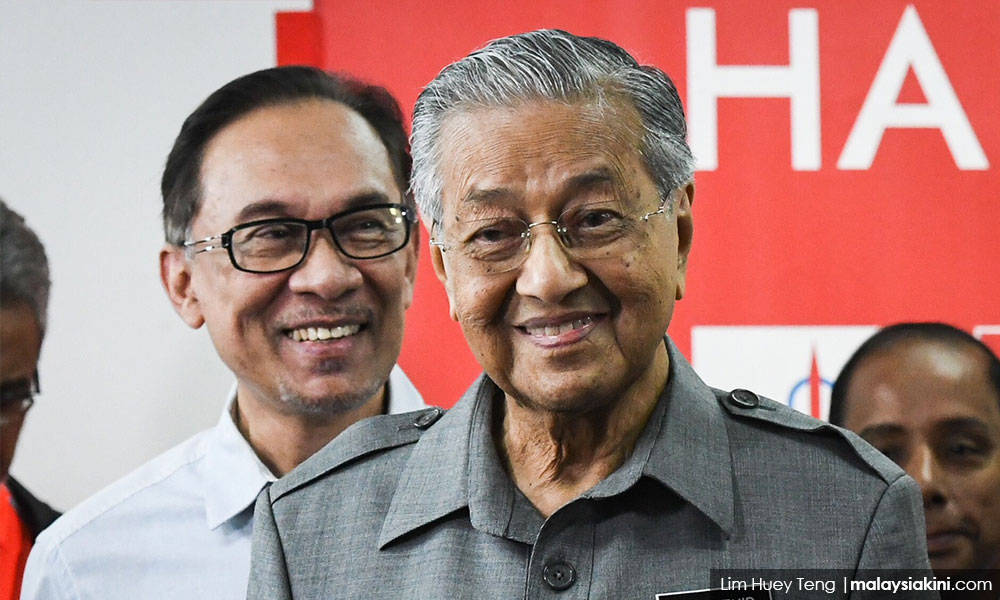

May 9 was only the beginning of the road to M'sia Baru
COMMENT | Too many pundits are paying attention to the transition from Malaysia’s seventh prime minister to the eighth. The analysis, if one can call it such, is so hackneyed, that one does not have to mention names. We know who they are, and what is at stake: Malaysia Baru.
Malaysia Baru or New Malaysia was not born on May 9. That day was merely the beginning of its creation. Hiccups and stumbling blocks are the norm in any process of creating something new, and so there is no running away from it in the conceptualisation of Malaysia Baru too.
Umno, together with PAS, would of course like to create a huge stumbling block in this process. But if the transition does happen the way the seventh prime minister has repeated the world over, from Putrajaya to New York City that houses the United Nations and Council for Foreign Relations, then Umno and PAS are "finished".
First, Umno and PAS have never been the preferred instrument of choice to change Malaysia, irrespective of whether it is led by the seventh PM or the eighth. In the case of the latter, Angkatan Belia Islam Semalaysia (Abim) has always been the preferred choice.
That, however, would have required the unthinkable - canvassing Abim as a political party when it was purely a self-strengthening movement.
The earliest history of Abim had it down as a tuition centre or teaching unit. The goal was to use the sheer power of the intellect - ideally global scholarship - to steer the proverbial ship to the port (invariably through the choppy seas)...
COMMENT | Too many pundits are paying attention to the transition from Malaysia’s seventh prime minister to the eighth. The analysis, if one can call it such, is so hackneyed, that one does not have to mention names. We know who they are, and what is at stake: Malaysia Baru.
Malaysia Baru or New Malaysia was not born on May 9. That day was merely the beginning of its creation. Hiccups and stumbling blocks are the norm in any process of creating something new, and so there is no running away from it in the conceptualisation of Malaysia Baru too.
Umno, together with PAS, would of course like to create a huge stumbling block in this process. But if the transition does happen the way the seventh prime minister has repeated the world over, from Putrajaya to New York City that houses the United Nations and Council for Foreign Relations, then Umno and PAS are "finished".
First, Umno and PAS have never been the preferred instrument of choice to change Malaysia, irrespective of whether it is led by the seventh PM or the eighth. In the case of the latter, Angkatan Belia Islam Semalaysia (Abim) has always been the preferred choice.
That, however, would have required the unthinkable - canvassing Abim as a political party when it was purely a self-strengthening movement.
The earliest history of Abim had it down as a tuition centre or teaching unit. The goal was to use the sheer power of the intellect - ideally global scholarship - to steer the proverbial ship to the port (invariably through the choppy seas).
Since Malays were in a worse shape in 1970s, no one can blame the PM-in-waiting for focusing on using (progressive) Islam to transform the Malay community. However, since Abim could not be Umno or PAS, a choice had to be made.
When that choice was made, it was due to the appeal of the current prime minister, who was then the fourth PM. The eighth PM could trust the then-fourth PM precisely because both agreed that savvy and sophisticated Islam, one that combines "akhlak" (real character) and "akidah" (mind), could place Malaysia beyond what Umno and PAS could foresee.
Not surprisingly, as and when Umno and PAS lost their appeal to either the seventh PM and the PM-in-waiting, they were more than happy - and ready - to ditch them.
Now, these two parties have everything to be afraid of the 7th, and especially the 8th, who has a bevy of Islamic scholars, intellectuals and friends, to deny the "authenticity" of their Islamic interpretation.
Second, even if Umno and PAS are not afraid of the duo, what they have done since the “Summer of 2015 (when they paired up despite the 1MDB revelations by the US Department of Justice ) have made the pair toxic - together or as individual parties.
How do you accept an Umno or PAS that either mismanaged or mishandled USD 15 billion at the very least?
One does not even have to use the words kleptocracy or theft. The fact that they continue to deny the gravity of 1MDB and mini 1MDBs, all their future recruits would be the personification of a movie made with 1MDB money - Dumb and Dumber To.
The fact is, Malaysia Baru, and Pakatan Harapan, are bound in a race. Its every step (and potentially mis-step) is now keenly watched by Malaysians and the rest of the world. Pakistan and Maldives, for example, have emulated the example of Malaysia to change their respective government in recent months.
In this race, under the intense scrutiny of the global and social media, the seventh-to-eighth transition cannot fail.
If it does, Harapan would be a laughing stock, as would all Malaysian voters who cast their ballots to support the coalition.
Since the untraceable money verges in USD 10.5 billion at least, with USD 4.5 billion seized by the DOJ, no one knows if Umno and PAS may have seedy elements that want to use the dark stash of "Benjamin Franklins" to undo everything that Harapan had worked towards and created.
Thus, it is pointless to wonder if the seventh will hand over the reins of the leadership to the eighth. In a race as one unit, the coalition is as good as one serious faux pas (false step).
If Harapan falls, well, as the saying goes - you can’t unscramble scrambled eggs. All that everyone has been working hard to achieve would be ruined.
Come what may, the seventh PM knows the stakes are acutely high, which is why he is unafraid to repeat it - locally and globally.
This Malaysia Baru race should also ideally make the country the ultimate Asian powerhouse, based on a Renaissance of democracy, rule of law and institutionalisation.
When it does, at least 58 Muslim countries under the auspices of the Organisation of Islamic Cooperation as well as 68 countries parked under the Belt and Road Initiative would be looking at Malaysia in awe.
PHAR KIM BENG was a multiple award-winning head teaching fellow on China and the Cultural Revolution in Harvard University.
The views expressed here are those of the author/contributor and do not necessarily represent the views of Malaysiakini.


Are you sure you want to delete this comment?
This action cannot be undone.