


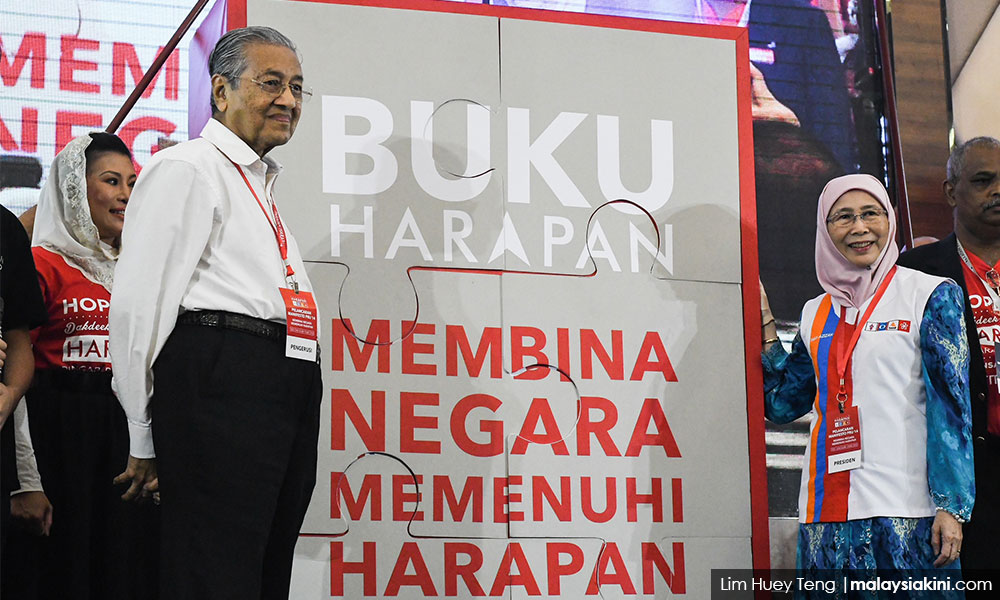

The real Harapan manifesto is Mahathir's
COMMENT | With Buku Harapan dominating the headlines again the past week, I am starting to suspect that it is not the Pakatan Harapan’s real manifesto. If you have been trained in law like me, you always look for the unwritten.
Buku Harapan
You may suggest that my suspicion is unfounded because the Harapan manifesto is already so long – how can there be a separate manifesto on top of that? But I am not hinting at an additional manifesto, but an alternative one – the Mahathir manifesto.
Let me explain. My suspicion started during Harapan’s campaign leading up to the historic May 9 election. It was welfare-based and people-centric.
Back then, I found it peculiar that a neoliberal like Dr Mahathir Mohamad would agree with so many things he was previously in principled opposition to – like raising the minimum wage, abolishing the tolls, delaying PTPTN loans, re-examining megaprojects, investigating scandals and other welfare programmes.
I thought to myself, this is too good to be true.
None who have followed Prime Minister Mahathir’s career would consider him an advocate for public welfare. There is always a feeling that he was following in the footsteps of former British PM Margaret Thatcher and former US president Ronald Reagan, who believed that everyone could escape poverty if they pulled themselves up by the bootstraps.
Recently, when Mahathir was asked why the minimum wage was only increased by a meagre RM50, he said he isn’t too keen on wage hikes before productivity is increased.
In 2012, he said implementing a minimum wage would bankrupt the country. He ignored the fact that the percentage of wage increase in the country was severely lagging behind inflation; or the existence of a vicious cycle of low wages, low skill, and low productivity.
This time, he said that the cost of business would be pushed too high if the minimum wage went anywhere higher than the announced RM50 increase. The sum itself is a gesture that satisfies the manifesto, while not offending the business owners too much...
COMMENT | With Buku Harapan dominating the headlines again the past week, I am starting to suspect that it is not the Pakatan Harapan’s real manifesto. If you have been trained in law like me, you always look for the unwritten.
Buku Harapan
You may suggest that my suspicion is unfounded because the Harapan manifesto is already so long – how can there be a separate manifesto on top of that? But I am not hinting at an additional manifesto, but an alternative one – the Mahathir manifesto.
Let me explain. My suspicion started during Harapan’s campaign leading up to the historic May 9 election. It was welfare-based and people-centric.
Back then, I found it peculiar that a neoliberal like Dr Mahathir Mohamad would agree with so many things he was previously in principled opposition to – like raising the minimum wage, abolishing the tolls, delaying PTPTN loans, re-examining megaprojects, investigating scandals and other welfare programmes.
I thought to myself, this is too good to be true.
None who have followed Prime Minister Mahathir’s career would consider him an advocate for public welfare. There is always a feeling that he was following in the footsteps of former British PM Margaret Thatcher and former US president Ronald Reagan, who believed that everyone could escape poverty if they pulled themselves up by the bootstraps.
Recently, when Mahathir was asked why the minimum wage was only increased by a meagre RM50, he said he isn’t too keen on wage hikes before productivity is increased.
In 2012, he said implementing a minimum wage would bankrupt the country. He ignored the fact that the percentage of wage increase in the country was severely lagging behind inflation; or the existence of a vicious cycle of low wages, low skill, and low productivity.
This time, he said that the cost of business would be pushed too high if the minimum wage went anywhere higher than the announced RM50 increase. The sum itself is a gesture that satisfies the manifesto, while not offending the business owners too much.
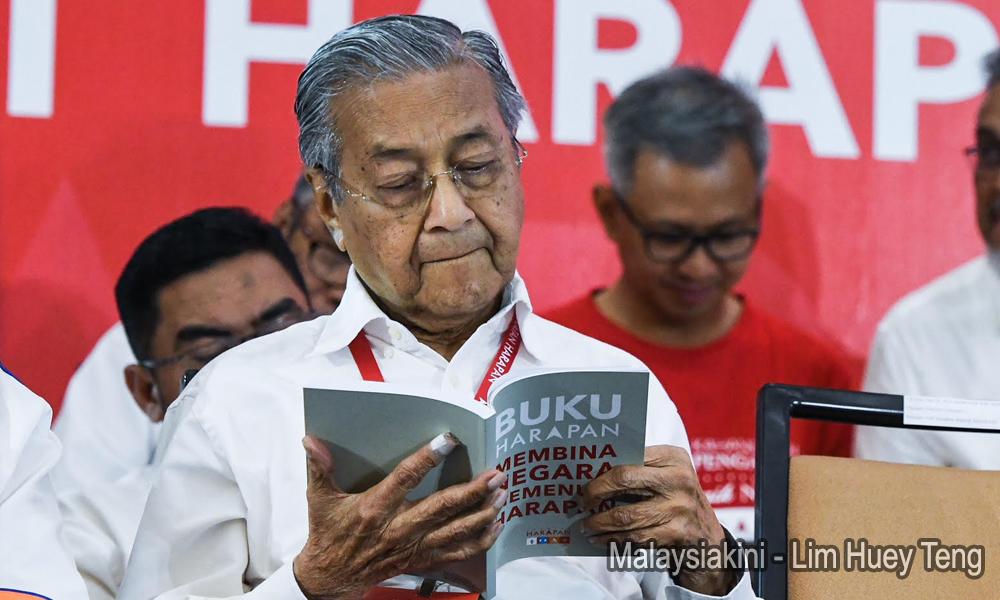
Mahathir understands the adage of “campaign in poetry, govern in prose”. The maxim, popularised by former New York governor Mario Cuomo, means that when you campaign, you promise everything under the sky in order to win votes – promises that have to be reneged on when you start governing, because you are confronted with numerous complex challenges.
Not a legally binding document
Campaign in poetry, govern in prose. At first, Mahathir said that the manifesto is not a bible. We all can agree to this. The manifesto is not a legally binding document, Harapan can’t be brought to court if it fails to keep its promises.
Voters are rational people. No one is seriously suggesting that the manifesto must be fulfilled to the letter. There are real hindrances and obstacles since the machinery of government is not just about willpower, it is also about consensus-building, compromises and practicality.
But even when the manifesto is not a legally binding document, it is also not merely a piece of paper. A manifesto is the closest thing to a legally binding document the people can pin their hopes to. It is a yardstick of accountability.
More important, a manifesto is a tool to determine how sincere the government is in improving the lives of its people.
So while it may not be a sacred text, it should be a sacred promise. It is the sincerity behind the manifesto that is paramount. That is the difference Mahathir missed.
Not written to win
Over time, Mahathir’s response towards not fulfilling the manifesto gets increasingly odd. He started to say the manifesto was written without the expectation that Harapan would win government.
Why would he take the dramatic step of not just quitting Umno, but forming a new party, and going through tireless campaigns across the country if he had no hope of winning government?
It is also contradictory to his statement months before the election, where he was quite certain that he would win the government. He is also now in an awkward position with the people he pleaded to for their unbridled support.
But the oddity here is compounded if you think seriously about what he said: who really writes a manifesto with no hope of winning government? Isn’t the whole purpose of a manifesto to win government? What else is a manifesto for?
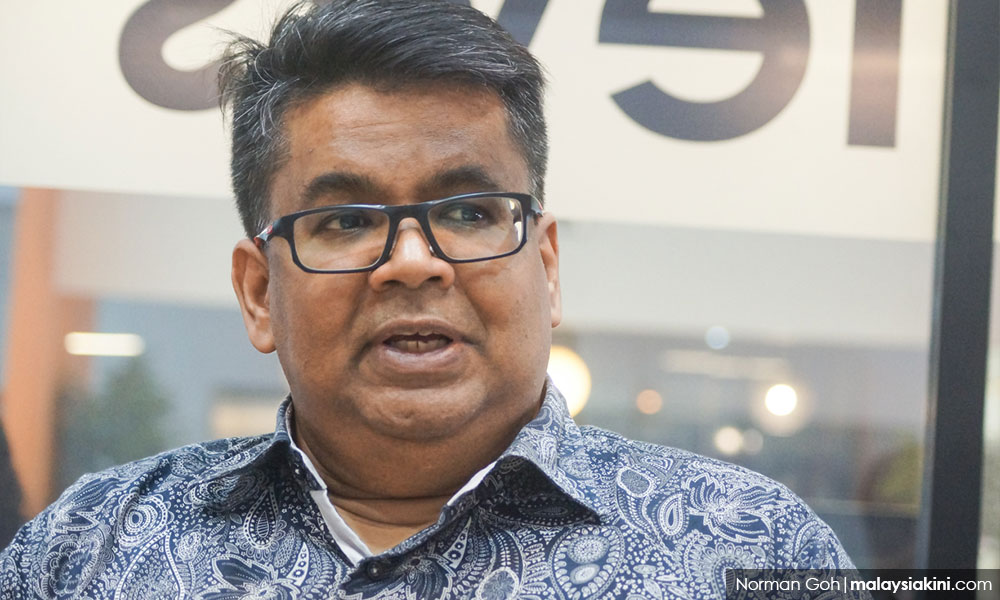
People like Rais Hussin (photo) who spent months and months writing the 190-page manifesto, would certainly have written it in hopes of winning. Mahathir’s response here appears like an excuse, with shades of ruse.
Not in agreement
Recently, we finally got a sense on why Mahathir is not bothered by the manifesto: he didn’t agree with a lot of the pledges made. This is the most sobering reason we have heard so far. Now it all makes sense.
If you had always doubted Mahathir’s sincerity in agreeing to things in the manifesto he had been against his whole life, you now have an explanation.
What Mahathir said is flagrantly unacceptable, since the least you could expect is that the leader of a coalition would agree to the most important document of the campaign. If even he did not agree to most of what is contained in the manifesto, what are the promises worth?
Again, a manifesto isn’t legal document; but it must at least be worth at least the paper it was written on.
Now there seems to be a separate manifesto that Mahathir’s government is following – his own. Against the megaprojects by fat cats like MRT2, Mahathir was quick to terminate them. But against the megaprojects like tolled highways, Mahathir was not as quick to do the same. Aren’t the levels of cronyism and corruption in both the same?
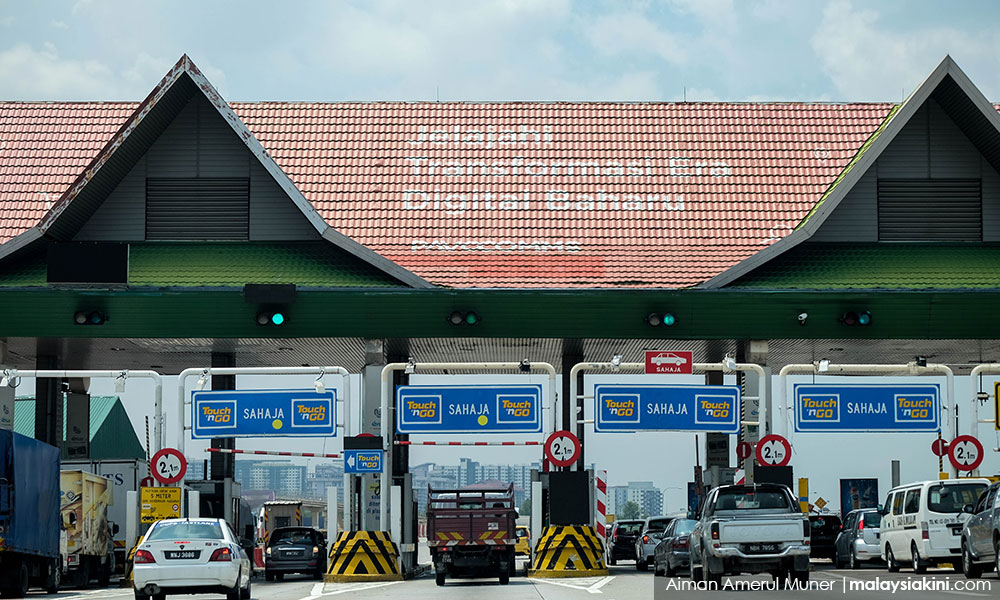
Against most of the promises of the manifesto, Mahathir said they needed more time because the government is laden with debts. But the national car project is being pursued with agility, with a prototype due to be rolled out as early as 2020. There are certain things Mahathir wants to hurry, and others he is holding back on.
Mahathir did not even attempt to find his way around fulfilling the principle of reducing the toll burden. He was not as careful as Baru Bian in proposing alternative ways of fulfilling the manifesto, of either reducing the amount charged, imposing fixed charges, or offering rebates.
The prime minister spoke from principle, in saying tolls are meant to be charged. The choice is either tolls or higher petrol prices, with nothing in between.
So Harapan cannot be accused of not following its manifesto. It is just a matter of which manifesto we’re talking about.
JAMES CHAI works at a law firm. His voyage in life is made less lonely with a family of deep love, friends of good humour and teachers of selfless giving. This affirms his conviction in the common good of people: the better angels of our nature. He tweets at @JamesJSChai.
The views expressed here are those of the author/contributor and do not necessarily represent the views of Malaysiakini.


Report this comment
Are you sure you want to delete this comment?
This action cannot be undone.