




Fiddler of the Truth - Moore low blows (Part 2)
Documentary presenter Christopher Hitchens, who is better known as a journalist-author, produced a widely quoted critique on Michael Moore that sums up what Moore critics feel to be his betrayal of the craft. Hitchens argues: " if I write an article and I quote somebody and for space reasons put in an ellipsis like this [], I swear on my children that I am not leaving out anything that, if quoted in full, would alter the original meaning or its significance. Those who violate this pact with readers or viewers are to be despised" (2).
To deliberately distort a conciliatory speech into a gloating one ( Part 1 ) is despicable. But if Moore had already painted a black picture of Charlton Heston through his alternate reality fix, well, the filmmaker is not through yet with his assault on the hapless actor. Closing his film Bowling for Columbine , Moore plays another Heston segment designed to evoke an undeserved and callous impression of Heston. Under false pretences, he had finagled an interview with the elderly movie star (then president of the National Rifle Association) at the latter's sprawling Hollywood home.
Watching on DVD, it is easier for my friend (a former sound engineer) and me - compared to cinema-goers - to spot the clues that point to the director manipulating video footage in Bowling . Using the DVD player's zoom-and-magnify tool, we see a wall clock in the background (near Moore's head) reading 5.47 at the start of the interview. When Heston finally escapes from Moore's badgering, it is 6.10. By the clock, 23 minutes had elapsed. Moore claims he had left the interview almost unedited, yet it timed only five and a quarter minutes. The doctored footage is brought to light by Moore's American critics but once you know what to look out for, you realise that these cuts are discernible to an alert layman.
Documentary presenter Christopher Hitchens, who is better known as a journalist-author, produced a widely quoted critique on Michael Moore that sums up what Moore critics feel to be his betrayal of the craft. Hitchens argues: " if I write an article and I quote somebody and for space reasons put in an ellipsis like this [], I swear on my children that I am not leaving out anything that, if quoted in full, would alter the original meaning or its significance. Those who violate this pact with readers or viewers are to be despised" (2).
To deliberately distort a conciliatory speech into a gloating one ( Part 1 ) is despicable. But if Moore had already painted a black picture of Charlton Heston through his alternate reality fix, well, the filmmaker is not through yet with his assault on the hapless actor. Closing his film Bowling for Columbine , Moore plays another Heston segment designed to evoke an undeserved and callous impression of Heston. Under false pretences, he had finagled an interview with the elderly movie star (then president of the National Rifle Association) at the latter's sprawling Hollywood home.
Watching on DVD, it is easier for my friend (a former sound engineer) and me - compared to cinema-goers - to spot the clues that point to the director manipulating video footage in Bowling . Using the DVD player's zoom-and-magnify tool, we see a wall clock in the background (near Moore's head) reading 5.47 at the start of the interview. When Heston finally escapes from Moore's badgering, it is 6.10. By the clock, 23 minutes had elapsed. Moore claims he had left the interview almost unedited, yet it timed only five and a quarter minutes. The doctored footage is brought to light by Moore's American critics but once you know what to look out for, you realise that these cuts are discernible to an alert layman.
It is after this that Moore perpetrates a really cheap trick. Heston ends the interview and leaves the room. Moore and crew trail after him and get Heston to briefly turn his head. This is what we see on screen: Moore holds up a photo of Kayla Rolland, a six-year-old girl shot dead by her classmate in another controversial school incident. Moore implores Heston to look at the picture, but elicits no response. "This is her Mr Heston, please don't leave. Mr Heston, please take a look at her. This is the girl." We are treated to Heston's resolutely retreating back.
At this juncture, you're almost ready to swear that Heston possessed a stone-cold heart, except that the melodrama is faked!
 Since we're looking from behind Moore's back (showing Heston ambling off in the distance), then at Moore's front (showing him holding the picture) with the camera angle shifting back and forth to give five perspectives in all of 18 seconds two cameramen would have been required to shoot this exchange.
But there's a catch. Could a second cameraman lugging his equipment in the few moments he had to give chase to Heston walking away have run that far ahead? Hardly, the intervening distance between Moore and Heston and the cameras is too great. Plus there is no earlier indication that Moore used or brought along two cameras.
The clincher that unravels Moore's deception, however, is that two cameramen would definitely have filmed each other as well. "The front footage is taken from a point about level with Moore's chest and clearly shows the area of his left side and shoulder. The back footage is taken immediately off Moore's left shoulder indeed, his arm and shoulder are visible in it and shows the area in front of him down to within a foot of the steps themselves. The front cameraman would have filmed the back camera at Moore's left side, and the back cameraman would have caught the front camera, right in the middle of its image." (Michael Moore is a Big Fat Stupid White Man, page 79).
Two cameramen (Big Fat authors David Hardy and Jason Clarke) could not have ducked up and down to be out of camera frame in the five perspectives switches within 18 seconds, nor one cameraman impossibly running to and fro considering there is no break in the footage. Authors Hardy and Clarke make a logical conclusion that Heston is first filmed walking away and Moore is later posed holding up Kayla's photo after Heston's departure. The footage purporting to show two camera angles was spliced together in the editing room. Which makes Moore's affected pleas nothing more than a ploy, though only heaven knows to what lofty purpose. Does he mean to hold Heston personally accountable for the little girl's death?
Moore low blows
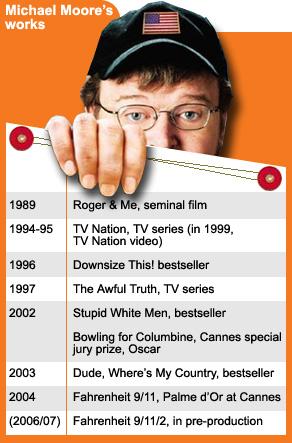
In an interview on his breakthrough film Roger & Me , Moore concedes in the wake of his interviewer's insistent probing: "Okay, you can say the chronology skips around a bit" (3).
A similar tweaking of timeline happens in Bowling . After a scene of Kayla's principal recalling the little girl's murder at her school in Mt Morris, Michigan (north of Flint) another Heston speech is juxtaposed. The "cold, dead hands" phrase makes a chilling re-appearance too, by the way.
Here the diehard sci-fi fan might holler, "Scotty, there appears to be another warp in the time-space continuum!" The Kayla shooting was in February 2000. Heston's speech was given in October, eight months later. The occasion was, again, not "a big pro-gun rally". Heston was campaigning for the Republicans to get out the vote in the most closely contested presidential election in American history (you can tell from the Vote Bush placards in the background).
Moore's cinematic devices do not permit his audience to register important details belonging to images that fly pass in the blink of an eye. One blatant example is a sequence, which clocked more or less 40 seconds, following the scene showing Moore comforting Kayla's principal. It features:
Heston's speech (Moore makes the contrived, fraudulent "cold, dead hands" connection here), narrator saying: "Just as he did after the Columbine shooting, Charlton Heston showed up in Flint, to have a big pro-gun rally", a still of a protestor's placard, flash of a student newspaper highlighting Heston's name (when in actual fact Heston makes no reference to Kayla), flash of the NRA website with the highlighted words "48 hours after Kayla Rolland was pronounced dead", and protestor wearing a "Million Mom's March" T-shirt wailing: "How could they come here? To me it's like they're rubbing our nose in it."
Six film elements gallop by in quick succession in about 40 seconds, and the viewer is encouraged in his impression that Heston showed up in Flint 48 hours after Kayla's death. But hold it right there! With the DVD player, a home viewer can freeze the rapid-fire flashes to make sense of each individual image. Under magnification, we can now read the full sentence on the NRA website: (highlighted and enlarged by Moore) "48 hours after Kayla Rolland was pronounced dead", (in fine print) "Bill Clinton is on The Today Show telling a sympathetic Katie Couric, 'Maybe this tragic death will help. We need the public aroused on this'" Hullo, Mr Moore, what is this?!
Chronology is not the only aspect Moore plays fast and loose with. The 40-second montage described above had nudged even professional movie reviewers into misconstruing "What was Heston thinking going to Michigan...?" I can only remain flabbergasted at Moore's underhanded tactic.
The rabble-rousing director compounds his offence when he asks Heston if he wants to apologise to the people of Flint. Heston is, to be expected, clueless but his truthful responses in view of Moore's devious set-up come across as "clumsy lies". Moore later granted that Heston's visit was long after the girl's death (4).
What documentary?
Many other methods employed by Moore in his filmmaking cast further doubt on his veracity. For instance, it is accepted that when a re-enactment is carried out, it is mentioned or captioned as such. Although Moore staged the dog-firing-a-gun vignette in Bowling , he neglects to indicate that it was a recreated scene.
People appearing in his films complain that Moore has misrepresented them, and one man even won a lawsuit after being pictured in a false light (5). Moore's supporters counter that his sins of omission and commission are necessary film techniques to juice up the presentation. My firm opinion is that his reprehensible methods and tactics simply degrade the documentary genre.
 I stand with the camp that finds Moore's deliberate crafting of false impressions to bolster his agenda unacceptable. I have nothing against Moore's issues platform but I do recoil from his methods. As an example, I support his stance in Bowling for Columbine urging for greater gun control believing, for one, that licensing hunters to shoot defenceless animals for sport reflects only Man's hubris but Moore's "the ends justify the means" methods are to me thoroughly abhorrent.
Closer scrutiny of Moore's films shows up evident self-contradictions inherent in his oversimplified theses this time factual errors instead of purposely-directed (mis)assumptions. The man floats innuendoes and peddles conspiracy theories (especially in Fahrenheit 9/11), so much so that an industry has sprung up to rebut point-by-point Moore's suspected falsifications in his major works (see recommended reading below).
Against this backdrop, it puzzles me to see Moore still enjoying such a high level of acclaim in Western Europe, locally and indeed around the world. Blueprint, the politics and policy journal of the Democratic Leadership Council in one article suggests a reason for his astounding popularity: "The predisposition abroad to loathe President Bush translates into uncritically loving Michael Moore" (6).
Moore's elevated status in Malaysia could be an amalgamation of the above reason as well as support for Moore's "Americans are the real villains / terrorists" paradigm contained in his works like Fahrenheit. Needless to say, the people who hold America to be the biggest threat to the planet already possess an in-built receptivity to Moore's loaded message.
In Stupid White Men , Moore rails against "the state of stupidity" in his country, the United States, which he alludes to as "a nation of idiots". This sits well with the French (but of course) and Germans who made the book a bestseller. Andrew Sullivan in the Times of London neatly sums up this theory concerning the superior attitude of Western Europeans, the intelligentsia and I daresay Malaysians too: "Alongside this (prejudices of the Left) theological zeal goes a general belief in the idiocy and indolence of most Americans and the stupidity and malevolence of their leaders. If you're a Guardian reader , this book's for you (7)".
It worries me that most Malaysians take Michael Moore's scattered shots to be gospel truth. Could this be due to the fact that the local mainstream media has paid scant notice to the controversies that have been brewing around Moore (his critics include apparently an ethics centre, and a propaganda study) for quite a long while now? The misguided desire to make a hero out of Moore (especially since he's now producing a sequel to Fahrenheit) seriously needs to be checked and debunked, not only abroad but locally where he is so fawned upon.
It's my fear also that few people here see through Moore's shallow propaganda. Hitchens even goes so far as to introduce Sergei Eisenstein (Josef Stalin's propagandist) and Leni Riefenstahl (Nazi filmmaker who made the 1936 Berlin Olympics documentary) as a gauge against which to measure Moore's "filmic standards" (8). Given Moore's myriad transgressions against long-held documentary standards, I hesitate to even dignify Moore's films as documentaries.
Nor should anyone claim Moore's work to be journalism either. Cornered on his fudged facts in Roger & Me , Moore blurted out his objection, 'because you see this primarily as a documentary'." Asked how he himself sees it, Moore says, "I think of it as a movie, an entertaining movie An entertaining movie like Sophie's Choice ." (9)
It is as if by refusing to characterise Roger & Me as a documentary, Moore relieves himself of the need to be accurate and accountable. Similarly when CNN's Lou Dobbs taxed him on the glaring inaccuracies in Stupid White Men, Moore famously shrugged: "But you know, look, this is a book of political humour... How can there be inaccuracy in comedy? You know." (10)
And there you have from the horse's mouth what should be a wake-up call to all of us. We would be much better off taking Moore's disingenuous statements at face value. Let's regard this outsized multimedia phenomenon as a talented entertainer or as a comedian. But please, put a big, fat question mark firmly against Moore's trustworthiness as a documentary director.
Part 1 of this article was published last week.
Endnotes:
2. Unfairenheit 9/11: The Lies of Michael Moore by Christopher Hitchens (online publication Slate.com, June 2004)
3. Michael & Me by Harlan Jacobson in Film Comment (Nov-Dec, 1989).
4. Not So Stupid White Men Fight Back by Clive Barker in Times of London (June 18, 2003)
5. (i) Idiot Time by Alan Wolfe in New Republic (July 8, 2002) reporting on Fred Barnes' denial that a conversation with Moore ever took place. Moore himself writes a different account elsewhere of the alleged phone call to Barnes compared to his version in Stupid White Men ; (ii) Moore was sued by his attorney (ex) friend Larry Stecco, who claimed the filmmaker portrayed him in a false light in Roger & Me. In 1993, a jury found for Stecco and awarded damages later paid by the film's distributor Warner Brothers (Information obtained by "MICHAEL Moore is a Big Fat Stupid White Man" authors from Stecco's attorney Glen Lenhoff).
6. Michael Moore's Truth Problem by Peter Ross Range in Blueprint, the politics and policy journal of the Democratic Leadership Council (March 2004).
7. America's Left Surrenders Itself to the Giant Sulk by Andrew Sullivan in Times of London (March 31, 2004).
8. With Michael Moore's Fahrenheit 9/11 , an entirely new note has been struck. Here we glimpse a possible fusion between the turgid routines of MoveOn.org and the filmic standards, if not exactly the filmic skills of Sergei Eisenstein or Leni Riefenstahl. To describe this film as dishonest and demagogic would almost be to promote those terms to the level of respectability." (Hitchens, op cited.)
9. Jacobson, op cited.
10. When Moore is Less by David Aaronovitch in The Guardian (Nov 19, 2003).
Moore Reading:
War, Lies, and Videotape: A Viewer's Guide to Fahrenheit 9/11 by The Ethics and Public Policy Center (Oct 5, 2004)
Propaganda Tactics & Fahrenheit 9/11 by by Kelton Rhoads, Ph.D in workingpsychology.com (2004)
Fifty-nine Deceits in Fahrenheit 9/11 by Dave Kopel in davekopel.com
Unmoored from Reality by John Fund in Wall Street Journal (March 21, 2003)
Michael and Me by Andrew Anthony in The Observer (May 23, 2004).
The World According to Michael by Richard Corliss in Time magazine cover story (July 19, 2004).
Less is Moore: Fact-checking a Polemicist by Andrew Sullivan in Sunday Times of London (Dec 8, 2002)
Moore is Less by Daniel Radosh in Salon (June 6, 1997)
Baloney, Moore or Less by Richard Cohen in Washington Post (July 1, 2004)
When Tables Turn, Knives Come Out by John Tierney in The New York Times (17 June, 2000)
Websites:
spinsanity.org (Brendan Nyhan / Ben Fritz)


