




Fiddler of the Truth (Part 1)
Some cherished notions are like tattered teddy bears you can't stand to throw out. The journalistic fraternity can attempt to set the record straight on misreported facts but it's harder to alter views already formed and fossilised. For example, while people may grudgingly accept the home minister's recent assertion that the nude woman in the ear-squat debacle is Malay and not Chinese, it could prove more difficult to budge entrenched public opinion that the Malaysian police are often naughty.
Some cherished notions are like tattered teddy bears you can't stand to throw out. The journalistic fraternity can attempt to set the record straight on misreported facts but it's harder to alter views already formed and fossilised. For example, while people may grudgingly accept the home minister's recent assertion that the nude woman in the ear-squat debacle is Malay and not Chinese, it could prove more difficult to budge entrenched public opinion that the Malaysian police are often naughty.
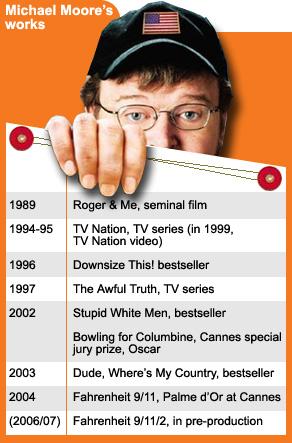
 In the matter of correcting errata, Michael Moore Inc today a multimedia brand name in the mould of Oprah provides a reverse study. Moore is so favourably regarded by readers and viewers that they're predisposed to believe everything he says. Although a growing posse of Moore scrutineers have fingered inaccuracies and discrepancies in his body of work, they still face an uphill task convincing his legion of fans that their idol has feet of clay.
You might think that it is mainly the American right which accuses Moore of twisting facts to fit his politics. On the contrary, among the earliest to reveal the flaws in Moore's work were the The Los Angeles Times and liberal magazine New Yorker (1). Their expose possibly cost Moore his first Oscar nomination for Roger & Me.
Since then, Moore's works and his public persona have been examined and found wanting in a wide spectrum of publications the likes of Washington Post , The New York Times , Times of London , The Independent , The Observer , The Guardian , Wall Street Journal , and a line that grows ever longer. This critical approach is a departure from the kid-glove days when all Moore got were the predictable raves.
A hardcover book titled Do As I Say (Not As I Do) released two months ago also assails Moore's 'Joe Baseball Cap' image. Corporate-basher Moore claims he has never owned stocks. Investigative author Peter Schweizer published Moore's tax returns which show the millionaire buying and selling shares in Halliburton and plenty of other stocks from the 'military-industrial complex' and oil industry.
D-I-Y detective work
With Moore's films now readily available on video, Malaysian viewers can check for themselves why the shock-jock's name has become so closely associated with "splice-and-dice", and whether the allegations of deceit continually levelled at him are warranted.
Thus, with printed notes in hand, I sat down to watch Bowling for Columbine on DVD. I had with me the trusty remote controller to rewind and replay three segments suspected to be doctored. These involve Charlton Heston, who at the time of filming was president of the National Rifle Association (NRA). Beside me was a friend trained in sound engineering.
Bowling tells of the shooting at Columbine High School in Littleton near Denver, Colorado in April, 1999. Twelve students and a teacher were gunned down before the two teenaged killers took their own lives. The film title comes from Moore's mistake in believing the boys had attended a bowling class on the morning of the tragedy; police later said they had played truant.
Billed as a documentary, Bowling is essentially a look at America's love affair with firearms and its culture of fear. Moore portrays the NRA as callous towards gun slaying and targeted Heston for, what Moore's critics say is, character assassination.
The first questionable segment appears after we see Columbine students weeping. The screen then goes blank and we hear Heston's voice proclaiming "I have only five words for you: 'from my cold, dead hands'" before he materialises waving a musket. The film proceeds to a shot of the billboard advertising NRA's gun expo-cum-annual meeting, while Moore gravely intones, "Just 10 days after the Columbine killings, despite pleas of a community in mourning, Charlton Heston came to Denver and held a large pro-gun rally for the National Rifle Association."
Moore is a Big Fat Stupid White Man ( Big Fat ), a 2004 book from the HarperCollins stable that hit the New York Times bestseller list, disputes Moore's contention. It is a far stretch to say the NRA marched to Denver as a response to Columbine, say the book's authors, attorney David Hardy and web designer Jason Clarke. The gathering was an annual meeting whose place and date had been fixed much earlier; the NRA would not have had time enough to inform its four million members should there be a postponement or change of venue. In any case, an annual meeting still had to be called in compliance with New York non-profit corporation law and to cancel it would have required 10 days' official notice whereas Columbine happened only 11 days before the meeting's scheduled date.
Furthermore, the association had cancelled all other events exhibitions, seminars, workshops, committee meetings, lunches, in fact everything but the voting required by law. Moore had purposely deleted Heston's announcement about scaling back the NRA activities by inserting a shot of the audience when showing Heston's speech.
Moore's narration Just 10 days after the Columbine killings immediately segues from the scene of Heston waving the musket and seemingly threatening "I have only five words for you: 'from my cold, dead hands'. Granted the phrase has dramatic value, but its out-of-the-blue use is devoid of context and may be interpreted by some viewers as being directed at Columbine survivors and victims' families. Heston actually says the "cold, dead hands" phrase not in Denver but 900 miles away in Charlotte, North Carolina, a whole year later. He was thanking the NRA for its gift of the handmade musket that we see him holding aloft, Hardy and Clarke tell us.
The real Denver speech follows after the billboard shot. Two separate speeches positioned together like that misleads viewers into thinking they are one and the same speech. Big Fat theorises that the billboard interlude was a distraction to deflect attention from Heston's little sartorial miracle. Remember that cinema audiences sitting in the dark when Bowling was first aired did not have the pause button facility.
Saying "cold, dead hands", Heston is wearing a checked purple tie and lavender shirt. The drape behind the podium is blue. Then, as movie buffs might say, "Houston, we have a continuity problem!" When Heston begins his speech with "Good morning", his tie is red, shirt white and the drapes maroon.
Missing pieces
My former sound engineer friend and I replay this next bit at least a dozen times bearing in mind, as he explains, "Nowadays, everything is done electronically. With computers, they can do this splicing seamlessly."
We hear Heston applauding NRA members for their courage in turning up for the meeting. The film cuts to a demonstration protesting the association's presence. Then Heston continues very abruptly "I have a message from the mayor" Being an accomplished public speaker, Heston has a measured tone. I'm inclined to another Moore edit here as the sudden dip and rise in cadence is out of whack with the rest of Heston's delivery.
Moore sceptics insist that the speech below, which makes out Heston to be defiant and taunting, is doctored: "I have a message from the mayor, Mr Wellington Webb the mayor of Denver. He sent me this. It says 'don't come here. We don't want you here.' I say to the Mayor, this is our country, as Americans we're free to travel wherever we want in our broad land. Don't come here? We're already here"!"
Heston appears to be talking in a continuous stream the half minute or so excerpted by Moore above (my friend pronounces Moore "a genius", I might add "evil genius"). But wait, Heston's words had been cleverly "cut and pasted" into new configurations, Moore's critics charge.
 They claim at one point, Moore actually joins two entirely different sentences by snipping the phrases halfway. Referring to his WWII veteran status, Heston states: "I say to the mayor, well my reply to the mayor is, 'I was 18 years old. Since then, I've run small errands for my country, from Nigeria to Vietnam. I know many of you here in this room could say the same thing."
The cooked-up version goes: "I say to the mayor, this is our country, as Americans we're free to travel wherever we want in our broad land." Moore covers the merge by cutting to footage of protestors before going back and showing Heston.
Watching TV news, the average Malaysian has heard a fair sampling of statesmen making speeches. Let's compare what we know with Michael Moore's treatment. Think about it where else have we ever encountered such a short speech comprising only seven sentences to be interspersed with almost as many interludes (noisy protesters [twice], cheering and clapping audiences [twice], stills, Mayor Webb's photo and Moore's overlapping narration)? It's easy to believe that the cutaways are there to disguise the fact that those seven sentences are spliced from five different parts of Heston's speech.
The "Don't come here? We're already here" segment coming on the heels of "as Americans we're free to travel wherever we want" occurs five paragraphs later in the speech, where again Moore uses the audience ruse to camouflage his doctoring, Hardy and Clarke reveal.
In full it reads: "NRA members are in City Hall, Fort Carson, NORAD, the Air Force Academy and the Olympic Training Center. And yes, NRA members are surely among the police and fire and Swat team heroes who risked their lives to rescue the students at Columbine. Don't come here? We're already here. This community is our home. We're a 128-year-old fixture of mainstream America. The Second Amendment ethic of lawful, responsible firearm ownership spans the broadest cross section of American life imaginable. So, we have the same right as all other citizens to be here. To help shoulder the grief and share our sorrow and offer our respectful, reassured voice to the national discourse that has erupted around this tragedy. NRA members are, above all, Americans. That means that whatever our differences, we are respectful of one another and we stand united, especially in adversity. ( Big Fat , page 71)
Compared to the Bowling version, Heston's speech in its proper context sounds conciliatory, doesn't it? And Moore appears to be the consummate liberal with film cuts, that is!
Part 2 will be published next week.
Endnote:
(1)"Will Controversy Cost 'Roger' an Oscar?" by Elaine Dutka in Los Angeles Times (Jan 17, 1990); "Roger & Me" review by Pauline Kael in New Yorker (Jan 8, 1990).
Related websites


