




Media between clumsiness and refinement
For those who work in the media industry in Malaysia, they have been experiencing the bleakest moments since Abdullah Ahmad Badawi became prime minister, ironically on the platform of creating an open government willing to listen to the voices of truth.
The China Press sent two of its highest paid editors packing for misreporting the identity of the woman at the centre of the ear-squat scandal, while the Sarawak Tribune was dealt with a heavier hand when the government decided that enough was enough, and it had to be more than heads-must-roll, as reproducing the caricature of Prophet Mohammad which had been printed by a Danish newspaper was too sacrilegious to be exonerated.
May the longest-circulating newspaper in the East Malaysian state rest in peace.
For those who work in the media industry in Malaysia, they have been experiencing the bleakest moments since Abdullah Ahmad Badawi became prime minister, ironically on the platform of creating an open government willing to listen to the voices of truth.
The China Press sent two of its highest paid editors packing for misreporting the identity of the woman at the centre of the ear-squat scandal, while the Sarawak Tribune was dealt with a heavier hand when the government decided that enough was enough, and it had to be more than heads-must-roll, as reproducing the caricature of Prophet Mohammad which had been printed by a Danish newspaper was too sacrilegious to be exonerated.
May the longest-circulating newspaper in the East Malaysian state rest in peace.
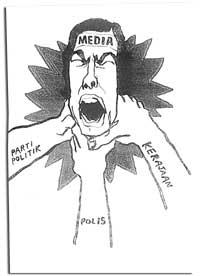 These two disciplinary actions have sent winter chills running up the spines of mainstream journalists. In this climate of fear, they can only commiserate over the fates of the two publications in their innermost selves, while walking on the tightrope like an acrobat.
On the other end of the spectrum, some have been more than amply awarded for their jealousy in guarding the Malaysian media. Noh Omar, who shot to international stardom by telling disaffected foreigners to leave the country late last year in the wake of the ear-squat saga, has been made a deputy education minister, with much head scratching among the public.
Zainuddin Maidin, who never tired of reminding the nation of western conspiracy, has finally taken charge of the ministry of information. Expect more "Malaysia-truly-Asia" content in our TV programmes.
Away from home
Away from home, outspoken journalists in China are now in for a long battle against the autocratic regime that is quick to show its fangs.
The Chinese Communist Party (CCP) that has been grappling with a multitude of social, economic and political challenges deemed Bing Dian, a critical and influential weekly, way out of line and showed no qualms in ordering its suspension last month. Meaning "freezing point' inauspiciously, the publication refused to budge from its investigative nature, and the censure signals the beginning of the deep freeze in the Chinese media industry. Bing Dian is now expected to return to the market in two weeks' time.
Meanwhile, Google announced that it would abide by Chinese laws and restrict access to content that was inimical to the CCP's interests. In other words, keying in terms written in Chinese characters that are sensitive to the Chinese authorities while in China, such as Tai Du (Taiwan independence), Jiu Ping (Nine Commentaries), Falun Gong (needing no explanation) and Liu Si (June 4), may not return the results that one desires.
 Google has argued that the best way to contribute to the greater access to information in China is to remain engaged with China. What is unsaid is that, with its global share value plummeting by up to one-third since two years ago, Google had no option but to tap into the huge market in China, whose netizens, at 110 million, number only second to the United States. More staggeringly, at least half of them are broadband users, and still counting, enough to make many salivate at the astronomical returns on such investment.
Google is not the only US technology giant to have kowtowed to the Chinese. Last September, Reporters Without Borders condemned Yahoo's Hong Kong arm of helping China track down Shi Tao, a dissident journalist, which led to the latter's jailing by the Chinese government.
Now, the moral dilemma for Yahoo users such as myself would be to decide what would be the best boycott tactic: to discard Yahoo, as Jeff Ooi has done, and switch to other alternatives (can any of them rival either Yahoo or Google?), or to simply stay put to see how things unfold?
The fact is, even without the collaboration of the two foreign companies, Beijing can still take care of its cyber dissidents pretty well. At 300,000, the country boasts the biggest number of internet monitors. Popularly known as "net police", these informants are working around the clock just to keep unfavourable items from the netizens.
In the West
 Over there in the West, one usually sees more media manipulation than outright censorship. Two days ago, David Miller of the
Guardian
wrote that fake news was being produced by the US authorities amidst mounting global pressure over Iraq. The most interesting aspect of this scenario lies in the fact that no journalists are needed, only actors who are willing to broadcast the upbeat news as 'genuine'.
Over there in the West, one usually sees more media manipulation than outright censorship. Two days ago, David Miller of the
Guardian
wrote that fake news was being produced by the US authorities amidst mounting global pressure over Iraq. The most interesting aspect of this scenario lies in the fact that no journalists are needed, only actors who are willing to broadcast the upbeat news as 'genuine'.
Being a fast learner, Tony Blair mastered the trick and went on to create his own fake news machine. Launched and masqueraded as an independent news website, the British Satellite News website is supported by World Television (WT), which in turn receives funding from the Foreign Office.
Moderate and measured criticisms of the US are necessary to help shed the impression that London is on Washington's coattails. According to WT, Malaysia is among the regular users of BSN news.
 Western media does get
clumsy
at times and the self-congratulatory government may lose its temper and snap at those who are audacious enough to rub its nose, as is the case with the latest
Abu Ghraib episode
.
Western media does get
clumsy
at times and the self-congratulatory government may lose its temper and snap at those who are audacious enough to rub its nose, as is the case with the latest
Abu Ghraib episode
.
And, contrary to what the Europeans have been arguing, once obsessed with self-righteousness, even the western press can be as biased, ignorant and arrogant as its Asian counterpart.
So, there may not be media control in the so-called developed nations as we know it here, yet the competition for public influence on the part of the powers-that-be through the media continues to be a fact in political life.
With real, semi-real, and pseudo news abounding, the struggle does not always begin with and end in the hands of the politicians, but takes the form of a psychological warfare, an element that is lacking in the media in this part of the world.
Little wonder that many a US apologist, unable to quench the thirst for excitement, savours it with relish.


Are you sure you want to delete this comment?
This action cannot be undone.