


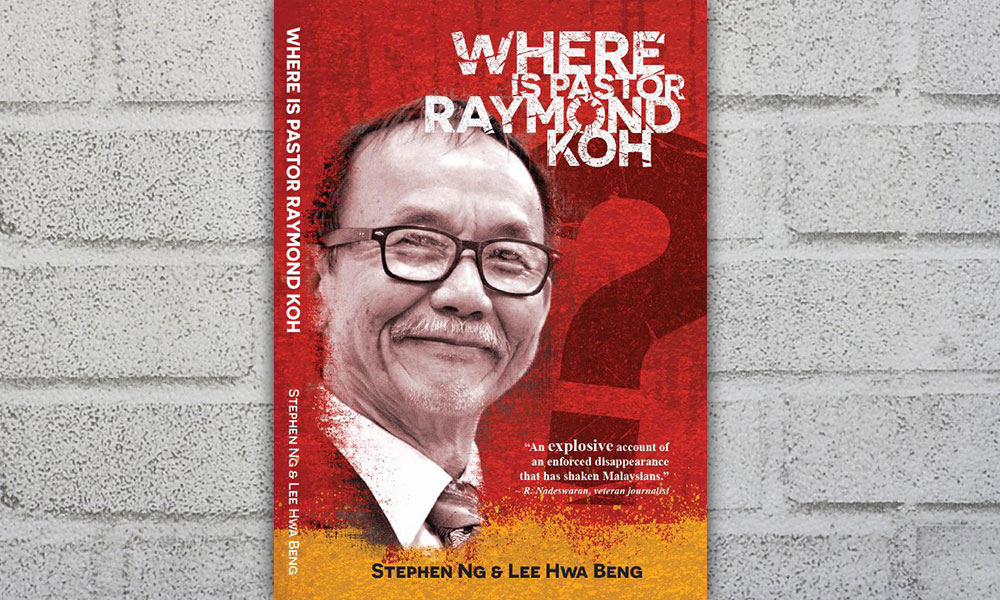

Forced to disappear but not forgotten
Title: Where is Pastor Raymond Koh
Authors: Stepen Ng & Lee Hwa Beng
Publisher: Semai Maju Sdn Bhd
Price: RM35.00
BOOK REVIEW | In my travels over the years, even when on holiday, I never miss opportunities to do networking and meeting with fellow journalists. In one of my forays in the late 80s, I met a young journalist who was very much into the arts – poetry and drama taking precedence over his profession.
I had met Richard Zoyza when I was part of a cricket team which played a series of friendly matches with the media in Colombo in the late Eighties. He was one of the many journalists I was to befriend, but I took a special interest because he was connected to Malaysia, or rather Malaya.
His maternal grandfather, Manocasothy Saravanamuttu, was the editor of the now-defunct Straits Echo – the first English newspaper in this part of the world. To cricket aficionados, he captained Penang and the then Straits Settlements teams.
Richard had never met his grandfather, but talked at length on journalism, freedom of the press and human rights.
In February 1990, the tragic death of Richard made news all over the world – he was kidnapped and murdered by the police. A group of police officers had entered his house in downtown Colombo and took him away in front of his mother.
Two days later, his body was found – washed up on a beach with a broken jaw, burn marks and a bullet through his head...
Title: Where is Pastor Raymond Koh
Authors: Stepen Ng & Lee Hwa Beng
Publisher: Semai Maju Sdn Bhd
Price: RM35.00
BOOK REVIEW |
In my travels over the years, even when on holiday, I never miss opportunities to do networking and meeting with fellow journalists. In one of my forays in the late 80s, I met a young journalist who was very much into the arts – poetry and drama taking precedence over his profession.
I had met Richard Zoyza when I was part of a cricket team which played a series of friendly matches with the media in Colombo in the late Eighties. He was one of the many journalists I was to befriend, but I took a special interest because he was connected to Malaysia, or rather Malaya.
His maternal grandfather, Manocasothy Saravanamuttu, was the editor of the now-defunct Straits Echo – the first English newspaper in this part of the world. To cricket aficionados, he captained Penang and the then Straits Settlements teams.
Richard had never met his grandfather, but talked at length on journalism, freedom of the press and human rights.
In February 1990, the tragic death of Richard made news all over the world – he was kidnapped and murdered by the police. A group of police officers had entered his house in downtown Colombo and took him away in front of his mother.
Two days later, his body was found – washed up on a beach with a broken jaw, burn marks and a bullet through his head. In those days, there was no Internet. Scant and bare details were obtained from friends who sent newspaper cuttings.
Enforced disappearances silence opponents and critics, but they also create uncertainty and fear in the wider community, silencing others who would oppose and criticise. Some regimes use enforced disappearance as an approach to spread fear within society. The feeling of insecurity and fear is far-reaching and affects communities and society as a whole.
In this case, the Sri Lankan authorities were attempting to do both.
Just when we thought that Malaysia was different and operated under the Rule of Law principles, a bombshell dropped. News of Pastor Raymond Koh’s disappearance first made its rounds more than two years ago, with a video clip of his kidnapping.
At that time, many (without any evidence) commented that it was a “Black Ops” carried out by the Special Branch.
Having closely followed Richard’s story, many journalists and I feared for Koh’s safety. When there was a clamour for answers into his disappearance, many of us made our stand by turning up at candlelight vigils to call for an official inquiry.
The events which followed and the findings of the Human Rights Commission of Malaysia, (Suhakam) released on April 5, provided authoritative evidence to authenticate earlier claims.
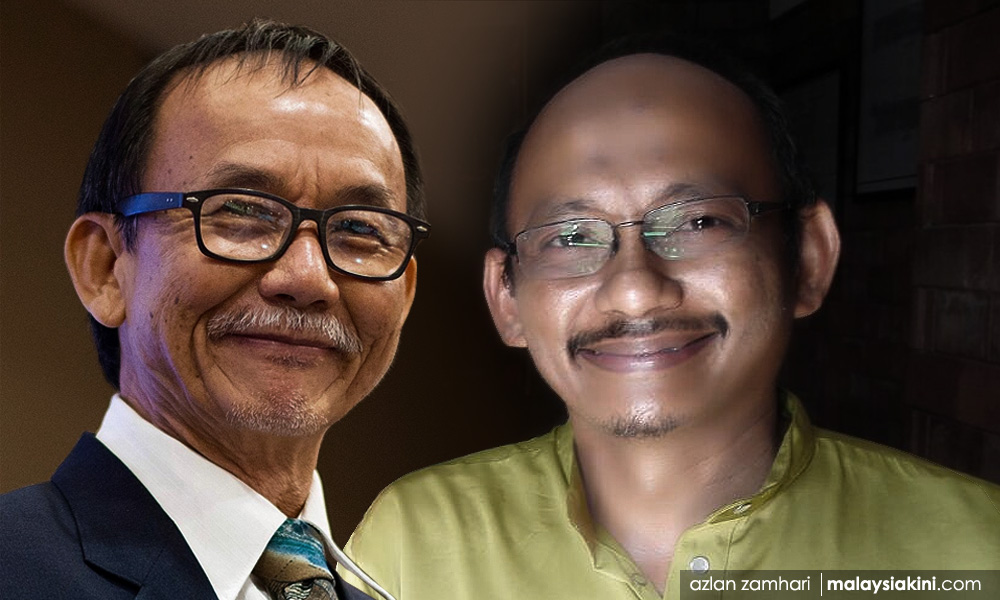
They were chilling indeed. Suhakam concluded that Pastor Raymond Koh (above, left) and a Muslim social activist, Amri Che Mat (above, right), were the victims of state-sponsored “enforced disappearances”.
Koh, who had been accused of proselytising to Muslims – something which was never proven - disappeared on Feb 13, 2017, in Petaling Jaya. Amri, who practices Shia Islam, which is banned in Sunni-majority Malaysia, disappeared on Nov 24, 2016, in Perlis. Suhakam said that the two men’s religious activities were the reason for their disappearance.
This book, 'Where is Pastor Raymond Koh' traces the course of events, including harassment by police and religious authorities, the events leading to the kidnapping, and the findings of the Suhakam Inquiry.
The news coverage of the inquiry may not have provided details, but the book contains enough material to show that police had carried out covert surveillance on individuals (although vehemently denied in their submissions.)
As described in the book, witnesses in both cases said that the men were kidnapped as they travelled in cars, which were boxed in by three other vehicles.
A gold-coloured Toyota Vios, owned by Special Branch officer Saiful Bahari, who has gone missing since, was at the scene of both attacks.
It is strange that the police have been unable to locate their own man, Saiful, who had worked in the force for 18 years. It is telling. Speculation is that he deliberately stayed away (on orders) from the inquiry.
This book gives a glimpse into the workings of the police force, which are seldom seen by the public. It chronicles many lies and deceits produced at the inquiry for reasons only known to those who made them.
There are several other pieces of information in the book that were not picked up by the media which covered the Suhakam Inquiry. To the many who are interested in current affairs and the workings of our system, this book makes compelling reading.
Co-author Stephen Ng has a telling message for the reader: “May this book strengthen the citizen’s resolution to fight the scourge of enforced disappearances. And may it give hope, without which all is lost.”
This alone is enough to get this book, read it and digest the many messages inter-weaved in the narrative.
NOTE: Ng and co-author Lee Hwa Beng are donating all proceeds from the sale of this book to Pastor Koh’s family.
R. NADESWARAN is a veteran journalist and hopes the committee set up to investigate the disappearance of these two men will be able to shed more light and point to the culprits who carried out these despicable acts. Comments: citizen.nades22@gamil.com
The views expressed here are those of the author/contributor and do not necessarily represent the views of Malaysiakini.


Are you sure you want to delete this comment?
This action cannot be undone.