




Where have the lessons gone?
President Hu Jintao of China, who asked for a state dinner at the White House but had to make do with a lunch, is reported by the Hong Kong press to have given his American host a copy of the Sun Tzu Art of War on his first visit as head of state to the United States.
Given the current mess in Iraq, it is perhaps useful for the American president to tap into the wisdom of the ancient war guru.
But Bush has his fair share of Schadenfreude too. As his visiting guest was giving a speech on the White House lawn, a female Falun Gong campaigner was yelling from outside. Her hysterical voice overwhelmed that of Hu, causing the Chinese president to halt for a few seconds before he continued unperturbed.
President Hu Jintao of China, who asked for a state dinner at the White House but had to make do with a lunch, is reported by the Hong Kong press to have given his American host a copy of the Sun Tzu Art of War on his first visit as head of state to the United States.
Given the current mess in Iraq, it is perhaps useful for the American president to tap into the wisdom of the ancient war guru.
But Bush has his fair share of Schadenfreude too. As his visiting guest was giving a speech on the White House lawn, a female Falun Gong campaigner was yelling from outside. Her hysterical voice overwhelmed that of Hu, causing the Chinese president to halt for a few seconds before he continued unperturbed.
These two interludes the Sun Tzu Art of War and the lone but loud protest of the Falun Gong follower so coincidentally juxtaposed side by side symbolise to the two world leaders a dilemma, namely how best to strike a balance between safeguarding state sovereignty and upholding the notion of human rights.
Pre-emptive war
The moral high ground taken by the Clinton administration in 1999 to stop the ethnic cleansing in Kosovo no doubt provided impetus to the interventionists who had become tired of and even hostile to the principle of non-interference in the domestic affairs of a sovereign state.
 Since Bush took over the White House, the influence of this self-conscious group continued to gain ground within the new administration, culminating in their successful argument for a pre-emptive war against the brutal regime of Saddam Hussein.
The interventionists, owing to their realist streak, urged the international community (read: London and Washington) to use its military might to rescue the oppressed from the malevolence of the tyranny, even at the expense of international law.
Three years on, the once solid moral ground assumed by Bush and Blair has turned into moral quicksand, leaving the world with a plethora of delicate issues to grapple with.
The Treaty of Westphalia of 1648 established the normative system of sovereign states which also set limits on the authority of states to exercise power over others, except in the case of aggression. The Westphalian principle dictates that states mind their own business, and prescribes that a government that is domestically democratic has no right to overthrow an autocratic regime merely because the latter is totalitarian.
I am not arguing here that the world should watch idly by when a ruthless ruler buys himself a sinkhole of blood through indiscriminate and systematic killing as well as reign of terror. I certainly wish that the Bosnian catastrophe had been stopped by a coalition force, and the ethnic cleansing in Rwanda averted by some other form of military intervention.
In the similar vein, it was absolutely right and proper for the US and Britain to forcibly establish no-fly zones in the north and south of Iraq in 1992 to nib the genocidal intention of the Saddam regime in the bud vis a vis the Kurds and the Shi'a Muslims.
But 2003 was different. First of all, there was no evidence of mass slaughter on the part of the tyrant. True, the absolute power of the Ba'ath government represented the most ghoulish guise of the Westphalian sovereignty principle, but the creation of the no-fly zones and the frequent use of force by the US and Britain against military targets inside them had been effective in deterring the brutal regime from exacting greater harm either against its own citizenry or the regional countries. Full invasion was neither needed nor justified.
Moreover, the false claims of Bush and Blair regarding Saddam's alleged links to al-Qaeda and maintenance of WMD clearly deprive them of any justification for a war that should have been avoided at all costs.
Decade-long sanctions
Most ironically, while Bush and Blair waged the war in order to, inter alia, restore the human rights to the Iraqi people, it was the decade-long sanctions imposed by the international community that had devoured the essence of human rights of the Iraqi children the right to life.
 This series of sanctions, insisted by the very nations claiming to punish the oppressive regime, turned out to be the "WMD", as some commentators once sarcastically remarked. A UN sub-commission on the Promotion and Protection of Human Rights found that the disastrous health situation in Iraq in the wake of the sanctions led to about 6,000 deaths a month among children under the age of five, while the embargo was bringing illiteracy back to the population. Meanwhile, Unicef reported a two-fold increase of infant mortality since 1990.
Iraq used to enjoy a relatively improved standard of living. Saddam solely ruined it with his ambitions. But the sanctions and embargo since 1991 were the last straw that broke the camel's back. These catastrophic consequences were brought home to the occupying forces post-2003 when they realised that even the western-trained groups were ill-equipped to restore essential public utilities to the Iraqi people.
While the Iraqi lessons are still fresh and the country struggling to return to normalcy, President Bush has begun to worry about the next international "bully" Iran . Here, it is worth reminding the lone superpower that it misreads Iran at its own expense. As Michael Axworthy has written in the Prospect Magazine recently, the US and Britain have misjudged Iran time and time again.
Functioning country
Like Iraq before the 2003 invasion, Iran is not a failed state. For all its economic malaise and rising unemployment, the country is functioning, albeit imperfectly. What is more, it is a working democracy, which debunks the Huntingtonian myth that liberal politics is not part and parcel of an Islamic culture. Iran's former president Mohammad Khatami remains a highly respected third world leader, thanks to his democratic mandate that he secured at home and his intellectual generosity.
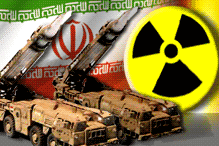 The US government must understand Washington and its allies may receive the blessing of the international community to launch military action in response to imminent and demonstrated menace, but each state's armaments are within its own sovereignty. The best way to solve the crisis is to bring Iran within an effective anti-proliferation regime - which it actually already is and to monitor its future (non)compliance in this regard.
Driving the Iranian leadership up the wall will only alienate the mostly moderate Iranian society that has been growing wary and frustrated with the ruling clerics, and cause them to rally behind the jingoistic Ahmadinejad. With the Saddam regime in mind, blowing the threat-perception out of proportion will only force the Iranians into the conclusion that their beloved country may well be overrun for a gander or a goose, and hence go out of their way to have both. North Korea is already a case in point.
In the worst case scenario, a war on Iran may turn out a large population of highly radicalised youths susceptible to fanatical ideologies of all kinds, while human rights will find it hard to flourish in conditions of instability, conflict, civil war and occupation, not to mention the plausibility of more Abu Ghraibs to come.
In short, there is no one-size-fits-all rule when it comes to confronting the autocrats around the world, and different dictatorships call for different strategies and measures. The US is certainly dealing with Myanmar and China two close partners in autocracy - in hugely dissimilar manners, and we all know why. If President Bush is flexible about this, what about Iran?


Are you sure you want to delete this comment?
This action cannot be undone.