




The Mahathir patronage
"I understood her pain at losing office better than she knew. I saw it etched on her face, and in her uneasy posture when she sat on the backbenches. It was evident in her body language when we met: she was uncertain how to react to someone who now held what she regarded as her job Politics had dominated all her life, and, no longer prime minister, she felt dispossessed, cheated and betrayed by those she had led. Cut loose from the Downing Street support mechanism, lesser men than those who had once advised her now poured poison in her ear perhaps with the intention of cheering her up. The target was, inevitably who else could it be? her successor." - John Major on Margaret Thatcher.
Not many people expected the former prime minister Dr Mahathir Mohamad to fall out with his successor so soon. In his tributes to the late Ghafar Baba last week, Prime Minister Abdullah Ahmad Badawi praised the deceased Umno veteran as someone who "dijemput datang, disuruh pergi". There was no mistake whom the PM was referring to.
"I understood her pain at losing office better than she knew. I saw it etched on her face, and in her uneasy posture when she sat on the backbenches. It was evident in her body language when we met: she was uncertain how to react to someone who now held what she regarded as her job Politics had dominated all her life, and, no longer prime minister, she felt dispossessed, cheated and betrayed by those she had led. Cut loose from the Downing Street support mechanism, lesser men than those who had once advised her now poured poison in her ear perhaps with the intention of cheering her up. The target was, inevitably who else could it be? her successor." - John Major on Margaret Thatcher.
Not many people expected the former prime minister Dr Mahathir Mohamad to fall out with his successor so soon. In his tributes to the late Ghafar Baba last week, Prime Minister Abdullah Ahmad Badawi praised the deceased Umno veteran as someone who "dijemput datang, disuruh pergi". There was no mistake whom the PM was referring to.
Although not his protg, Abdullah is nevertheless Mahathir's anointed one. Since "winning" the general election under the milieu of tight media control and gerrymandering two years ago, Abdullah has been slowly but steadfastly reorienting government policy, much to the dismay of his bestower.
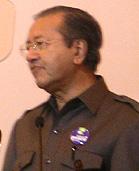 Mahathir has no doubt been feeling increasingly alienated in the process. He was clearly transfixed and alarmed when his nemesis Anwar Ibrahim was released from jail in September 2004, which in his understanding of politics could have been avoided through executive intervention. And the recent cancellation of the proposed crooked bridge over the Tebrau Strait finally prompted him to take public umbrage at his chosen one.
It goes without saying that the former PM has always been jealous and anxious in safeguarding his "legacy". From Proton to Putrajaya, he remains adamant that all this effor will serve Malaysia well in the long run.
He once boldly annoucned to the world that Malaysia was more than capable of achieving an annual growth rate of 7% to meet the goal of becoming a fully developed nation, but the economy has failed to grow beyond 6% since the dying days of his prime minstership. It would seem that the Wawasan 2020 has been put in the backburner now that Abdullah is preoccupied with othe priorities.
But there is more to Mahathir's outburst at the present government. Like Thatcher, the erstwhile Malay ultra was, and still is, a visionary and a man of conviction, the fact that many of his arguments and beliefs have been proven flawed is no concern to him.
This sense of self-importance will only decrease or even evaporate in the wake of an extremely humbling or humiliating experience. Helmut Kohl, for 16 years the Chancellor of Germany, readily vacated his party leadership after his Christian Democratic Union was routed in the federal elections in 1998, and the Father of Reunification gracefully retired from politics. He is still fondly missed by many.
A strong man (or woman) is always a tough act to follow, and all the more so when the successor is commonly perceived to be weak and uncharismatic. When Major took over from Thatcher in an abrupt manner following the sudden leadership challenge that managed to force the longest serving British prime minister in the 20th century into resignation, he was still absent-minded as far as an overall policy framework was concerned.
I-Know-Best syndrome
Such condition or dilemma invariably causes the successor to be susceptible to the manipulation of the predecessor, especially on vital policy issues and directions. In the case of Thatcher, her first attempt to influence the Major government came when she delivered a damning speech against Britain's pro-European stance to a group of conservatives in the United States in March 1991. Major was hurt at a time when he was still struggling to grow out of Thatcher's shadow. After all, everyone from his cabinet colleauges to the conductor on a Routemaster plying the streets of London knew that he owed her his job.
Unable to establish himself as an authoritative leader, Major succumbed to his former boss and took her on board during the 1992 election campaign. Having secured a razor's thin majority in the House of Commons for the Tories, a vindicated Thatcher issued a stern warning to her successor not to "undo my work" in Newsweek magazine in May 1992, in which she also rudely dismissed Major as being "his own man".
Mahathir may very well be suffering from a similar I-Know-Best syndrome as that of Thatcher. As he once famously remarked: I cannot sit and wait to see things happen; I must make things happen. His delusion that he was first and foremost a mover and shaker in Malaysian politics festered his distrust of and disdain for those who served under him.
True, Abdullah was deputy prime minister for a good four years before he finally acended to the throne, but Mahathir only loosened his grip on power towards the end of his leadership. Visinoaries are not known for their preference of a weakling as successor. The longest serving Malaysian prime minister had settled for Abdullah merely because the latter was not in a position to challenge him and might even be beholden to him. At most, Abdullah, in the eyes of Mahathir, was only a seat-warmer.
But it is in fact inappropriate and bizarre to mention both Thatcher and Mahathir in the same breadth. The Iron Lady, for all her dictatorial tendency, had to operate within a mature and powerful democratic structure of check and balance. Despite the rise of the executive branch under her leadership, this did not come at the expense of the Judiciary.
Fighter in top form
In Britain, a scenario in which the prime ministers use their proxies in the court to finish off their political opponents and to land them in jail is as good as reading Arabian Nights. Even if the domestic democratic development torpedoed to the point of no return, a British version of the Anwar incident would surely result in Britain's expulsion from the European Union, a pariah between Europe and the US.
Moreover, there was no love lost between Thatcher and the forever suspicious and hostile left-wing British press, especially the Guardian and the Daily Mirror . She might have won the affinity of the conservative-leaning broadsheets, but on the eve of the fateful leadership challenge in November 1990, even the staunchest Thatcherite paper the Sunday Times bid her a reluctant farewell.
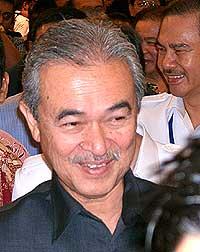 Over here, Mahathir is still fighting to rebuild his credibility and image nearly eight years after the Anwar fiasco. And for him to complain of the lack of press freedom in Malaysia? It would be just as surreal to hear Stalin and Chairman Mao protest at the inhumane conditions of the Gulag and Laogai. And Mahathir must remember the Malaysian public is yet to witness a wolf-pack's attack on him as what happened to Anwar a few years back.
Be so as it may, Mahathir remains a crowd-puller and a fighter in top form. He is also a world-class populist. In February, he chaired a mock trial on George W Bush, Tony Blair and Ariel Sharon for their human rights violations in the Iraq War. One may think it ridiculous, but the significance of the trial lies in the fact that it was attended by several important witnesses of international calibre, including Hans Blix, the former head of the UN inspection team to Iraq. The near-absent coverage by the world media gives Mahathir one more reason to be loathsome and grumpy.
But justice must begin at home. It is futile for the former PM to project himself as an upholder of human rights while refusing to correct all the human wrongs under his 22-year rule in Malaysia. It is here that Abdullah can make a difference, and he must not squander the remainder of his potentially short premiership. He may not aspire to be Bapa (father) of anything but, as PM, he must also do his utmost to avoid being remembered simply as Bapa of Nori and Khairy.


