




S'wak polls' land rights issue
Native Customary Rights land will be one of the main issues in the rural areas - especially in the Dayak-based constituencies - for the forthcoming Sarawak elections.
NCR land has always become an issue in any election. But in this election, NCR land has not only become the hottest issue, but has also been the subject of police reports and court cases. A number of NCR landowners have landed in jail in defending their rights.
Dayak opposition candidates, especially from the yet to be registered Malaysian Dayak Congress, see this NCR land issue as the biggest vote puller and as such will highlight the May 2000 amendments to the Land Code.
Native Customary Rights land will be one of the main issues in the rural areas - especially in the Dayak-based constituencies - for the forthcoming Sarawak elections.
NCR land has always become an issue in any election. But in this election, NCR land has not only become the hottest issue, but has also been the subject of police reports and court cases. A number of NCR landowners have landed in jail in defending their rights.
Dayak opposition candidates, especially from the yet to be registered Malaysian Dayak Congress, see this NCR land issue as the biggest vote puller and as such will highlight the May 2000 amendments to the Land Code.
The most damaging part of the amendments, according to them, is that it focuses on the provisions relating to native customary rights over land. Section 5 (a) (2)(I) of the Code was amended by substituting the word 'acquired' wherever it appears in the subsection with the word 'created'. Before the amendments, NCR land could be acquired
-
 through the felling of virgin jungle and the occupation of the land thereby created;
Therefore by substituting the word 'acquired' with 'created', the customary rights over such land could be terminated, as only the 'creator' would have customary rights over such land. After his death, the land will revert back to the government if his descendants are unable to provide proof for such a claim.
As the laws states that NCR cannot have been 'created' after Jan 1,1958, the fear among the current landowners is that there will be no NCR land left, land that had been 'created' before that year.
Massive plantations
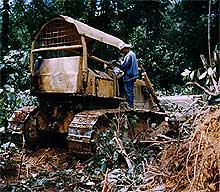
Armed with these provisions, the government has declared certain areas including NCR land as 'state land" and then issued Provisional Leases (PLs) to companies and BN politicians to cultivate the land for oil palm. With the PLs, the companies then bulldoze their way clearing and felling fruit and rubber trees, destroying paddy fields, cocoa and pepper gardens while ignoring the protests from the landowners.
There are houses in Tatau that have also been demolished. What makes the landowners angry is that no compensation is being made because the companies say that they have been given the PL and the land is 'state land'.
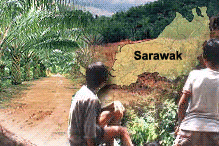 Up to the third quarter of 2005, a total of 1,268,888,161 hectares of land in Sarawak the bulk of it NCR land, have been approved for oil palm, rubber, banana and sago plantations. In the Sri Aman Division alone, some 34,244.08 hectares have been approved for oil palm plantations covering areas from Selanjan to Klauh, Tanjong Bijat, Skrang and the Bukit Lesong land districts.
Some Dayak politicians in the BN and their relatives own thousands of shares in the companies that have been given these indiscriminate PLs.
The landowners say that they have customary rights over their land although the land is not surveyed nor issued with titles. But the government disagrees. This was clearly stated by Awang Tengah Ali Hassan, Second Minister of Resource Planning and Management during the Sarawak legislative assembly sitting in June last year.
The government says the landowners if the landowners have rights over their land, then they must provide proof. But the amendments to the Land Code appear to have made it more difficult to claim and prove NCR land as the onus is put on the landowners to prove their claim.
Their only asset
On the other hand, the government had been given the privilege of a presumption in law to have rights over the land being claimed by the landowners. Thus the dilemma of the native landowners sets in.
Daniel Tajem, former president of the defunct Parti Bansa Dayak Sarawak (PBDS), NCR land 'is a not stale issue'.
"It is a continuing process by the government to take away the people's land and the process becomes more intense with each passing year especially after the amendments to the Land Code in May 2000. None of the 26 Dayak state assembly members spoke against the Bill," said Tajem.
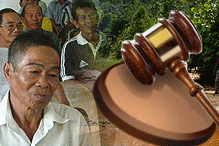 "Land is the economic life of the people especially the Dayaks. It is their only valuable assest. Take their land away, you are dis-empowering them.
"It is just like taking away water from fish," he said during a campaign recently at a longhouse at the Bukit Begunan constituency. The response from the audience, apparently, was equally vociferous.
NCR land has been made the main issue in the campaign of the opposition parties loosely grouped together as the Barisan Bersatu Sarawak (BBS) front. The coalition has come up with a 10-point land policy the main thrust of which is to return the land to the people.
Another major issue or the coming state polls is the failure of government to register the Malaysian Dayak Congress (MDC). Following the deregistration of Parti Bansa Dayak Sarawak (PBDS) in 2004, a group of ex-PBDS members applied to register MDC so that it would become a Dayak party to articulate the community's political, economic, social, educational and cultural interests. Its application has yet to be accepted.
Legal implications
Openly the Dayak leaders in the BN have urged the authorities not to approve the MDC registration, because they fear MDC will further split the Dayaks.
The Dayaks, they say, should join any of the existing political parties through which they can express their political views.
In explaining to voters, proponents of the Malaysian Dayak Congress say that Dayak leaders in the state government have supported a move to get rid of the word 'Dayak' when the Interpretation Ordinance of Sarawak was amended last year.
Following the amendment, the terms 'Sea Dayak', 'Land Dayak' and 'Murut' have been changed to 'Iban', 'Bidayuh' and 'Lon Bawang' respectively.
By supporting the amendment, they did not see the legal implications. Iban, Bidayuh and Lon Bawang are no longer listed as natives under Article 161A clause 7 of the Federal Constitution.
Since they are no longer natives, they are therefore not entitled to privileges as spelt out in Article 39 of the State Constitution and Article 153 of the Federal Constitution.
They are not entitled to special privileges, quotas, and do not have any customary rights on land they have acquired. This is the issue that the opposition intends to expose.
JOSEPH TAWIE is information chief of the yet-to-be-registered Malaysian Dayak Congress.


Are you sure you want to delete this comment?
This action cannot be undone.