




The Sarawak election - An epilogue
I was as surprised as everyone else by the fall of the four Kuching state seats into opposition hands in the recent Sarawak election. After all, I stood nine times in those seats and fought against the mighty SUPP. The collapse of Goliath must have delighted many Davids. As one friend told me over the telephone, the air over Kuching is now cleaner.
My earlier prediction has proven to be wrong. The Chinese were restless, instead of the natives.
After the fact, people will wonder why there was this sudden swing of Chinese votes for the opposition, in Kuching in particular and in Sarawak in general. Surely it cannot be the charisma or the reputation of the candidates only, since many opposition faces were relatively new to voters.
There are some obvious factors that most people can agree on.
I was as surprised as everyone else by the fall of the four Kuching state seats into opposition hands in the recent Sarawak election. After all, I stood nine times in those seats and fought against the mighty SUPP. The collapse of Goliath must have delighted many Davids. As one friend told me over the telephone, the air over Kuching is now cleaner.
My earlier prediction has proven to be wrong. The Chinese were restless, instead of the natives.
After the fact, people will wonder why there was this sudden swing of Chinese votes for the opposition, in Kuching in particular and in Sarawak in general. Surely it cannot be the charisma or the reputation of the candidates only, since many opposition faces were relatively new to voters.
There are some obvious factors that most people can agree on.
The recent hike in petrol and diesel pieces must have generated a great deal of resentment among the Chinese. Already, the Chinese are denied access to government jobs and contracts. They have to eke out a living in the private sector, competing with fellow Chinese, and without any prospect of government bailout if they fail. Struggling under the yoke of inflation, higher cost of production of goods and services, and a harder life generally, they would give vent to their frustration at the poll.
Considering that the Chinese people usually have a high threshold of tolerance for all forms of injustices, as long as they can survive, this change of heart among Kuching Chinese voters for the first time in 32 years is indeed a wake-up call to the national BN leaders that the economy of the nation does need a great deal of attention and rethinking.
I personally know that indeed business has been bad in my home town for many years. The job and business markets are very limited. The kind of rapid industrialisation that KL people have taken for granted is absent in Sarawak. Hoards of young Sarawakians are flocking to the cities and towns in Peninsular Malaysia for better pay and better job prospects.
This trickle of resentment can also turn into a flood at the worst of times.
Private sector, land issue
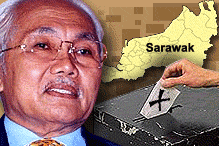 For many years now, Kuching people in the business world all know about the omnipresence of the CM's family business empire. Unlike other Sarawakians living in the rural areas, urban Chinese do have easy access to information, even though criticism of the CM and his family's dominance of the Sarawak business world have always been tabooed in the media! Over the recent past, I have heard increasing tremor of rumours rumbling out of Sarawak about the CM. I will not repeat publicly those curses and the nick-names the cynical people of Kuching have conjured up for this senior politician.
Private sector being their only recourse to a decent living, the Chinese must be bristling in private for many long years about the opportunities that have been robbed from their grasp by cronyism and nepotism.
The uncertainty about renewing land titles therefore must have touched a raw nerve among the Chinese. It is a reminder that they will forever be second class citizens in their own country. All that they can own is expensive mixed-zone land, in contrast to relatively cheap native and native customary right (NCR) land.
Land is a matter under state jurisdiction. There has been long-murmured news that every application of any sort involving land transaction must go through the CM's office. The interest of the CM's family members and cronies in land acquisition is also a matter of public knowledge.
In the urban Chinese seats, the SUPP and the opposition parties have their traditional blocs of die-hard supporters, with the government party enjoying a clear advantage. In the past, the results were often determined by those who have no clear party affiliation, intelligent voters as well as opportunistic ignorant fence sitters.
In this recent election, while fighting for the middle ground, the opposition has successfully tried to neutralise traditional SUPP support, by exposing the misdeeds and sterility of SUPP leaders in fighting for Chinese rights in the state cabinet, as well as explaining that their real enemy is not the SUPP as a party, but rather the CM himself.
The SUPP die-hard supporters at the grassroots level may never vote for the opposition, but they can stay away. The low turn-out in some Kuching voting stations is really telling.
The loss of confidence in the SUPP, even among long-standing SUPP members in Kuching, has been a gradual but certain process. It has something to do with their peculiarly parochial politics.
Tired slogans, outdated tactics
There has always been this complicated power-play between SUPP leadership in Kuching, Miri and Sibu. In the last ten years or so, the SUPP power centre has shifted away from Kuching to first Sibu, and finally Miri. Declining influence does mean that the Kuching SUPP are losing out on ministerial positions, ease in obtaining minor development funds and other political largesse, as well as goodies for cronies and supporters.
 The current SUPP party chief is a doctor from Miri. Under his patronage, Miri has grown fast, overtaking Sibu as the second largest city in Sarawak. He has also done rather well since assuming important public offices. He is not all that well liked by his party colleagues in Kuching and Sibu.
Unlike his predecessor, the formidable Dr Wong Soon Kai, the current SUPP chief lacks the tenacity and wile to create new political capital. The party has been living on their fixed deposit without any new sources of political income. In the recent election, they still depend on tired slogans and outdated tactics from a past era. Perhaps they have grown complacent from too much electoral success in the past.
With so many unexpected casualties at the poll, the SUPP is now confronted with an unprecedented crisis. It can also be a crisis for the CM, since he has depended on the Chinese wing within the state BN to hold on to power in times of crisis. My sometimes faulty crystal ball indicates the possibility of an internal power struggle in the SUPP in the immediate future.
As for the brand new opposition YBs, the expectation on them to perform and deliver opposition goods is tremendous. A state assembly overloaded with BN members headed by a seasoned old fox can be a very intimidating place. They would not be speaking to idolising converts at ceramah any more. A wrong move could cut short their political career. It has happened in the past. Their real test is just beginning.
Those opposition state assemblypersons worth their salt would be thinking about defending their seats in five years' time. It would not be easy. The urban Chinese votes supporting opposition in one election tend to swing back to the BN in the next in what Lim Kit Siang described once as the "pendulum effect".
Already, even those who have voted for the opposition will ask this eternal question typical of a minority race, "What will happen to the Chinese now?"
With the Chinese representation in the state government much reduced, your average Chinese person is bound to wonder whether Sarawakians of his ethnic persuasion will be sidelined in development. As long as the opposition parties are trapped in the strait-jacket of racial politics, their electoral victory will always be limited and short-lived.
Change of government
I personally would like to see a change of government in Sarawak and a change of CM at least.
In an article published in the NST entitled They rarely walk gracefully into twilight, Ralf Dahrendorf commenting on Tony Blair's reluctance to leave office in the UK has the following observation on leaders who overstay their welcome:
"The addiction to political office is always worrisome, because democracies turn into autocracies when leaders cease to recognise the limits of their power. Disconnection is the beginning, followed by the belief that one is the only person who knows what is right and good."
The CM's fatalistic addiction to his office is self-evident. That he must go now is not that self-evident to him. One way or another, he will have to go, now or later. He would be prudent not to take Tony Blair's bad example, and instead step down gracefully like the former PM. He can always enjoy his twilight years as the irreproachable governor of the state!
Top leaders come and go. It does not guarantee instant justice for the poor, the marginalised, and the voiceless. A change of government may not always be a change for the better. But it is the pre-condition for a meaningful working democracy, because in the long run - it does return political power to the people at large.
For that to happen in Sarawak, you will need a broad-based multi-ethnic coalition led by someone with a new inclusive agenda, and fortified by the necessary political skills to deal with a federal government controlled by the BN. And then perhaps, the federal government ought to change hands first.
The Chinese in Sarawak have revolted. It would have been much more gratifying if there has been a parallel and coordinated uprising in the Malay/Melanau and Dayak/Orang Ulu areas as well.


Are you sure you want to delete this comment?
This action cannot be undone.