




Police defy oversight plan
Prime Minister Abdullah Badawi's plan to set up an ombudsman to oversee the functioning of Malaysian police, that has an unsavoury reputation for abuse and rights violations, has come up against opposition.
A document posted on the force's official website has revealed the full extent of defiance by the men in uniform.
Following a meeting that the premier had with police associations over the setting up of an Independent Police Complaints and Misconduct Commission (IPCMC), some officers seem to have run amok.
Prime Minister Abdullah Badawi's plan to set up an ombudsman to oversee the functioning of Malaysian police, that has an unsavoury reputation for abuse and rights violations, has come up against opposition.
A document posted on the force's official website has revealed the full extent of defiance by the men in uniform.
Following a meeting that the premier had with police associations over the setting up of an Independent Police Complaints and Misconduct Commission (IPCMC), some officers seem to have run amok.
Abdullah had said he would make good on an election promise to reform the police and, following several cases of police excesses last year, announced that the IPCMC would be set up.
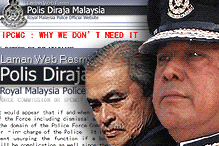 But soon after the meeting, the police website carried warnings that the force would 'retaliate' by allowing crime to escalate and also demanded an eight-hour-five-day-week schedule like other civil servants.
Some Malaysians found the threats hilarious and indicative of how out of touch with the modern world the police force, created in colonial times, had become. Opposition lawmakers and human rights activists, however, saw the reactions on the official website as dangerous to civil society.
The posting, since removed, stated: "The explicit and implicit effect of the formation of an independent body is that the real organ which exercise powers of control over the police will be the commissioners of the body and NOT the minister. Let politicians beware that they will eventually lose powers, control and influence over..."
This allowed a rare glimpse into police attitudes on human rights and on the steps being taken to restore transparency and accountability within the force.
"'Definitely, it is blackmail! It is unprofessional for them to act as such. It should not even cross their mind to do such things," said Simon Sipaun, vice-chairperson of the Human Rights Commission of Malaysia.
Bone of contention
Opposition lawmakers are urging Abdullah to act quickly and put an end to what they say is an "open police revolt" against his government.
 "It is unprecedented for police to act with such arrogance. Threatening to allow crime to rise is utterly irresponsible and a complete surrender of the moral and legal authority of the police," said Lim Guan Eng, secretary-general of the opposition DAP.
The IPCMC has been a bone of contention between police and opposition lawmakers and human rights groups since two separate commissions of inquiry recommended it last year.
One commission was set up to study and recommend ways to turn the 86,000-strong force, often accused of corruption and inefficiency, into a 21st century entity that is respected and admired by the people. Forming the IPCMC was a key recommendation.
Another commission was set up after a young woman was forced to do 'ear squats' in the nude at a police lock-up. A secret taping, done with a handphone camera, found its way into the public domain and sparked an outcry. A commission of inquiry then reiterated the need for the IPCMC.
While civil society has been urging the government to hasten the setting up of the IPCMC, the police have been actively opposing it and trying to hamstring its creation with help from a group of government backbenchers, officers' associations and section of Abdulah's cabinet.
'Only alternative'
Police chief Bakri Omar has sought to distance himself from the posting on the website, although he has publicly opposed the IPCMC plan.
"It is an internal document and not meant for public consumption," he said of the document.
The recent criticism has however mortified the police leadership. A brief statement was issued saying it would abide by any decision made on the IPCMC by the government or the Attorney-General.
In this and other controversies, Abdullah has been accused of being indecisive.
"Clearly civil authority needs to act fast to reassert control over the police. Such disrespect, defiance and insubordination cannot be allowed to go unpunished or it will blur the legal authority, established since Merdeka (independence from colonialism), of civilian and political control over the police force," Lim told IPS .
Such an open rejection, Lim said, is an embarrassment for Abdullah, who favours setting up the IPCMC but has passed the buck to the Attorney-General for "further study and fresh recommendations".
"The IPCMC is the only alternative to cleaning up the police force to serve the larger national interest as a protector of the people to fight crime and maintain order in an efficient and trustworthy manner," Lim added.
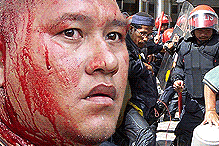 Critics of the police are also angry with their high-handedness in handling civil protests. A recent peaceful demonstration by several hundred people protesting sharp hikes in fuel and energy prices turned bloody after police blasted them with water cannons and ploughed in with batons swinging.
Several protesters were injured and received treatment for broken heads or limbs.
"This brutal and unaccountable behaviour is another reason why an oversight committee is urgently needed," said Yap Swee Seng, executive director of human rights group Suaram.
"Until and unless the commission is set up to hold police officers accountable for their corrupt and brutal acts, the culture of police violence will continue with total impunity."
Said S Arulchelvam, secretary-general of the pro-tem Parti Sosialis Malaysia: "It is clear that Abdullah lacks the political will to push through the promised reforms. It is just not going to happen." - IPS


Are you sure you want to delete this comment?
This action cannot be undone.