




Sybil Kathigasu new stories, same legend
Until early 1980s, the name and legend of Sybil Kathigasu was very well-known in Malaysia, especially in the Ipoh-centered Kinta Valley.
 The Christian Eurasian woman (
pix
) - who was very un-apologetically pro-colonial and spoke Cantonese - was particularly remembered by older generations of Chinese residents of Ipoh and its satellite township Papan as one simple, kind-hearted and extraordinarily brave soul who saved many lives and inspired those in despair during the 44-month Japanese occupation from December 1941 to August 1945. To those who are younger, her legend is preserved in her wartime memoirs
No Dram of Mercy
first published in 1954.
The Christian Eurasian woman (
pix
) - who was very un-apologetically pro-colonial and spoke Cantonese - was particularly remembered by older generations of Chinese residents of Ipoh and its satellite township Papan as one simple, kind-hearted and extraordinarily brave soul who saved many lives and inspired those in despair during the 44-month Japanese occupation from December 1941 to August 1945. To those who are younger, her legend is preserved in her wartime memoirs
No Dram of Mercy
first published in 1954.
According to the legend, the simple housewife of Dr AC Kathigasu, who operated a clinic at No.141 at Brewster Road in Ipoh, secretly helped to supply medicines and medical services to the anti-Japanese guerrilla forces in Papan where she and her family lived as war refugees. She also helped them to illegally keep shortwave radio sets and listen to broadcasts from Britain and the outside world. Because of those 'subversive' activities she and her husband were arrested, tortured and detained until the war ended.
Until early 1980s, the name and legend of Sybil Kathigasu was very well-known in Malaysia, especially in the Ipoh-centered Kinta Valley.
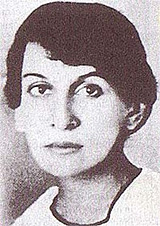 The Christian Eurasian woman (
pix
) - who was very un-apologetically pro-colonial and spoke Cantonese - was particularly remembered by older generations of Chinese residents of Ipoh and its satellite township Papan as one simple, kind-hearted and extraordinarily brave soul who saved many lives and inspired those in despair during the 44-month Japanese occupation from December 1941 to August 1945. To those who are younger, her legend is preserved in her wartime memoirs
No Dram of Mercy
first published in 1954.
The Christian Eurasian woman (
pix
) - who was very un-apologetically pro-colonial and spoke Cantonese - was particularly remembered by older generations of Chinese residents of Ipoh and its satellite township Papan as one simple, kind-hearted and extraordinarily brave soul who saved many lives and inspired those in despair during the 44-month Japanese occupation from December 1941 to August 1945. To those who are younger, her legend is preserved in her wartime memoirs
No Dram of Mercy
first published in 1954.
According to the legend, the simple housewife of Dr AC Kathigasu, who operated a clinic at No.141 at Brewster Road in Ipoh, secretly helped to supply medicines and medical services to the anti-Japanese guerrilla forces in Papan where she and her family lived as war refugees. She also helped them to illegally keep shortwave radio sets and listen to broadcasts from Britain and the outside world. Because of those 'subversive' activities she and her husband were arrested, tortured and detained until the war ended.
At one point just before her arrest, guerilla leaders offered to move her and her family into the jungle for protection against the imminent action to be taken against them by the Japanese military. The offer was, however, declined on various grounds.
After the Japanese surrender, Sybil - whose lower part of the body had been paralysed due to repeated kicking and beatings by male Kempetai officers - was rescued by armed communists from the Batu Gajah prison and later sent to Britain for medical treatment. While in Britain, she was awarded the George Medal for bravery at the Buckingham Palace on Nov 7,1947. On June 12, 1948, she passed away in Scotland but her remains were later returned to Ipoh for burial at the St Michael's churchyard.
The fact that she died four days before the proclamation of the 'Emergency' in faraway Scotland ironically ensured that the legacy of this staunchly pro-colonial woman who helped to save, directly or indirectly, so many communist lives, would always be acceptable or indisputable to both sides of the Cold War divide.
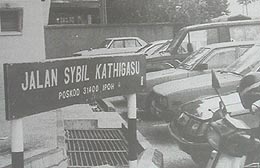 A street in Ipoh was even named Jalan Sybil Kathigasu to forever salute Mrs K or 'Mother' for her humanitarianism, courage and sacrifice during the 44-month Occupation. Despite many changes in the names of Ipoh streets in Ipoh and throughout Peninsular Malaysia as a result of the post-Merdeka rising of nationalist sentiments, Jalan Sybil Kathigasu or Sybil Kathigasu Street still stands as a reminder of the horror of wars and a tribute to the extraordinary courage of a this woman in the face of the most dreaded army and most accursed secret police of the world at that time.
Generational shift
For a while in the 1990s, her legend seemed to have faded away considerably from the collective memory of younger Malaysians, including those living in Ipoh and its surrounding region in the Kinta Valley. However, it was revived as the 60th anniversary of the end of the Pacific War and the liberation of Malaya approached and as the stories in Alias Chin Peng: My Side of History began to reverberate and resonate on the ground.
Thanks to the good people in Papan and Ipoh - like Lau Gaik Hong - who still consider it their noble duty as good citizens and patriots to preserve Papan's No 74, Main Road, Malaysians and Singaporeans have been flocking to the otherwise forgotten 'ghost town' to pay respects to the heroine and to also learn the true history of this land.
Last year, when the Chinese-language edition of Sybil Kathigasu's wartime memoirs No Dram of Mercy was launched in Kuala Lumpur and Ipoh, young and old Chinese of different schools of thoughts were united in their expression of gratitude for this woman who had saved so many lives irrespective of race, religion and ideology during the dark age of Japanese occupation and who had already passed away 58 years ago in Scotland. Commercially and politically competing newspapers suspended their rivalry to simultaneously publish reviews and excerpts of the memoirs as a mark of respect and salute to Mrs K or 'Mother'.
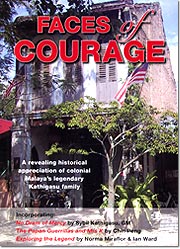 Seen in this light, the 240-page
Faces of Courage A Revealing Historical Appreciation of Colonial Malaya's Legendary Kathigasu's Family
(Singapore, Media Masters, 2006) is published at a right moment of history when generational shift and unbridled globalisation of consumerist, hedonist and nihilist sub-cultures in the name of 'borderless liberalism' threaten to cut the younger generations off from the historical continuity of the great collective memory of their land of their birth and that of their parents and grandparents. Which ultimately reduces them into what neo-Marxist philosopher Herbert Marcuse conceptualised as "one-dimensional" men (and women).
Seen in this light, the 240-page
Faces of Courage A Revealing Historical Appreciation of Colonial Malaya's Legendary Kathigasu's Family
(Singapore, Media Masters, 2006) is published at a right moment of history when generational shift and unbridled globalisation of consumerist, hedonist and nihilist sub-cultures in the name of 'borderless liberalism' threaten to cut the younger generations off from the historical continuity of the great collective memory of their land of their birth and that of their parents and grandparents. Which ultimately reduces them into what neo-Marxist philosopher Herbert Marcuse conceptualised as "one-dimensional" men (and women).
Technically, Faces of Courage is also co-authored by Sybil Kathigasu because her 1954 wartime memoirs No Dram of Mercy form the first of the three parts of the book. It occupies 158 pages of the 240-page book. However, the new writings were penned by Communist Party of Malaya's veteran Chin Peng and the co-authors of his memoirs, Singapore-based Australian veteran journalists Ian Ward and Norma Miraflor.
Contrary to the imagination of some of those who have not read the book or those of have read too much into it with wild imagination, what Chin Peng has written about the legend of Sybil Kathigasu or Mrs K is not a 'big bang'. The 20-page reminiscence of Chin Peng as told to Ian Ward and Norma Miraflor essentially centers on his personal recollections of the landscapes of Ipoh, Papan and other townships in Perak where he was active as a young underground communist with very normal relations with Sybil Kathigasu and her husband Dr AC Kathigasu.
His philosophising memories of ex-comrades like the late Ho Thean Fook @ Moru and Sybil Kathigasu's most respected communist guerilla leader, Chen Yen.
While Ho died in Ipoh in 2004 as a retired bank officer, Chen Yen, having being banished to China at the outbreak of the anti-colonial war in 1948 (even though he had already quit the party and politics altogether earlier) passed away in the Mainland in the 1980s. One particularly philosophical observation made by Chin Peng in response to Ho Thean Fook's postwar bitterness about what he called 'tainted glory' is the question: 'Where in the history of the world would we find untarnished glory?' (pp.175-176).
Gray aspects
In the essay titled 'The Papan Guerrillas and Mrs K, Chin Peng also pays respect and salutes Sybil Kathugasu for her heroism and personal sacrifice for the common cause, although he is also aware that she was 'a great champion of the British colonial rule'.
The most revealing part of the book is, in fact, contained in 'Exploring the Legend', an investigative report written by 'recalcitrant bourgeois' Norma Miraflor and her husband Ian Ward.
While the writers personally maintain deep respect for the legend of Sybil Kathigasu, they also explore, with documentary facts supported by oral testimonies, the more complex and gray aspects of Sybil Kathigasu and the Kathigasu family, such as the question of her illegitimate daughter Dawn, the lack of procedural justice in the war crimes tribunal conviction of Ekio Yoshimura (who was alleged to have committed the crime of torturing her and other civilians in Ipoh), her husband's remarriage with a patient after her death in Scotland in 1948 and psychological problems faced by her legitimate as well as illegitimate daughters, Olga and Dawn respectively.
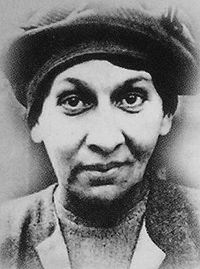 To their great credit, Miraflor and Ward deal with these aspects of the legacy of Sybil Kathigasu (
pix
) and her family not only with hard facts but, more importantly, with discretion, balance, good taste and a high standard of journalistic ethics. They never sensationalise the illegitimate origin of Dawn, although it has now been found to be factually true and confirmed by none other than Dawn's elder sister Olga who is still alive and mentally very sound in Ipoh at the age of 86.
To their great credit, Miraflor and Ward deal with these aspects of the legacy of Sybil Kathigasu (
pix
) and her family not only with hard facts but, more importantly, with discretion, balance, good taste and a high standard of journalistic ethics. They never sensationalise the illegitimate origin of Dawn, although it has now been found to be factually true and confirmed by none other than Dawn's elder sister Olga who is still alive and mentally very sound in Ipoh at the age of 86.
To intellectually sophisticated and emotionally mature readers, the factual and discreet revelations of these aspects do not diminish at all the status of Sybil Kathigasu as a heroine. For in both Christian and traditional Chinese cultures, heroes and heroines are simply rare people on earth who display extraordinary courage and are ready to sacrifice their life at critical moments for the good and well-being of a larger community and they are always known to be ranked just below God, angels, prophets and saints.
The revelations have rightly restored Sybil Kathigasu as a real human being and a great resistance heroine whose legacy still command deep respect from both communists and those who are on the other sides of the ideological divide irrespective of race, religion and culture. Sybil Kathigasu remains one of the proudest icons of anti-fascist resistance in the people's history of Malaya/Malaysia.
Faces of Courage , which tells all these humanly heroic stories centered around Sybil Kathigasu, is, however, still not approved by the Malaysian home affairs ministry for sale in her homeland (which she defended with her life even as a woman) although it has been bought and read by many in outside world like Singapore, Australia and Britain.
JAMES WONG WING ON is chief analyst of Strategic Analysis Malaysia. He is a former DAP member of Parliament for Kampar (1990-1995) and a former columnist for the Sin Chew Jit Poh Chinese daily (now Sin Chew Daily). He read political science and economics at Monash University in Melbourne, Australia.


