



COMMENT | 'Fake news' ordinance creates culture of fear
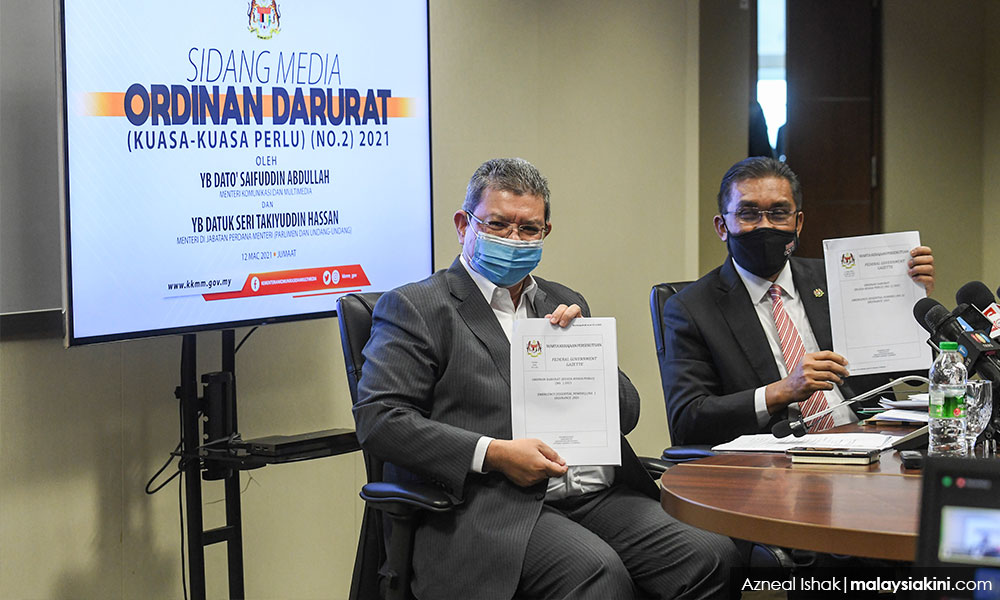
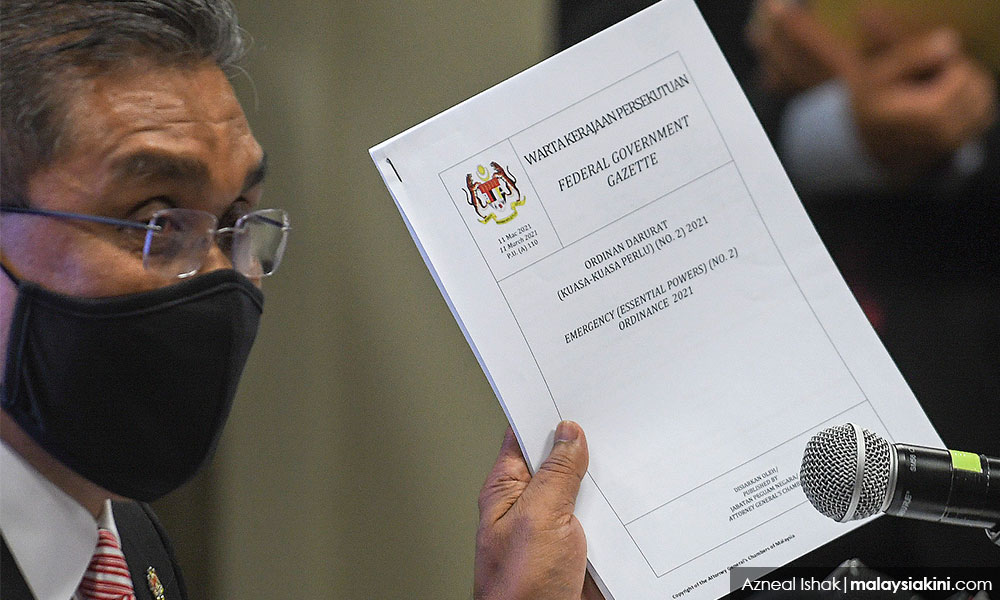
COMMENT | On Thursday, a new emergency ordinance was promulgated under powers given by the recent proclamation of emergency. The Emergency (Essential Powers)(No 2) Ordinance 2021 (“the ordinance”) came into effect yesterday.
The ordinance revives the much-criticised Anti Fake News Act, which was abolished by Parliament during the time of the Pakatan Harapan government. It criminalises those who "create, offer, publish, prints, distributes, circulates or disseminates" any "fake news" or publication containing fake news, on pain of fines not exceeding RM100,00, a jail term of up to three years, or both.
There are several problems with the ordinance.
Firstly, the definition of "fake news" is very wide. According to the ordinance, "fake news" includes any news, information, data and report which is or are wholly or partly false relating to Covid-19 or the proclamation of emergency.
The ordinance is silent on what constitutes "wholly or partly false". Is whether something is false or true dependent upon whether the information comes from the government? There is every possibility that this will be the case.
For example, if ..
COMMENT | On Thursday, a new emergency ordinance was promulgated under powers given by the recent proclamation of emergency. The Emergency (Essential Powers)(No 2) Ordinance 2021 (“the ordinance”) came into effect yesterday.
The ordinance revives the much-criticised Anti Fake News Act, which was abolished by Parliament during the time of the Pakatan Harapan government. It criminalises those who "create, offer, publish, prints, distributes, circulates or disseminates" any "fake news" or publication containing fake news, on pain of fines not exceeding RM100,000, a jail term of up to three years, or both.
There are several problems with the ordinance.
Firstly, the definition of "fake news" is very wide. According to the ordinance, "fake news" includes any news, information, data and report which is or are wholly or partly false relating to Covid-19 or the proclamation of emergency.
The ordinance is silent on what constitutes "wholly or partly false". Is whether something is false or true dependent upon whether the information comes from the government? There is every possibility that this will be the case.
For example, if a person tweets that the emergency proclamation was sought because the prime minister has lost his majority, this can be deemed to be "fake news" as the "official reason" for seeking the emergency was "to combat Covid-19". The government has repeatedly said that the proclamation of emergency was purely to deal with the pandemic and not because of political reasons.
In terms of the element of intention, the offence can be committed if the "fake news" is "likely to cause fear or alarm to the public or any section of the public". This seems to suggest that intention may not be necessary to be proved so long as it can be established that the act has the likelihood to cause fear or alarm.
The ordinance also empowers the police to order the removal of any publication (such as a tweet or a Facebook post) that contains "fake news". Failure to comply with the order may expose the person having custody, possession or control of such a publication to be charged in court and if convicted, liable to a fine of RM100,000.
It appears that the police need not prove that the publication indeed is "wholly or partly false" before making the order for removal thus giving the police rather wide discretion.
Taken together, the creation of these offences will have a chilling effect on freedom of speech and expression in this country, and create a "culture of fear" amongst netizens who are known to be quite vocal in their criticisms of the government, especially in relation to its handling of the Covid-19 crisis and the emergency.
Saddest part
Apart from the predicate offences mentioned, the ordinance also departs from the established rules of evidence. Confessions and admissions are admissible, and so, too, any documents obtained under the ordinance.
These departures from the Evidence Act are very similar to the provisions contained in the Security Offences (Special Measures) Act (Sosma) which was enacted to deal with security offences (such as terrorism and organised crime).
If Sosma is any indication, these provisions will violate the accused person's right to a fair trial and tip the balance in favour of the prosecution.
There is no rhyme or reason why offences of "fake news" need to be tried as if they are terrorism-related offences.
The principle that a man (or woman) should be presumed innocent until proven guilty in a court of law is the bedrock of our criminal justice system and the tried and true rules of evidence are established in order to ensure that accused persons are accorded the right to a fair trial.
The government will likely try to sell this ordinance by saying there is a need to stop people from spreading false information about the Covid-19 vaccine.
But the offences cast a much wider net, and more importantly, the real mischief is the criminalisation of any attempt to question the proclamation of emergency.
A whistleblower who reveals information about vaccine queue jumpers, a student who questions the reasons for the proclamation of emergency or a mother who is angry at the everchanging SOPs and lashes out at the government may all potentially run afoul of this new ordinance.
The saddest and most deflating part of this whole affair is that the ordinance did not even go through Parliament before it was thrust upon all Malaysians.
Such wide discretionary powers given to the state, with far-reaching consequences, is now legally binding without even the illusion of a parliamentary debate.
SYAHREDZAN JOHAN is a civil liberties lawyer and political secretary to Iskandar Puteri MP Lim Kit Siang.
The views expressed here are those of the author/contributor and do not necessarily represent the views of Malaysiakini.




Report this comment
Are you sure you want to delete this comment?
This action cannot be undone.