


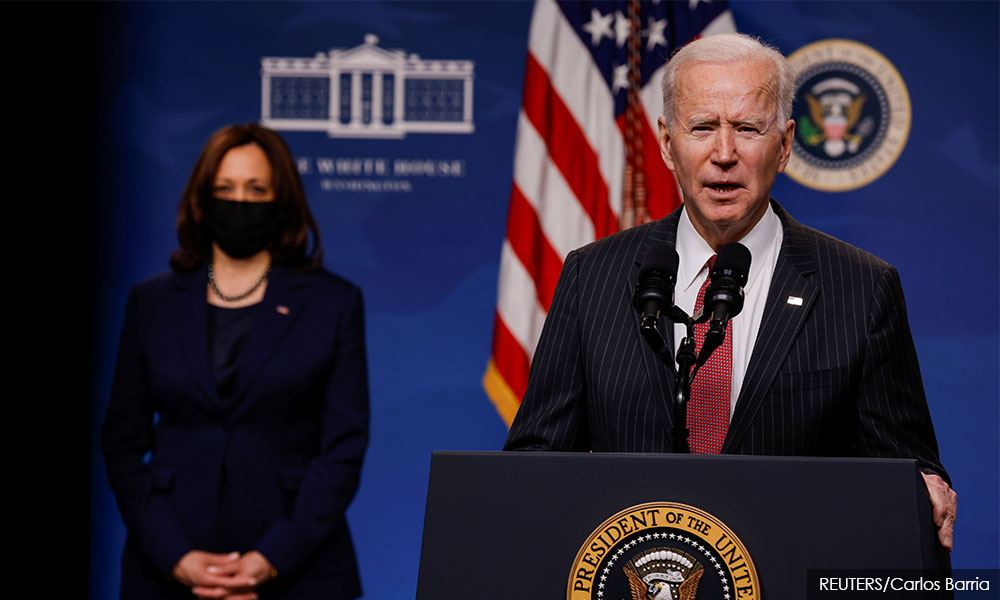

MP SPEAKS | Open letter to President Biden and Vice-President Harris
MP SPEAKS | Dear President Joe Biden and Vice-President Kamala Harris,
First of all, I would like to congratulate you on a historic 100 days in office. Among some of your many achievements are (i) vaccinating more than 200 million Americans and other residents in the US (ii) passing a US$1.9 trillion stimulus package despite no support from the other side of the aisle (iii) started the process of restoring the role of the US in global alliances starting with rejoining the Paris Climate Accords.
I would also like to thank both of you for speaking strongly and unequivocally on the attacks in Atlanta, where Asian Americans were targeted and killed by an extremely disturbed man for extremely disturbing reasons. As someone of Asian descent (I am a Malaysian Chinese) who lived in Durham, North Carolina, for 6 years from 2004 to 2010, whilst pursuing my PhD in political science at Duke University as a Fulbright scholar, I am somewhat aware of the racial dynamics in a Southern city in the United States. And I can only somewhat imagine the psychological impact on people of Asian descent in the US as a result of the racial rhetoric that has been “amped” up over the past couple of years, no doubt fueled by the actions and words of your predecessor.
I am writing this letter primarily to lay out my thoughts on what I think a reasonable US foreign policy towards Southeast Asia (SEA) would look like. I am not an international relations specialist (my focus areas in political science were comparative and American politics) but I did serve as Malaysia’s deputy international trade and industry minister for 20 months from July 2018 to February 2020. As such, my views and preferences are more pragmatic in nature and less “calculative” and “strategic”, if this makes sense. The following are a few recommendations which I hope that someone from your office or from the US State Department...
MP SPEAKS | Dear President Joe Biden and Vice-President Kamala Harris,
First of all, I would like to congratulate you on a historic 100 days in office. Among some of your many achievements are (i) vaccinating more than 200 million Americans and other residents in the US, (ii) passing a US$1.9 trillion stimulus package despite no support from the other side of the aisle, and (iii) starting the process of restoring the role of the US in global alliances, beginning with rejoining the Paris Climate Accords.
I would also like to thank both of you for speaking strongly and unequivocally on the attacks in Atlanta, where Asian Americans were targeted and killed by an extremely disturbed man for extremely disturbing reasons. As someone of Asian descent (I am a Malaysian Chinese) who lived in Durham, North Carolina, for six years from 2004 to 2010, whilst pursuing my PhD in political science at Duke University as a Fulbright scholar, I am somewhat aware of the racial dynamics in a Southern city in the United States. And I can only somewhat imagine the psychological impact on people of Asian descent in the US as a result of the racial rhetoric that has been “amped” up over the past couple of years, no doubt fuelled by the actions and words of your predecessor.
I am writing this letter primarily to lay out my thoughts on what I think a reasonable US foreign policy towards Southeast Asia (SEA) would look like. I am not an international relations specialist (my focus areas in political science were comparative and American politics) but I did serve as Malaysia’s deputy international trade and industry minister for 20 months from July 2018 to February 2020. As such, my views and preferences are more pragmatic in nature and less “calculative” and “strategic”, if this makes sense. The following are a few recommendations that I hope someone from your office or from the US State Department who is currently thinking about foreign policy options in SEA would consider reading.
Firstly, US foreign policy in SEA should not and cannot be only about how to react to and counter China. This was the mistake made by your predecessor. Under former secretary Mike Pompeo’s tenure, there was a dread among the SEA diplomatic community and foreign ministers when dealing with his office and his visits because all he would do would be to lecture and badger them about all the bad things which China was doing in SEA and around the world.
While China is an important player in SEA in the military, economic and social realms, this cannot be the one and only issue on the table when it comes to US foreign policy priorities in SEA. The US has a long-standing presence in the region and I am confident that you and your experienced team will re-engage leaders, policymakers and important stakeholders in a number of important policy areas including climate change, trade and investment flows, educational and cultural exchanges, and, of course, Covid-19 related policy areas.
It is important for the governments as well as the people of Southeast Asia to see the whole range of priority areas in which the US wants to re-engage the region. This kind of approach will lead to more “win-win” situations for us and will increase the probability that US priority goals will be achieved hand-in-hand with the individual governments in SEA and with Asean as well.
Here, I want to express my deepest disappointment with your recent joint address to both Houses of Congress. “China” was mentioned four times and “Beijing” once (by the way, I don’t think Beijing produces that many wind turbines anymore. It would have been more accurate for you to have mentioned Xinjiang instead). The “European Union” was mentioned just once, “India” once, “Nato” once and the word “allies” appeared twice, presumably a stand-in for countries like “Japan” which was not even mentioned once.
Africa and the Middle East were mentioned just once and this was linked to terrorism. The word “Asia” or “Southeast Asia” did not even appear once in your address. I know that the audience for your address was primarily domestic, but surely, as someone with your international experience, you must have known that the world was watching and paying close attention to your words? I guess we can cut you some slack since this isn’t a foreign policy speech per se. But we hope we don’t have to wait too long before you share with us more details about your engagement with the rest of the world including the nations of SEA.
Secondly, I hope that you will be able to find some “win-win” approaches when it comes to dealing with China, especially in the SEA region. We do not want to be called upon (and you and your foreign policy team know this well) to choose between China and the US. Both are important economic and security partners in the region and we want to maintain good ties with both countries.
While I understand the rationale of you having to appear “tough” on China, especially for the domestic audience, I hope that you can empower your cabinet members and members of your diplomatic core to seek out win-win opportunities on the ground, especially in the areas of sustainable development and renewable energy (more on this below). Even in the “sensitive” area of infrastructure development, would your administration be bold enough to push for regional multilateral institutions such as the Asian Development Bank (ADB) and the Asian Infrastructure Investment Bank (AIIB) to co-fund infrastructure projects in SEA (perhaps the on-again-off-again Kuala Lumpur-Singapore High-Speed Rail project) with involvement from Chinese, Japanese, Korean and American companies with meaningful involvement from SEA companies?
Thirdly, I hope that you are able to moderate your tone and messaging on investment and manufacturing in the US and beyond. You are right in saying that there is no reason why wind turbines cannot be built in Pittsburgh. There is already a company by the name of WindStax in Plum Borough, Pittsburgh, which is already doing this. But it does not make sense for all or most of the wind turbines in the world to be built in the US!
Forcing US wind turbine and solar panel companies with global operations to bring back their manufacturing activities to the US would have a great negative impact on their financial positions which would put into question the long-term sustainability of these companies.
Surely, you don’t want US solar panel producers to go bust and be taken over by competitors from other countries? Some on-shoring can take place but rather than being overly focused on increasing domestic manufacturing, why not focus on retraining and re-skilling your workers in the manufacturing sector to be installers of wind turbines and solar panels across the US? These kinds of service-related jobs are much more difficult to outsource to other countries and can potentially provide higher-paying jobs to blue-collar Americans. Not to mention that the comparative advantage for the US is not so much in the manufacturing of basic models of wind turbines and solar panels but more so in the design and software which powers these renewable energy installations. Did you also not mention the lack of R&D in renewable energy in the US during your address?
In the specific context of Malaysia, my home country, why not take a look at a win-win solution provided by First Solar, one of the biggest solar panel manufacturers in the world, with a large factory in Kulim, Kedah, and with plans to work with Jing Jing, a Chinese solar glass manufacturer which is building a factory in the vicinity of First Solar’s factories? Why not look for win-win partnerships involving US and Indonesian companies in the manufacturing of EV batteries in the most populous nation in SEA? Why not highlight the strong presence of US biotech companies that are already doing cutting-edge R&D in Biopolis, a biomedical R&D hub in Singapore? The list can be easily expanded with the attention of your political and economic councillors and your ambassadors in all the SEA nations.
Fourthly, we come to the tricky area of democracy and human rights advocacy. The word “democracy” appears 17 times in your address and the word “human rights” twice. I truly believe that you mean it when you say that human rights is the “essence” of what the US stands for. But I also believe that we in SEA are very wary of this kind of “lecturing”. Yes, we have many democratic deficits among the SEA nations, including Malaysia, where an emergency was declared in January this year ostensibly to control the Covid-19 pandemic.
But there are other better ways to support the cause of democracy and human rights in SEA. This would include working with international agencies such as the UN and also Asean on tricky issues such as the military coup in Myanmar and the deportation of Rohingya refugees. This would include providing technical assistance on strengthening civil society, the civil service, and electoral and parliamentary processes in SEA nations, just to name a few. The strategies and avenues are multiple and varied.
Fifthly and finally, don’t forget to deploy your substantial soft power in the region. You can start with the small stuff first such as having your respective embassies re-engage with various alumni groups such as former students of US universities and those who have attended various State Department-sponsored programmes including YSEALI, IVP and Fulbright, just to name a few (thankfully, your predecessor didn’t think that these programmes were deserving of his attention). Perhaps work with local cinema operators in SEA to showcase some of the best entertainment products which the US has to offer such as recent Oscar winners Nomadland (with a China-born female best director), Minari (with a Korean winner in the best supporting female actor category) and The Trial of the Chicago 7 (nominated for seven Oscars and a film which dares to take a very critical look at the US justice system). And as the pandemic recedes, opportunities for more meaningful engagement will present themselves.
I would be remiss if I didn’t remind you of an important component of the Asian “pivot” undertaken by former president Barack Obama when you were his vice-president. The Trans-Pacific Partnership Agreement (TPPA) was one of the key components of Obama’s Asian pivot. It will take some time but I hope that you will apply for the US to join the CPTPP before the end of your term as president.
ONG KIAN MING is Bangi MP and former deputy international trade and investment minister.
The views expressed here are those of the author/contributor and do not necessarily represent the views of Malaysiakini.


Are you sure you want to delete this comment?
This action cannot be undone.