




Malaysia, Truly Hazier
Will the haze prove as threatening to tourism in Malaysia as it surely is to the health of all those of us who live here, and to the credibility of official Malaysian and Indonesian "efforts" to combat it?
The picture on the front page of a newspaper last Thursday provided a graphic response to the question, showing a tourist on the observation level of the KL tower snapping a picture of a poster portraying a clear panorama of the city, while his companions at the viewing windows glumly gaze out at nothing...but nothing.
But even hazier than the air in Malaysia has been lately is the atmosphere of mystery concerning who is causing the problem, and how they get away with it year after year.
Will the haze prove as threatening to tourism in Malaysia as it surely is to the health of all those of us who live here, and to the credibility of official Malaysian and Indonesian "efforts" to combat it?
The picture on the front page of a newspaper last Thursday provided a graphic response to the question, showing a tourist on the observation level of the KL tower snapping a picture of a poster portraying a clear panorama of the city, while his companions at the viewing windows glumly gaze out at nothing...but nothing.
But even hazier than the air in Malaysia has been lately is the atmosphere of mystery concerning who is causing the problem, and how they get away with it year after year.
Tourism Malaysia director-general Mirza Mohammad Taiyab didn't clarify matters much, saying that he hoped the haze wouldn't get any worse, then proceeding to savage the "foreign media" for publishing reports exaggerating the situation.
 And Selangor Menteri Besar Mohd Khir Toyo failed to shed further light on the subject with the blindingly obvious observation that the haze was due to open burning in Sumatra.
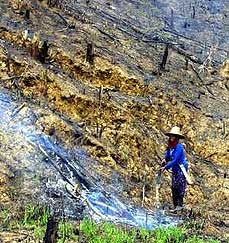
Everybody has long been well aware of what causes the problem. In what has become an annual ritual of inter-government accusations, Malaysia largely blames Indonesia for the haze, claiming that it is the smoke from blazes set by illegal loggers and plantation owners to raze more rainforest on the much-abused islands of Borneo and Sumatra.
Indonesia in its turn regularly retorts that many of these arboreal and agricultural arsonists are actually Malaysian-owned companies operating within its territory, but fails to explain why it does little if anything to stamp out these offenders' incendiary activities.
And there the matter rests for yet another year, with Indonesia failing to sign the Asean Transboundary Haze Treaty, and Malaysia pretending it hasn't the foggiest idea whether any of its corporate citizens are among the culprits. It leaves the offenders free to brazenly light more fires, fan the flames and deliberately let them rage out of control while pretending to try and contain them, safely out of the public gaze, and thus utterly unfazed.
At the height of the haze season last year, in an attempt to dispel the shroud of secrecy surrounding this issue, or at least kindle a spark of interest in it at a responsible level, I asked a top executive of a major Malaysian media group whether any of his newspapers were planning to try and get to the truth of the matter. But he replied that they didn't have the financial or reporting resources for such a remote and complex investigative assignment, and quickly changed the subject.
Alleged complicity
In other words, as I took him to mean, however many readers of his group's newspapers might be choking with rage at the illegal pollution of their atmosphere, not to mention wanton destruction of yet more of the natural environment, the topic of Malaysian companies' alleged complicity in causing the haze was officially off-limits, and he was prepared to avoid firebrand reporting in favour of helping to maintain the prevailing smokescreen.
 Given that where there's smoke there's not only ire but also fire, I guess this far-from-burning desire to uncover the true source of the haze inevitably tells its own story. So it seems reasonable to conclude that there's more than a grain of truth in smouldering suspicions that some Malaysian companies are as guilty of environmental vandalism in Indonesia as they reportedly are in other lawless, corruption-prone and resource-rich locations in the Asia Pacific, like Papua New Guinea.
It shouldn't be hard to uncover and reveal the facts of the matter. What with the efficiency of spy-in-the-sky photography these days, any organisation with access to a satellite feed or world-watch website should be able to clearly pinpoint the positions of haze-generating fires. And the identities of individual or corporate owners or lessees of these areas should be obvious to anyone with access to statutory land-tenure records.
So I assume that the relevant government agencies of Malaysia, Indonesia, Singapore and any other country affected by or interested in the haze phenomenon know perfectly well who the culprits are, and that news organisations could also be well aware if they chose to be. I must say I'm somewhat surprised that Greenpeace and similar environmental-protection organisations haven't been more vocal on the subject. But perhaps they have, and their statements have been largely ignored or played-down by the local news agencies and media.
 Of course even if the arsonists were identified, it might be tough to prove in court that they had deliberately set the fires in the first place, or purposely let these spread unchecked. So it is unlikely they could be made to cough-up fines for corruption or environmental damage, or that a class-action could be successfully brought against them by all those people like asthmatics and air travellers whose health or even lives have been endangered by their dire disregard for the consequences of their activities. But at least naming them might make for some interesting test-cases, and even shame them ever so slightly.
Meanwhile, as I write this, the haze lies over KL like a blanket of gloom, dooming us all to yet another day of praying for rain to wash some of the smoke away, or a change of wind direction to bring a breath of fresh air.
Let's also hope the winds of change eventually blow sufficiently strongly at government level to fire-up official efforts to snuff-out slash-and-burn logging and land-clearing once and for all, so we can safely forget about Malaysia, Truly Hazier and get back to enjoying life in Malaysia, Truly Asia.


Are you sure you want to delete this comment?
This action cannot be undone.