




Flaws in EPU's apparent methodology
Typically, a company starts operations with paid-up capital based on par value that remains at this level for a long time. It doesn't need to increase paid-up capital (so long as it is not short of new capital injection) because the accounting and business fraternities value the shares on market value.
 Par value of shares have little significance except for a archaic company law disclosure requirement. For example, a company starts with paid-up (par value) capital of RM1 million in 2006 and is awarded a 10-year contract to build a bridge.
Say, it makes a profit of RM10 million for the duration of the contract and keeps the profits intact. The market value of the company in 2016 is RM11 million but its par value remains intact at RM1 million. The shareholders can extract the profits through directors' emoluments, dividends, management services, etc
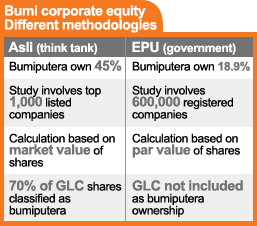
The methodology used by the Economic Planning Unit (EPU) in calculating bumiputera equity is shrouded in secrecy. From what has been disclosed in the press, it can be gathered that the methodology uses the par value of shares and exclusion of government-linked companies (GLCs).
Par value accounting has inherent flaws and if EPU uses the par value system without redeeming adjustments, then this would suffer from inherent flaws. Until there is clarification, I'll term this as 'EPU Apparent Methodology'.
Typically, a company starts operations with paid-up capital based on par value that remains at this level for a long time. It doesn't need to increase paid-up capital (so long as it is not short of new capital injection) because the accounting and business fraternities value the shares on market value.
 Par value of shares have little significance except for a archaic company law disclosure requirement. For example, a company starts with paid-up (par value) capital of RM1 million in 2006 and is awarded a 10-year contract to build a bridge.
Say, it makes a profit of RM10 million for the duration of the contract and keeps the profits intact. The market value of the company in 2016 is RM11 million but its par value remains intact at RM1 million. The shareholders can extract the profits through directors' emoluments, dividends, management services, etc
The methodology used by the Economic Planning Unit (EPU) in calculating bumiputera equity is shrouded in secrecy. From what has been disclosed in the press, it can be gathered that the methodology uses the par value of shares and exclusion of government-linked companies (GLCs).
Par value accounting has inherent flaws and if EPU uses the par value system without redeeming adjustments, then this would suffer from inherent flaws. Until there is clarification, I'll term this as 'EPU Apparent Methodology'.
Based on generally accepted accounting principles and current norms, the EPU Apparent Methodology is seriously flawed as demonstrated below.
Example 1
Ali owns 100 Tenaga shares. Par value RM100 (RM1 per share). Market value RM1,000 (RM10 per share). Ah Chong owns 1,000 Farlim shares. Par value RM1,000 (RM1 per share). Market value RM430 (RM0.43 per share).
EPU Apparent Methodology:
Ah Chong is 10 times richer than Ali. Therefore, Ali needs help to be on par with Ah Chong.
Flaw:
Par value has no relation to the actual value of shares. In fact, Ali is richer than Ah Chong. If EPU does not bring relative wealth into the equation, how does it know who to help to redress the equal distribution of wealth? Obviously, as this case shows, EPU may be helping the wrong guy.
Example 2
Ali owns 100 percent of Ali Bhd. Five years ago, he sold 90 percent of the company at RM100 million. He bought a property in London for RM30 million and a property in Malaysia at RM10 million after 7 percent discount; invested RM20 million in shares in Africa; spent RM10 million on son's wedding; gave his first wife alimony of RM30 million after marrying again. No one knows anything about his foreign assets although his personal marital affairs became hot news in a newspaper.
EPU Apparent Methodology:
Ali only holds 10 percent share in Ali Bhd now. He is marginalised because other races have 90 percent share. He should be given an additional 20 percent to make up the 30 percent equity share.
Flaws:
- It only takes Malaysian shares into account and omits other important assets such as properties, bank savings, foreign share investments, and profits extraction (spending). Ali was originally given 100 percent share but he divested this and converted the proceeds into foreign and other assets. If Ali were to invest 100 percent of his proceeds into shares of a Malaysian company, only then the actual bumiputera percentage can be correctly reflected.
Example 3
Ali owns 100 percent of Ali Bhd. He sells 90 percent to a GLC (government-linked company) controlled by Umno.
EPU Apparent Methodology:
Ali Bhd is no longer a bumiputera company since a GLC is not categorised as one. Ali's share is 10 percent. Since the GLC doesn't want to sell down its shares, Ali should be given another 20 percent in another company, Ah Chong Bhd, to make up the 30 percent equity.
Flaws:
-
 Notice how this has caused the overall bumiputera equity to drop by 90 percent
vis-a-vis
increasing the non-bumiputera equity percentage immediately upon the sale to the GLC, even though nothing has been changed?
Notice how this has caused the overall bumiputera equity to drop by 90 percent
vis-a-vis
increasing the non-bumiputera equity percentage immediately upon the sale to the GLC, even though nothing has been changed?
This also roughly reflects the bumiputera population as the government argues that it benefits all races. Use 68 percent, 65 percent or even 60 percent maybe, but to treat GLC bumiputera share as zero percent is miles away from justice and fairness compared to Asli's methodology.
Example 4
Ali is given 30 percent share (30 million shares) in Muthu Bhd at an IPO (initial public offering) price of RM1.50 per share for a total of RM45 million. After one year, Ali sells all his shares at RM10 per share for RM300 million. He makes a profit of RM255 million which he keeps in the bank.
EPU Apparent Methodology:
Since he does not now own shares, Ali is entitled to another bumiputera portion (30 percent) of IPO in Ah Chong Bhd at RM1.50 in the second year. Ali proceeds to buy Peter Bhd, Ranjit Bhd, Sayonara Bhd, etc in the third, fourth, fifth year, using the same modus operandi. All these years the bumiputera equity never exceeds 30 percent.
Flaw:
It doesn't take into account how many times Ali applies for an IPO as long as he had sold his shares before applying for another one if he uses the name of his nominees. This obviously results in double (triple, quadruple, etc) handouts as long as he keeps his money out of the system of calculation (e.g. in the bank, purchased properties, foreign investments, etc).
As you can see, there are ample opportunities for leakages (triple, quadruple, etc, handouts) without even disturbing the 30 percent equity barometer.
Example 5
Ali
forms a RM2 company called Ali Sdn Bhd in Year 1. He finds an ingenious way to sell a piece of paper for an enormous amount of money and makes RM200 million a year. In Year 5, his RM2 company is worth RM1 billion in cash.Ahmad forms a RM2 company called Ahmad Sdn Bhd in Year 1. He is given a huge number of taxi permits and makes a reasonable profit of RM10 million a year, which he draws out as salary each year. In Year 5, his company is still worth RM2 but he has earned RM50 million in salary.
Aziz is a rich man but is involved in a risky business where he fears creditors going after him. On the advice of his accounting firm, he transfers all his assets worth RM500 million into an investment holding company called Aziz & Sons Sdn Bhd, controlled by his nominee for RM250 ordinary shares and the rest in preference shares in Year 1. His investment company earns RM20 million a year in rental and dividends but in Year 5, his company's share is still RM250.
Muthusamy forms a company called Muthusamy Sdn Bhd. In Year 1, he borrows RM1,000 from his relative, puts this into his company as capital and starts a business selling kacang putih , peddling his wares around Chow Kit on a motorcycle which his company bought on hire purchase. He makes RM1,000 a year and re-invests RM100 annually into his company as capital. In Year 5, his capital has risen to RM1,400.
EPU Apparent Methodology:
- Year 1: Since the methodology counts only ordinary shares at par value, the bumiputera equity is only 20 percent (254/(254 + 1,000) x 100 = 20 percent) while Muthusamy has 80 percent. Therefore Ali, Ahmad and Aziz all need help and should be continued to be given assistance until the equity reaches 30 percent.
Flaws:
Now, notice the biggest flaws of using par value to account for percentage equity:
- Ali, Ahmad and Aziz are way, way richer than Muthusamy in wealth but using the par value methodology shows that Muthusamy is way ahead of them by 80:20.
The use of flawed methodology could be one reason why bumiputera equity has dropped from 25 percent to 18.9 percent, apart from the fact that some bumiputeras have sold their shares.
Comments
I have deliberately used these names as examples to elicit attention. People tend to view such matters with a racial slant - that it's all about Malays and non-Malays. That is when prejudice sets in and people clam up and start to defend their position rather than see the need for, and good points of, a possible restructure. What I want to stress is that it's not about Malays and non-Malays.
 The Muthusamy in the Example 5 could well be Pak Dollah, the fisherman from Kelantan, Aminah selling
kuih
in the KL Central Market, Ah Swee selling
popiah
in Penang or even the Orang Asli rattan gatherer in the interior of Sarawak.
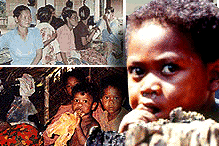
The Muthusamy in the Example 5 could well be Pak Dollah, the fisherman from Kelantan, Aminah selling
kuih
in the KL Central Market, Ah Swee selling
popiah
in Penang or even the Orang Asli rattan gatherer in the interior of Sarawak.
Ali, Ahmad and Aziz could well be the elite, affluent and politically well-connected Ah Chong, Vincent, Gonzales, Puspha or Shahabbudin. Try to substitute the names and you will see that it affects you in one way or other.
What needs doing
Until and unless the EPU is more transparent in its methodology to eliminate the flaws, the application of accounting principles and general knowledge will lead to the public seeing it as seriously flawed - serious in the sense that interpretation of results (as shown in the examples) can be disastrously wrong.
- Par value accounting does not change whereas market value changes according to the performance and wealth of a company. It does not take a genius to figure out that if the par value of Ali Sdn Bhd is RM2 in 2006, it will still be RM2 in 2020 even though it is awarded RM10 billion worth of contracts throughout this duration, unless Ali wants to change it. Par value has no significance in accounting at all, but I wonder whether the authorities have an agenda in continuing to use this system.
Instead of helping politically connected people, the government should be helping ordinary people like Pak Dollah, Aminah, rattan gatherers, Ah Swee and Muthusamy.
 Because the methodology is tilted to the elite group, I cannot but feel that the implementors of par value methodology are less than honest with all hard-working non-politically connected, average Malaysians.
The EPU's findings are used in formulating national policies and in planning and charting the growth and investments. The impact is immense, far-reaching and fundamental, not only to the daily lives of 26 million Malaysians, but also to bilateral relations. Countries, and recently Singapore (who has been accused of marginalising its minority groups), are already moving away from using the par value of shares.
And yet, Malaysia uses it. How could methodology that is so seriously flawed be used in making important decisions for the country?
LJ WONG is a chartered accountant by profession. He worked in a tax consultancy firm and a public listed company before he retired. He is now involved in an Internet-based business.


Are you sure you want to delete this comment?
This action cannot be undone.