




Trashing our treasures
In October 2006, Malaysia's Minister for Culture, Arts and Heritage, Rais Yatim, reportedly criticised UNESCO for ignoring Asia in its list of world heritage and historical sites, and proposed that the Organisation establish an Asian version of the list.
If this proposal was rejected, he said, countries like China, India, Indonesia, Japan, Korea and Malaysia would create their own organization to determine historic and heritage sites in the region, adding that "this is not impossible as we have historians and experts in the field and also in the areas of culture."
What a pity, then, that this powerful combination of local zeal and expertise failed to prevent the recent destruction of the lovely old KL landmark, Bok House, also popularly known as Le Coq D'or.
Despite its having been the first building to be nominated for its architectural, social and historical value under the National Heritage Act, the Culture, Arts and Heritage Ministry failed to gazette it for preservation because, according to Rais, the mansion was "private property and hence the government could do little to save it", and it "could not be gazetted as a heritage building because of the high rehabilitation and conservation costs."
In October 2006, Malaysia's Minister for Culture, Arts and Heritage, Rais Yatim, reportedly criticised UNESCO for ignoring Asia in its list of world heritage and historical sites, and proposed that the Organisation establish an Asian version of the list.
If this proposal was rejected, he said, countries like China, India, Indonesia, Japan, Korea and Malaysia would create their own organization to determine historic and heritage sites in the region, adding that "this is not impossible as we have historians and experts in the field and also in the areas of culture."
What a pity, then, that this powerful combination of local zeal and expertise failed to prevent the recent destruction of the lovely old KL landmark, Bok House, also popularly known as Le Coq D'or.
Despite its having been the first building to be nominated for its architectural, social and historical value under the National Heritage Act, the Culture, Arts and Heritage Ministry failed to gazette it for preservation because, according to Rais, the mansion was "private property and hence the government could do little to save it", and it "could not be gazetted as a heritage building because of the high rehabilitation and conservation costs."
And in any case, he dismissively added, it was of no historic or cultural distinction, but merely "a rich man's house."
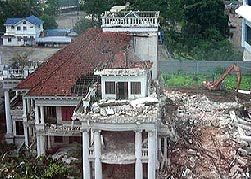 Rais's attempted alibis for his own and his department's failure to prevent this wanton act of vandalism by the DBKL are far from convincing. The government is high-handed enough about acquiring private property when it considers such acquisition to be in its own or the public interest, after all.
And it apparently has no trouble finding RM400 million for a new Istana or a RM600 for a handout to Umno-connected Class F contractors.
As for the Minister's snide slur on Bok House as being nothing but a "just a rich man's house", it invites comparison of this case with that of another rich man's house, Datuk Zainal@ Zakaria Mat Deros's so-called Istana Impian, which has so far defied demolition despite being allegedly built illegally on formerly public land alienated by his wife for a suspiciously low price.
And into the bargain, there appears to be no evidence forthcoming to explain how Zakaria is managing to afford or finance the enormous cost of his celebrated mansion on his salary as a State Assemblyman and (now former) Klang councilor.
Sad state of Masjid Jamek
Chua Cheng Bok, on the other hand, was well known to have amassed his wealth through ventures including the importation of bicycle tyres and the establishment of the enormously successful auto-import company Cycle & Carriage.
In later life he turned to philanthropy, donating a good deal of his fortune to charity, and on his death leaving his family home in perpetuity to his descendants.
That this generation of his beneficiaries have seen fit to turn his house and land into cash is sad enough. Perhaps they'd fallen on lean times and needed the money. But that the authorities have elected to permit the obliteration of this popular landmark instead of acquiring and preserving it for the nation is a disgrace.
But at least they can't be accused of favouritism in overseeing the destruction of a "rich (China)man's house".
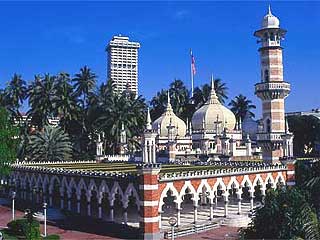 One of KL's other most precious, indeed sacred, historical artifacts, Masjid Jamek, the lovely old mosque sited at the very heart of the old city, at the confluence of the Klang and Gombak Rivers, has become so obscured by a clutter of "modern" concrete monstrosities, the latest an LRT station, that it's almost hidden from view.
And when you do catch a glimpse of it, you see it's sorely in need of a new coat of paint.
I'm especially pained by the appalling appearance or disappearance of Masjid Jamek, as it's suffering precisely the same fate as the birthplace of Sydney, Circular Quay.
Framed by the famed Harbour Bridge on its West side, and the Opera House on the East, this historic stretch of water, originally known as Sydney Cove, is completely obscured from the city side by a monumentally ugly combination of a commuter train station and a traffic overpass known as the Cahill Expressway, or as I prefer to think of it, "Excressway".
Money, money, money
So Malaysia isn't alone in trashing its treasures. In fact the powers of preservation in Australia could give their counterparts here a real run for their money. "Money", of course, being the operative word when it comes to preservation or lack of it.
The same blend of greed and corruption that today threatens to turn the pristine islands of Malaysia's East Coast from meccas for divers into just plain dives also drove the "development" of some high-rise towers on Queensland's Gold Coast so close to the beach that their shadows blanket the sunbathers and surfers every afternoon.
And the same mad scramble to make capital out of natural beauty that's had such terrible results in formerly charming little towns like Tanah Rata in the Cameron Highlands was long ago also inflicted on the Blue Mountains outside Sydney.
Each of us, I'm sure, has his or her own special atrocity in mind when the subject turns to willful failure to protect special sites. Bok House, I must say, is near the top of my own list. But number one for me personally will always be the ghastly mess they've made of Malacca.
 As if permitting a company car park to be cut into St Paul's Hill many years ago wasn't sufficient, and as if allowing the tomb of an illustrious Malay warrior to be surrounded on three sides by a plumbing-supplies yard, the city fathers extended the padang, filled in what was left of the harbour and covered the whole area with a shoplot development as boring, unbeautiful and uncalled-for as you could find anywhere in Malaysia.
And now, as if the nation's most historic and potentially tourist-attracting town hadn't already had enough sacrilege enacted on it, its remaining beaches are still having rocks dumped on them to form breakwaters for yet more over-development, and work is already in progress on a revolving, or perhaps that should be "revolting", 100-metrehigh observation tower with a keris on top.
Meanwhile, Malaysia's Culture, Arts and Heritage Minister wonders why UNESCO refuses to put such trash as this on its list of world heritage sites, and happily shrugs-off the tragic loss of treasures like Bok House.


Are you sure you want to delete this comment?
This action cannot be undone.